



Biliatresone

Based on 1 Customer Validation
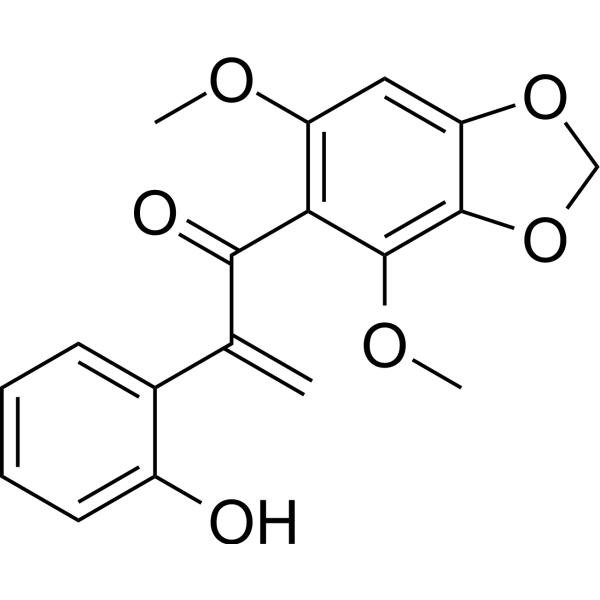
Biliatresone is a natural toxin isolated from Dysphania glomulifera and D. littoralis. Biliatresone, a 1,2-diaryl-2-propenone class of isoflavonoid, produces extrahepatic biliary atresia in a zebrafish model.
For research use only. We do not sell to patients.
- Purity : 98.51%
- CAS No.: 1801433-90-8
- Formula: C18H16O6
- Molecular Weight:328.32
-
Storage:
-80°C, stored under nitrogen
* The compound is unstable in solutions, freshly prepared is recommended.

To place orders, for customer services and technical support, please contact: MedChemExpress USA
Tel: 609-228-6898 E-mail: [email protected] [email protected]


-
 Biological Activity
-
Chemical Information
-
Solvent & Solubility
- Protocols
- Purity & Documentation
- References
-
 Help & FAQs




Biological Activity
Description
In Vitro
Biliatresone has a reduction in primary cilia and a dose-dependent decrease in visible microtubules, suggesting that Biliatresone decreases microtubule stability in primary neonatal mouse extrahepatic cholangiocytes[1].
Biliatresone (2 μg/ml; for 24 hours) shows disruption of the spheroid lumen and abnormal cholangiocyte polarity in mouse cholangiocyte[1].
MedChemExpress (MCE) has not independently confirmed the accuracy of these methods. They are for reference only.
In Vivo
Larvae treated at 5 dpf with low doses of biliatresone [0.0625 μg/ml (0.2 μM) and 0.125 μg/ml (0.4 μM)] shows only subtle gallbladder defects, whereas larvae treated with higher doses has pronounced morphological defects of the gallbladder and extrahepatic ducts[1].
MedChemExpress (MCE) has not independently confirmed the accuracy of these methods. They are for reference only.


Chemical Information
-
CAS No. 1801433-90-8
-
Appearance Viscous Liquid
-
Molecular Weight 328.32
-
Formula C18H16O6
-
Color White to yellow
-
SMILES
C=C(C(C1=C(C=C2OCOC2=C1OC)OC)=O)C3=CC=CC=C3O
-
Structure Classification
-
Initial Source
-
Shipping
Shipping with dry ice.
-
Storage
-80°C, stored under nitrogen
* The compound is unstable in solutions, freshly prepared is recommended.


Solvent & Solubility
In Vitro:
DMSO : 50 mg/mL (152.29 mM; Need ultrasonic; Hygroscopic DMSO has a significant impact on the solubility of product, please use newly opened DMSO)
Please refer to the solubility information to select the appropriate solvent. The compound is unstable in solutions, freshly prepared is recommended.
Please refer to the solubility information to select the appropriate solvent. The compound is unstable in solutions, freshly prepared is recommended.
Concentration (start) × Volume (start) = Concentration (final) × Volume (final)
In Vivo:
Select the appropriate dissolution method based on your experimental animal and administration route.
- For the following dissolution methods, please ensure to first prepare a clear stock solution using an In Vitro approach and then sequentially add co-solvents:
- To ensure reliable experimental results, the clarified stock solution can be appropriately stored based on storage conditions. As for the working solution for In Vivo experiments, it is recommended to prepare freshly and use it on the same day.
- The percentages shown for the solvents indicate their volumetric ratio in the final prepared solution. If precipitation or phase separation occurs during preparation, heat and/or sonication can be used to aid dissolution.
Add each solvent one by one: 10% DMSO 40% PEG300 5% Tween-80 45% Saline
Solubility: 2 mg/mL (6.09 mM); Suspended solution; Need ultrasonic
This protocol yields a suspended solution of 2 mg/mL. Suspended solution can be used for oral and intraperitoneal injection.
Taking 1 mL working solution as an example, add 100 μL DMSO stock solution (20.0 mg/mL) to 400 μL PEG300, and mix evenly; then add 50 μL Tween-80 and mix evenly; then add 450 μL Saline to adjust the volume to 1 mL.
Preparation of Saline: Dissolve 0.9 g sodium chloride in ddH₂O and dilute to 100 mL to obtain a clear Saline solution.
Add each solvent one by one: 10% DMSO 90% (20% SBE-β-CD in Saline)
Solubility: ≥ 2 mg/mL (6.09 mM); Clear solution
This protocol yields a clear solution of ≥ 2 mg/mL (saturation unknown).
Taking 1 mL working solution as an example, add 100 μL DMSO stock solution (20.0 mg/mL) to 900 μL 20% SBE-β-CD in Saline, and mix evenly.
Preparation of 20% SBE-β-CD in Saline (4°C, storage for one week): 2 g SBE-β-CD powder is dissolved in 10 mL Saline, completely dissolve until clear.
For the following dissolution methods, please prepare the working solution directly:
It is recommended to prepare fresh solutions and use them promptly within a short period of time.
The percentages shown for the solvents indicate their volumetric ratio in the final prepared solution. If precipitation or phase separation occurs during preparation, heat and/or sonication can be used to aid dissolution.
Add each solvent one by one: 50% PEG300 50% Saline
Solubility: 25 mg/mL (76.15 mM); Clear solution; Need ultrasonic
In Vivo Dissolution Calculator
Please enter the basic information of animal experiments:
-
-
-
-
Recommended: Prepare an additional quantity of animals to account for potential losses during experiments.
Please enter your animal formula composition:
-
%DMSO +
Recommended: Keep the proportion of DMSO in working solution below 2% if your animal is weak.
-
%+
-
+%Tween-80 + +
-
%Saline +
The co-solvents required include: DMSO, . All of co-solvents are available by MedChemExpress (MCE). , Tween 80. All of co-solvents are available by MedChemExpress (MCE).
Working solution concentration: 0.22 mg/mL
Method for preparing stock solution: mg drug dissolved in μL DMSO. Stock solution concentration: mg/mL. * The compound is unstable in solutions, freshly prepared is recommended.
1. Take μL DMSO stock solution;
2. Add μL .
μL , mix evenly;
3. Then add μL Tween 80, mix evenly;
4. Then add μL
Please ensure that the stock solution in the first step is dissolved to a clear state, and add co-solvents in sequence. You can use ultrasonic heating (ultrasonic cleaner, recommended frequency 20-40 kHz), vortexing, etc. to assist dissolution.


Purity & Documentation
-
Data Sheet (280 KB)
-
SDS (480 KB)
- English - EN (480 KB)
- Français - FR (480 KB)
- Deutsch - DE (480 KB)
- Norwegian - NO (480 KB)
- Español - ES (480 KB)
- Swedish - SV (480 KB)
- Italian - IT (480 KB)
- Korean - KR (480 KB)
- Portuguese - PT (480 KB)
-
Handling Instructions (2659 KB)
References
[1]. Kyung A Koo, et al. Biliatresone, a Reactive Natural Toxin From Dysphania Glomulifera and D. Littoralis: Discovery of the Toxic Moiety 1,2-Diaryl-2-Propenone. Chem Res Toxicol. 2015 Aug 17;28(8):1519-21. [Content Brief]
[2]. Kristin Lorent, et al. Identification of a Plant Isoflavonoid That Causes Biliary Atresia. Sci Transl Med. 2015 May 6;7(286):286ra67. [Content Brief]


Complete Stock Solution Preparation Table
Please refer to the solubility information to select the appropriate solvent. The compound is unstable in solutions, freshly prepared is recommended.
| Optional Solvent | Concentration Solvent Mass | 1 mg | 5 mg | 10 mg | 25 mg |
|---|---|---|---|---|---|
| DMSO | 1 mM | 3.0458 mL | 15.2290 mL | 30.4581 mL | 76.1452 mL |
| 5 mM | 0.6092 mL | 3.0458 mL | 6.0916 mL | 15.2290 mL | |
| 10 mM | 0.3046 mL | 1.5229 mL | 3.0458 mL | 7.6145 mL | |
| 15 mM | 0.2031 mL | 1.0153 mL | 2.0305 mL | 5.0763 mL | |
| 20 mM | 0.1523 mL | 0.7615 mL | 1.5229 mL | 3.8073 mL | |
| 25 mM | 0.1218 mL | 0.6092 mL | 1.2183 mL | 3.0458 mL | |
| 30 mM | 0.1015 mL | 0.5076 mL | 1.0153 mL | 2.5382 mL | |
| 40 mM | 0.0761 mL | 0.3807 mL | 0.7615 mL | 1.9036 mL | |
| 50 mM | 0.0609 mL | 0.3046 mL | 0.6092 mL | 1.5229 mL | |
| 60 mM | 0.0508 mL | 0.2538 mL | 0.5076 mL | 1.2691 mL | |
| 80 mM | 0.0381 mL | 0.1904 mL | 0.3807 mL | 0.9518 mL | |
| 100 mM | 0.0305 mL | 0.1523 mL | 0.3046 mL | 0.7615 mL |


Biliatresone Related Classifications
HY-119412 Related Classifications
 Powered by Bioz