



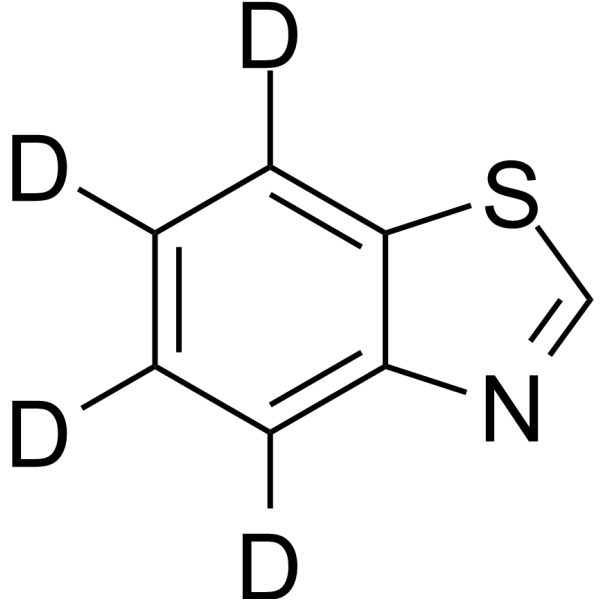
Benzothiazole-d4
Benzothiazole-d4 is a deuterium labeled Benzothiazole (HY-W012634). Benzothiazole is a natural occurring heterocyclic nuclei. Benzothiazole nucleus possesses a number of biological activities such as anticancer, antimicrobial, antidiabetic, anti-inflammatory, antileishmanial, and antiviral.
Nos produits utilisent uniquement pour la recherche. Nous ne vendons pas aux patients.
- CAS No.: 194423-51-3
- Formule: C7HD4NS
- Masse moléculaire:139.21
-
Stockage:Pure form -20°C, 3 years , 4°C, 2 years ; In solvent -80°C, 6 months , -20°C, 1 month

To place orders, for customer services and technical support, please contact: MedChemExpress USA
Tel: 609-228-6898 E-mail: [email protected] [email protected]


-
 Activité biologique
-
Chemical Information
- Protocole
- Pureté et documentation
- Références
-
 Help & FAQs




Activité biologique
Description
In Vitro
Stable heavy isotopes of hydrogen, carbon, and other elements have been incorporated into drug molecules, largely as tracers for quantitation during the drug development process. Deuteration has gained attention because of its potential to affect the pharmacokinetic and metabolic profiles of drugs[1].
MedChemExpress (MCE) has not independently confirmed the accuracy of these methods. They are for reference only.
Application
1. This compound can be used as a tracer
2. This compound can be used as an internal standard for quantitative analysis by NMR, GC-MS, or LC-MS.


Chemical Information
-
CAS No. 194423-51-3
-
Unlabeled CAS 95-16-9
-
Appearance Oil
-
Masse moléculaire 139.21
-
Formule C7HD4NS
-
Color Light brown to brown
-
SMILES
[2H]C1=C(SC=N2)C2=C([2H])C([2H])=C1[2H]
-
Livraison
Room temperature in continental US; may vary elsewhere.
-
Stockage
Pure form -20°C 3 years 4°C 2 years In solvent -80°C 6 months -20°C 1 month


Pureté et documentation
-
Fiche technique (272 KB)
-
SDS (393 KB)
- English - EN (393 KB)
- Français - FR (393 KB)
- Deutsch - DE (393 KB)
- Norwegian - NO (393 KB)
- Español - ES (393 KB)
- Swedish - SV (393 KB)
- Italian - IT (393 KB)
- Korean - KR (393 KB)
- Portuguese - PT (393 KB)
-
Instruction de manipulation (2659 KB)
Références

Calculators
Concentration (start) × Volume (start) = Concentration (final) × Volume (final)


Benzothiazole-d4 Related Classifications
HY-W012634S Related Classifications
 Powered by Bioz