



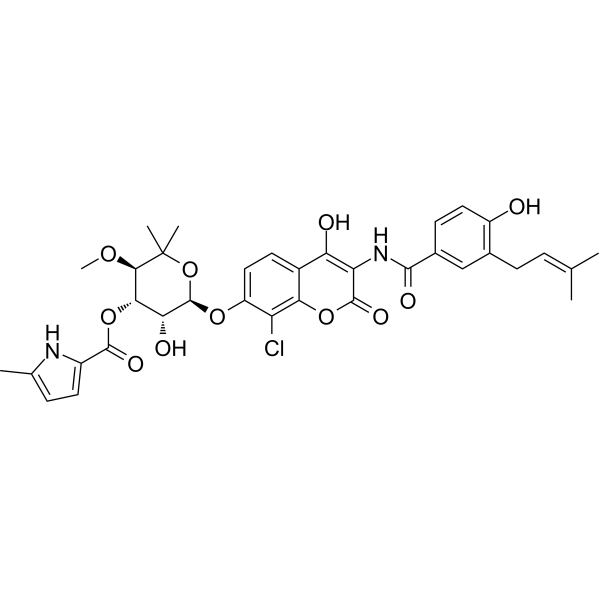
Clorobiocin
Clorobiocin is an antibacterial agent with an IC50 of 0.21 μM against the B subunit of E. coli DNA gyrase. Clorobiocin targets the mLaC protein of Gram-negative bacteria. Clorobiocin potently inhibits bacterial DNA replication. Clorobiocin can be used in studies on Gram-negative bacterial infections, such as Acinetobacter baumannii and E. coli infections.
Nos produits utilisent uniquement pour la recherche. Nous ne vendons pas aux patients.
- CAS No.: 39868-96-7
- Formule: C35H37ClN2O11
- Masse moléculaire:697.13
-
Stockage:
Please store the product under the recommended conditions in the Certificate of Analysis.

To place orders, for customer services and technical support, please contact: MedChemExpress USA
Tel: 609-228-6898 E-mail: [email protected] [email protected]


-
 Activité biologique
-
Chemical Information
- Protocole
- Pureté et documentation
- Références
-
 Help & FAQs




Activité biologique
Description
In Vitro
Combination treatment with clorobiocin (12.5 μM; overnight) and LL-37 (HY-P4744) exhibits synergistic antibacterial activity against Acinetobacter baumannii AB5075, with a fractional inhibitory concentration (FIC) value of 0.5[1].
Clorobiocin (14 μM; 24-48 h) inhibits the growth of Escherichia coli J53 in vitro with a bacteriostatic concentration of 14 μM, and the concentration required for it to inhibit bacterial growth is 67-fold higher than that required for inhibiting DNA gyrase[2].
MedChemExpress (MCE) has not independently confirmed the accuracy of these methods. They are for reference only.


Chemical Information
-
CAS No. 39868-96-7
-
Masse moléculaire 697.13
-
Formule C35H37ClN2O11
-
SMILES
OC(C(C(OC1=O)=C2Cl)=CC=C2O[C@H](OC3(C)C)[C@@H]([C@@H]([C@H]3OC)OC(C(N4)=CC=C4C)=O)O)=C1NC(C(C=C5)=CC(C/C=C(C)\C)=C5O)=O
-
Livraison
Room temperature in continental US; may vary elsewhere.
-
Stockage
Please store the product under the recommended conditions in the Certificate of Analysis.


Pureté et documentation
-
Fiche technique (267 KB)
-
SDS (252 KB)
- Français - FR (252 KB)
- Deutsch - DE (252 KB)
- Norwegian - NO (252 KB)
- Español - ES (252 KB)
- Swedish - SV (252 KB)
- Italian - IT (252 KB)
- Korean - KR (252 KB)
- Portuguese - PT (252 KB)
-
Instruction de manipulation (2659 KB)
Références
[1]. Huang YM, et al. Docking simulation and antibiotic discovery targeting the MlaC protein in Gram-negative bacteria. Chem Biol Drug Des. 2019;93(4):647-652. [Content Brief]
[2]. Hooper DC, et al. Effects of novobiocin, coumermycin A1, clorobiocin, and their analogs on Escherichia coli DNA gyrase and bacterial growth. Antimicrob Agents Chemother. 1982;22(4):662-671. [Content Brief]

Calculators
Concentration (start) × Volume (start) = Concentration (final) × Volume (final)


Clorobiocin Related Classifications
HY-123515 Related Classifications
 Powered by Bioz
Keywords
- Clorobiocin
- 39868-96-7
- acinetobacter baumannii infection
- Escherichia coli
- Escherichia coli DNA gyrase B subunit
- Escherichia coli J53
- Acinetobacter baumannii Mla pathway
- MlaC protein
- Escherichia coli DNA gyrase
- gram-negative bacterial infection
- escherichia coli infection
- Acinetobacter baumannii
- Inhibitor
- inhibitor
- inhibit