



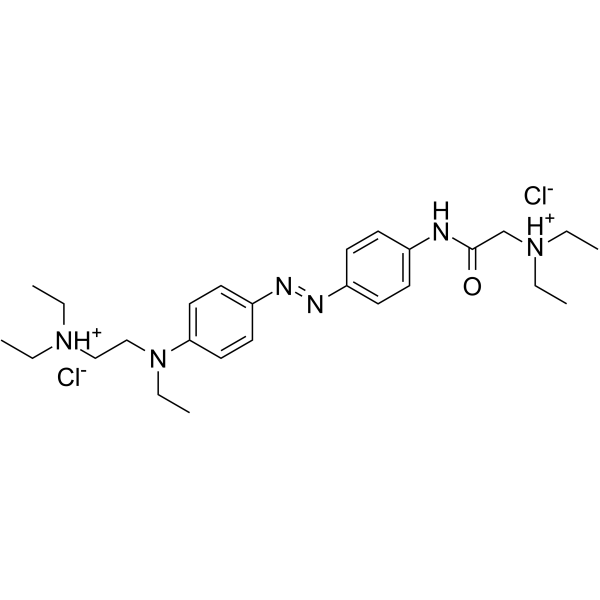
DAD dichloride
DAD dichloride is a type of ion channel blocker that blocks voltage-gated potassium channels. DAD dichloride is a third-generation photoswitch that responds to visible light. DAD dichloride has the potential for restoring visual function.
Nos produits utilisent uniquement pour la recherche. Nous ne vendons pas aux patients.
- Formule: C26H42Cl2N6O
- Masse moléculaire:525.56
-
Stockage:
Please store the product under the recommended conditions in the Certificate of Analysis.

To place orders, for customer services and technical support, please contact: MedChemExpress USA
Tel: 609-228-6898 E-mail: [email protected] [email protected]


-
 Activité biologique
-
Chemical Information
- Protocole
- Pureté et documentation
- Références
-
 Help & FAQs




Activité biologique
Description
In Vitro
DAD is not permanently charged, and the uncharged form enables the photoswitch to rapidly and effectively cross biological barriers and thereby access and photosensitize retinal neurons. DAD selectively photosensitizes retinal neurons upstream of retinal ganglion cells (RGCs). DAD is capable of restoring retinal ganglion cell light responses to blue or white light[1].
MedChemExpress (MCE) has not independently confirmed the accuracy of these methods. They are for reference only. Further protocols information, click here.
In Vivo
MedChemExpress (MCE) has not independently confirmed the accuracy of these methods. They are for reference only.
Essai clinique
| NCT Number | Sponsor | Condition | Start Date |
Phase

|
|---|---|---|---|---|
| NCT01329991 | Plexxikon| | 2011-05 | PHASE1 |


Chemical Information
-
Masse moléculaire 525.56
-
Formule C26H42Cl2N6O
-
SMILES
O=C(C[NH+](CC)CC)NC(C=C1)=CC=C1/N=N/C2=CC=C(N(CC)CC[NH+](CC)CC)C=C2.[Cl-].[Cl-]
-
Livraison
Room temperature in continental US; may vary elsewhere.
-
Stockage
Please store the product under the recommended conditions in the Certificate of Analysis.

Protocole
-
Two-electrode voltage clamp in Xenopus oocytes
Two-electrode voltage clamp measures whole-oocyte membrane current from Xenopus oocytes expressing exogenous ion channels, receptors, or transporters; one intracellular microelectrode senses membrane voltage, and the second injects current so the amplifier can hold the membrane at command voltages while recording the compensating current as the functional readout. The method is suited to Xenopus oocytes because their large size supports microinjection and intracellular electrode impalement, but the large membrane area can limit voltage-clamp speed and accuracy, especially for large or fast currents.


Pureté et documentation
Références

Calculators
Concentration (start) × Volume (start) = Concentration (final) × Volume (final)


DAD dichloride Related Classifications
HY-136564 Related Classifications
 Powered by Bioz