



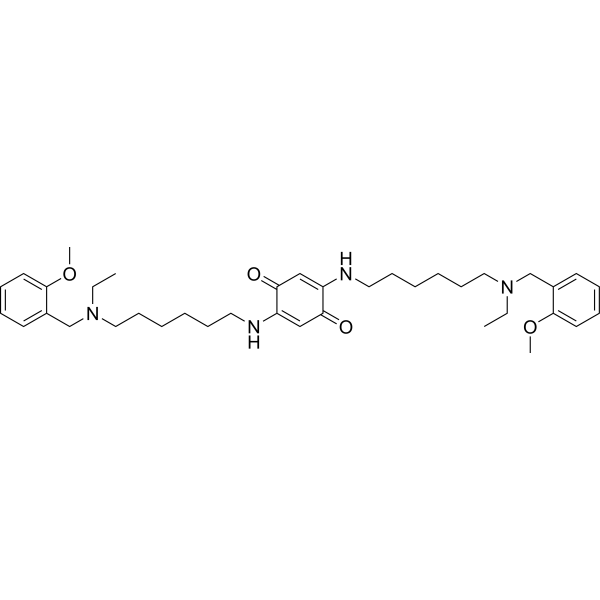
Memoquin
Memoquin is an anti-amyloid and anti-oxidant multi-target-directed ligand. Memoquin is an orally active inhibitor of BACE-1 and AChE with IC50 values of 108 and 1.55 nM, respectively. Memoquin is a cognitive enhancer that prevents the Aβ-induced neurotoxicity mediated by oxidative stress. Memoquin can be used for the research of Alzheimer’s disease (AD).
Nos produits utilisent uniquement pour la recherche. Nous ne vendons pas aux patients.
- CAS No.: 616885-87-1
- Formule: C38H56N4O4
- Masse moléculaire:632.88
-
Stockage:
Please store the product under the recommended conditions in the Certificate of Analysis.

To place orders, for customer services and technical support, please contact: MedChemExpress USA
Tel: 609-228-6898 E-mail: [email protected] [email protected]


-
 Activité biologique
-
Chemical Information
- Protocole
- Pureté et documentation
- Références
-
 Help & FAQs




Activité biologique
Description
IC50 & Target
|
hAChE 1.55 nM (IC50) |
BACE1 108 nM (IC50) |
Cellular Effect
|
Cell Line

|
Type | Value | Description | References |
|---|---|---|---|---|
| SH-SY5Y | IC50 |
19.4 μM
Compound: 1
|
Neurotoxicity in human SH-SY5Y cells assessed as decrease in cell viability by MTT assay
Neurotoxicity in human SH-SY5Y cells assessed as decrease in cell viability by MTT assay
|
[PMID: 21236667] |
| T-cell | IC50 |
5.93 μM
Compound: 8
|
Inhibition of self-aggregation of amyloid beta (1 to 42) (unknown origin) by thioflavin T method
Inhibition of self-aggregation of amyloid beta (1 to 42) (unknown origin) by thioflavin T method
|
[PMID: 35635955] |
In Vitro
Memoquin inhibits hAChE, Aβ(1-40) aggregation induced by hAChE, Aβ(1-42) self-aggregation and BACE-1 with IC50 values of 0.00155, 28.3, 5.93 and 0.108 μM, respectively[2]. Memoquin shows binding properties to hAChE with a Ki value of 2.6 nM[2].
MedChemExpress (MCE) has not independently confirmed the accuracy of these methods. They are for reference only.
In Vivo
MedChemExpress (MCE) has not independently confirmed the accuracy of these methods. They are for reference only.
-
Animal Model:Mice with scopolamine-induced amnesia[1]
-
Dosage:7, 10 and 15 mg/kg
-
Administration:Oral administration; 7, 10 and 15 mg/kg, once
-
Result:Reversed the scopolamine-induced memory deficits and verified by a T-maze test. Rescueed episodic memory impairment at a dose of 15 mg/kg.
-
Animal Model:Mice with Aβ- induced amnesia[1]
-
Dosage:15 mg/kg
-
Administration:Oral administration; 15 mg/kg, daily for 2, 4, and 6 days before behavioral testing
-
Result:Weekly alleviated the insult induced by Aβ1-42 for 2-4 days treatment and fully rescued with a 6-day treatment.


Chemical Information
-
CAS No. 616885-87-1
-
Masse moléculaire 632.88
-
Formule C38H56N4O4
-
SMILES
O=C1C(NCCCCCCN(CC2=CC=CC=C2OC)CC)=CC(C(NCCCCCCN(CC3=CC=CC=C3OC)CC)=C1)=O
-
Livraison
Room temperature in continental US; may vary elsewhere.
-
Stockage
Please store the product under the recommended conditions in the Certificate of Analysis.


Pureté et documentation
Références
[1]. Capurro V, et al. Pharmacological characterization of memoquin, a multi-target compound for the treatment of Alzheimer's disease. PLoS One. 2013;8(2):e56870. [Content Brief]
[2]. Cavalli A, et al. A small molecule targeting the multifactorial nature of Alzheimer's disease. Angew Chem Int Ed Engl. 2007;46(20):3689-92. [Content Brief]

Calculators
Concentration (start) × Volume (start) = Concentration (final) × Volume (final)


Memoquin Related Classifications
HY-122080 Related Classifications
 Powered by Bioz