



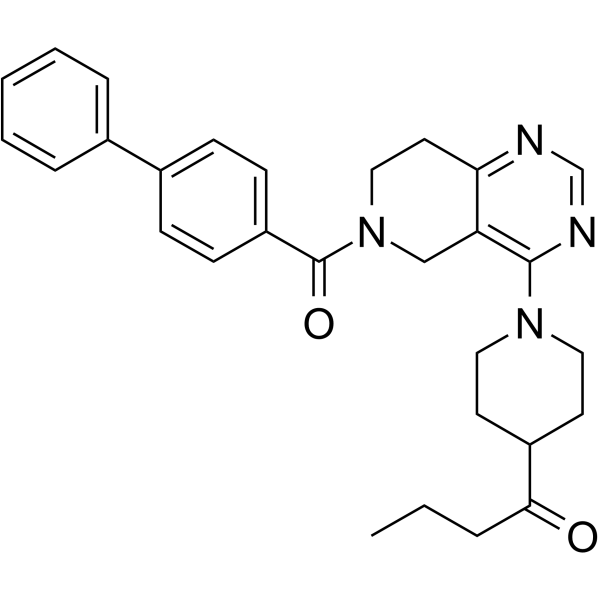
PK-THPP

Based on 1 Customer Validation
PK-THPP is a potent and brain-penetrant TWIK-related acid-sensitive K+ ion channel (K2P9.1 or TASK-3) blocker with IC50s of 35 nM and 300 nM for TASK-3 and TASK-1, respectively. PK-THPP shows no or less activity against other K+ channels. PK-THPP is an effective breathing stimulant and can be used for the study of breathing disorders.
Nos produits utilisent uniquement pour la recherche. Nous ne vendons pas aux patients.
- Pureté : 99.4%
- CAS No.: 1332454-07-5
- Formule: C29H32N4O2
- Masse moléculaire:468.59
-
Stockage:Powder -20°C, 3 years , 4°C, 2 years ; In solvent -80°C, 6 months , -20°C, 1 month

To place orders, for customer services and technical support, please contact: MedChemExpress USA
Tel: 609-228-6898 E-mail: [email protected] [email protected]


-
 Activité biologique
-
Chemical Information
-
Solvant et solubilité
- Protocole
- Pureté et documentation
- Références
-
 Help & FAQs




Activité biologique
Description
Cellular Effect
|
Cell Line

|
Type | Value | Description | References |
|---|---|---|---|---|
| CHO | IC50 |
300 nM
Compound: 2
|
Inhibition of TASK-1 (unknown origin) expressed in CHO cells by thallium flux assay
Inhibition of TASK-1 (unknown origin) expressed in CHO cells by thallium flux assay
|
[PMID: 25017033] |
| HEK293 | IC50 |
0.035 μM
Compound: 42; PK-THPP
|
Inhibition of human TASK3 expressed in HEK293 cells by Qpatch HT platform based assay
Inhibition of human TASK3 expressed in HEK293 cells by Qpatch HT platform based assay
|
[PMID: 31260312] |
| HEK293 | IC50 |
0.3 μM
Compound: 42; PK-THPP
|
Inhibition of human TASK1 expressed in HEK293 cells by Qpatch HT platform based assay
Inhibition of human TASK1 expressed in HEK293 cells by Qpatch HT platform based assay
|
[PMID: 31260312] |
In Vitro
PK-THPP (compound 23) is inactive against the K2P channels TREK-1 (IC50 >10 000 nM). PK-THPP is weakly active against the voltage-gated Kv1.5 (IC50 ~5 µM), insensitive to hERG at the highest test concentration (>15 µM), and does not inhibit KATP (<10% inhibition at 10 µM). PK-THPP shows no activity being observed against more than 100 different receptors, ion channels and enzymes (10 µM exposure)[1].
MedChemExpress (MCE) has not independently confirmed the accuracy of these methods. They are for reference only. Further protocols information, click here.
In Vivo
MedChemExpress (MCE) has not independently confirmed the accuracy of these methods. They are for reference only.
-
Animal Model:Male C57/BL6 background or TASK-3 mutant mice and male Sprague–Dawley rats implanted with radiotelemetric monitors[1].
-
Dosage:15 mg/kg (rat), 50 mg/kg (rat), 100 mg/kg (mice)
-
Administration:s.c.; daily; for either three (rat) or five (mice) consecutive days
-
Result:Increased the time spent awake and decreases the duration of rapid eye movement (REM) and delta sleep in mice.
Dose-dependent effects across all sleep stages were marked by more consistent sleep reductions and greater next-day homeostatic rebound of sleep/wake patterns in rat.


Chemical Information
-
CAS No. 1332454-07-5
-
Appearance Solid
-
Masse moléculaire 468.59
-
Formule C29H32N4O2
-
Color Off-white to light brown
-
SMILES
O=C(C1=CC=C(C2=CC=CC=C2)C=C1)N3CC4=C(N5CCC(C(CCC)=O)CC5)N=CN=C4CC3
-
Livraison
Room temperature in continental US; may vary elsewhere.
-
Stockage
Powder -20°C 3 years 4°C 2 years In solvent -80°C 6 months -20°C 1 month


Solvant et solubilité
In Vitro:
DMSO : 25 mg/mL (53.35 mM; Need ultrasonic; Hygroscopic DMSO has a significant impact on the solubility of product, please use newly opened DMSO)
Please refer to the solubility information to select the appropriate solvent. Once prepared, please aliquot and store the solution to prevent product inactivation from repeated freeze-thaw cycles.
Storage method and period of stock solution: -80°C, 6 months; -20°C, 1 month. When stored at -80°C, please use it within 6 months. When stored at -20°C, please use it within 1 month.
Please refer to the solubility information to select the appropriate solvent. Once prepared, please aliquot and store the solution to prevent product inactivation from repeated freeze-thaw cycles.
Storage method and period of stock solution: -80°C, 6 months; -20°C, 1 month. When stored at -80°C, please use it within 6 months. When stored at -20°C, please use it within 1 month.
Concentration (start) × Volume (start) = Concentration (final) × Volume (final)
In Vivo:
Select the appropriate dissolution method based on your experimental animal and administration route.
- For the following dissolution methods, please ensure to first prepare a clear stock solution using an In Vitro approach and then sequentially add co-solvents:
- To ensure reliable experimental results, the clarified stock solution can be appropriately stored based on storage conditions. As for the working solution for In Vivo experiments, it is recommended to prepare freshly and use it on the same day.
- The percentages shown for the solvents indicate their volumetric ratio in the final prepared solution. If precipitation or phase separation occurs during preparation, heat and/or sonication can be used to aid dissolution.
Add each solvent one by one: 10% DMSO 40% PEG300 5% Tween-80 45% Saline
Solubility: ≥ 2.5 mg/mL (5.34 mM); Clear solution
This protocol yields a clear solution of ≥ 2.5 mg/mL (saturation unknown).
Taking 1 mL working solution as an example, add 100 μL DMSO stock solution (25.0 mg/mL) to 400 μL PEG300, and mix evenly; then add 50 μL Tween-80 and mix evenly; then add 450 μL Saline to adjust the volume to 1 mL.
Preparation of Saline: Dissolve 0.9 g sodium chloride in ddH₂O and dilute to 100 mL to obtain a clear Saline solution.
Add each solvent one by one: 10% DMSO 90% (20% SBE-β-CD in Saline)
Solubility: 2.5 mg/mL (5.34 mM); Suspended solution; Need ultrasonic
This protocol yields a suspended solution of 2.5 mg/mL. Suspended solution can be used for oral and intraperitoneal injection.
Taking 1 mL working solution as an example, add 100 μL DMSO stock solution (25.0 mg/mL) to 900 μL 20% SBE-β-CD in Saline, and mix evenly.
Preparation of 20% SBE-β-CD in Saline (4°C, storage for one week): 2 g SBE-β-CD powder is dissolved in 10 mL Saline, completely dissolve until clear.
In Vivo Dissolution Calculator
Please enter the basic information of animal experiments:
-
-
-
-
Recommended: Prepare an additional quantity of animals to account for potential losses during experiments.
Please enter your animal formula composition:
-
%DMSO +
Recommended: Keep the proportion of DMSO in working solution below 2% if your animal is weak.
-
%+
-
+%Tween-80 + +
-
%Saline +
The co-solvents required include: DMSO, . All of co-solvents are available by MedChemExpress (MCE). , Tween 80. All of co-solvents are available by MedChemExpress (MCE).
Working solution concentration: 0.22 mg/mL
Method for preparing stock solution: mg drug dissolved in μL DMSO. Stock solution concentration: mg/mL.
1. Take μL DMSO stock solution;
2. Add μL .
μL , mix evenly;
3. Then add μL Tween 80, mix evenly;
4. Then add μL
Please ensure that the stock solution in the first step is dissolved to a clear state, and add co-solvents in sequence. You can use ultrasonic heating (ultrasonic cleaner, recommended frequency 20-40 kHz), vortexing, etc. to assist dissolution.

Protocole
-
Two-electrode voltage clamp in Xenopus oocytes
Two-electrode voltage clamp measures whole-oocyte membrane current from Xenopus oocytes expressing exogenous ion channels, receptors, or transporters; one intracellular microelectrode senses membrane voltage, and the second injects current so the amplifier can hold the membrane at command voltages while recording the compensating current as the functional readout. The method is suited to Xenopus oocytes because their large size supports microinjection and intracellular electrode impalement, but the large membrane area can limit voltage-clamp speed and accuracy, especially for large or fast currents.


Pureté et documentation
-
Fiche technique (277 KB)
-
SDS (254 KB)
- English - EN (254 KB)
- Français - FR (254 KB)
- Deutsch - DE (254 KB)
- Norwegian - NO (254 KB)
- Español - ES (254 KB)
- Swedish - SV (254 KB)
- Italian - IT (254 KB)
- Korean - KR (254 KB)
- Portuguese - PT (254 KB)
-
Instruction de manipulation (2659 KB)
Références
[1]. Coburn CA,et al. Discovery of a pharmacologically active antagonist of the two-pore-domain potassium channel K2P9.1 (TASK-3). ChemMedChem. 2012 Jan 2;7(1):123-33. [Content Brief]
[2]. Cotten JF. TASK-1 (KCNK3) and TASK-3 (KCNK9) tandem pore potassium channel antagonists stimulate breathing in isoflurane-anesthetized rats. Anesth Analg. 2013 Apr;116(4):810-6. [Content Brief]


Complete Stock Solution Preparation Table
Please refer to the solubility information to select the appropriate solvent. Once prepared, please aliquot and store the solution to prevent product inactivation from repeated freeze-thaw cycles.
Storage method and period of stock solution: -80°C, 6 months; -20°C, 1 month. When stored at -80°C, please use it within 6 months. When stored at -20°C, please use it within 1 month.
| Optional Solvent | Concentration Solvent Mass | 1 mg | 5 mg | 10 mg | 25 mg |
|---|---|---|---|---|---|
| DMSO | 1 mM | 2.1341 mL | 10.6703 mL | 21.3406 mL | 53.3515 mL |
| 5 mM | 0.4268 mL | 2.1341 mL | 4.2681 mL | 10.6703 mL | |
| 10 mM | 0.2134 mL | 1.0670 mL | 2.1341 mL | 5.3352 mL | |
| 15 mM | 0.1423 mL | 0.7114 mL | 1.4227 mL | 3.5568 mL | |
| 20 mM | 0.1067 mL | 0.5335 mL | 1.0670 mL | 2.6676 mL | |
| 25 mM | 0.0854 mL | 0.4268 mL | 0.8536 mL | 2.1341 mL | |
| 30 mM | 0.0711 mL | 0.3557 mL | 0.7114 mL | 1.7784 mL | |
| 40 mM | 0.0534 mL | 0.2668 mL | 0.5335 mL | 1.3338 mL | |
| 50 mM | 0.0427 mL | 0.2134 mL | 0.4268 mL | 1.0670 mL |


PK-THPP Related Classifications
HY-110184 Related Classifications
 Powered by Bioz