



SLC3037
Based on 1 publication(s) in Google Scholar
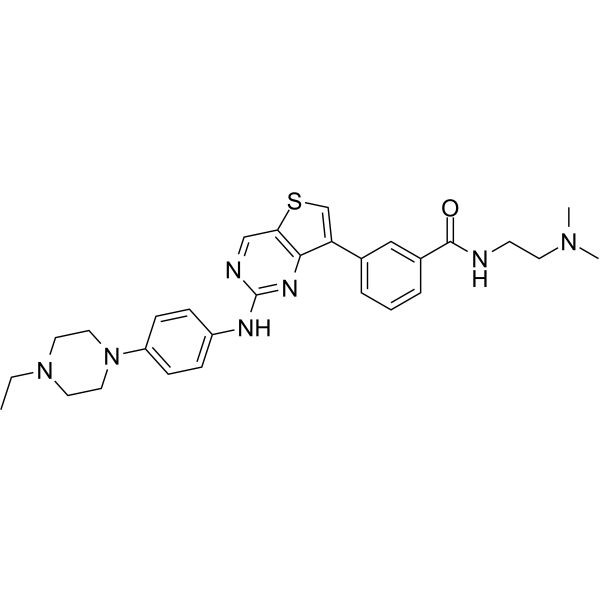
SLC3037 is a NLRP3 inhibitor which blocks NLRP3 from binding to NEK7 or oligomerization, inhibiting inflammasome caused by MSU and other inflammasome activators. SLC3037 can be used for research of gout, cardiovascular diseases, metabolic syndrome or neurodegenerative diseases.
Nos produits utilisent uniquement pour la recherche. Nous ne vendons pas aux patients.
- Pureté : 99.85%
- Formule: C29H35N7OS
- Masse moléculaire:529.70
-
Stockage:Powder -20°C, 3 years , 4°C, 2 years ; In solvent -80°C, 6 months , -20°C, 1 month

To place orders, for customer services and technical support, please contact: MedChemExpress USA
Tel: 609-228-6898 E-mail: [email protected] [email protected]


-
 Activité biologique
-
Chemical Information
-
Solvant et solubilité
- Protocole
- Pureté et documentation
- Références
-
 Help & FAQs


Publications Citing Use of MedChemExpress (MCE) SLC3037
More

Activité biologique
Description
IC50 & Target
|
NLRP3 |
NEK7 |
In Vitro
SLC3037 (1-10 μM, 5 h) inhibits the IL-1β induced by LPS and MSU dose-dependently in BMDMs[1].
MedChemExpress (MCE) has not independently confirmed the accuracy of these methods. They are for reference only.


Chemical Information
-
Appearance Solid
-
Masse moléculaire 529.70
-
Formule C29H35N7OS
-
Color Light yellow to yellow
-
SMILES
CN(CCNC(C1=CC(C2=CSC3=C2N=C(N=C3)NC4=CC=C(C=C4)N5CCN(CC5)CC)=CC=C1)=O)C
-
Livraison
Room temperature in continental US; may vary elsewhere.
-
Stockage
Powder -20°C 3 years 4°C 2 years In solvent -80°C 6 months -20°C 1 month


Publications (1)
-
Journal Impact Factor
-
Most Recent
-
Mol Cell
Consecutive palmitoylation and phosphorylation orchestrates NLRP3 membrane trafficking and inflammasome activation. [Abstract]2024 Sep 5;84(17):3336-3353.e7. PMID: 39173637


Solvant et solubilité
In Vitro:
DMSO : 200 mg/mL (377.57 mM; Need ultrasonic; Hygroscopic DMSO has a significant impact on the solubility of product, please use newly opened DMSO)
Please refer to the solubility information to select the appropriate solvent. Once prepared, please aliquot and store the solution to prevent product inactivation from repeated freeze-thaw cycles.
Storage method and period of stock solution: -80°C, 6 months; -20°C, 1 month. When stored at -80°C, please use it within 6 months. When stored at -20°C, please use it within 1 month.
Please refer to the solubility information to select the appropriate solvent. Once prepared, please aliquot and store the solution to prevent product inactivation from repeated freeze-thaw cycles.
Storage method and period of stock solution: -80°C, 6 months; -20°C, 1 month. When stored at -80°C, please use it within 6 months. When stored at -20°C, please use it within 1 month.
Concentration (start) × Volume (start) = Concentration (final) × Volume (final)


Pureté et documentation
-
Fiche technique (270 KB)
-
SDS (251 KB)
- English - EN (251 KB)
- Français - FR (251 KB)
- Deutsch - DE (251 KB)
- Norwegian - NO (251 KB)
- Español - ES (251 KB)
- Swedish - SV (251 KB)
- Italian - IT (251 KB)
- Korean - KR (251 KB)
- Portuguese - PT (251 KB)
-
Instruction de manipulation (2659 KB)
Références


Complete Stock Solution Preparation Table
Please refer to the solubility information to select the appropriate solvent. Once prepared, please aliquot and store the solution to prevent product inactivation from repeated freeze-thaw cycles.
Storage method and period of stock solution: -80°C, 6 months; -20°C, 1 month. When stored at -80°C, please use it within 6 months. When stored at -20°C, please use it within 1 month.
| Optional Solvent | Concentration Solvent Mass | 1 mg | 5 mg | 10 mg | 25 mg |
|---|---|---|---|---|---|
| DMSO | 1 mM | 1.8879 mL | 9.4393 mL | 18.8786 mL | 47.1965 mL |
| 5 mM | 0.3776 mL | 1.8879 mL | 3.7757 mL | 9.4393 mL | |
| 10 mM | 0.1888 mL | 0.9439 mL | 1.8879 mL | 4.7197 mL | |
| 15 mM | 0.1259 mL | 0.6293 mL | 1.2586 mL | 3.1464 mL | |
| 20 mM | 0.0944 mL | 0.4720 mL | 0.9439 mL | 2.3598 mL | |
| 25 mM | 0.0755 mL | 0.3776 mL | 0.7551 mL | 1.8879 mL | |
| 30 mM | 0.0629 mL | 0.3146 mL | 0.6293 mL | 1.5732 mL | |
| 40 mM | 0.0472 mL | 0.2360 mL | 0.4720 mL | 1.1799 mL | |
| 50 mM | 0.0378 mL | 0.1888 mL | 0.3776 mL | 0.9439 mL | |
| 60 mM | 0.0315 mL | 0.1573 mL | 0.3146 mL | 0.7866 mL | |
| 80 mM | 0.0236 mL | 0.1180 mL | 0.2360 mL | 0.5900 mL | |
| 100 mM | 0.0189 mL | 0.0944 mL | 0.1888 mL | 0.4720 mL |


SLC3037 Related Classifications
HY-163358 Related Classifications
 Powered by Bioz