



18449-82-6
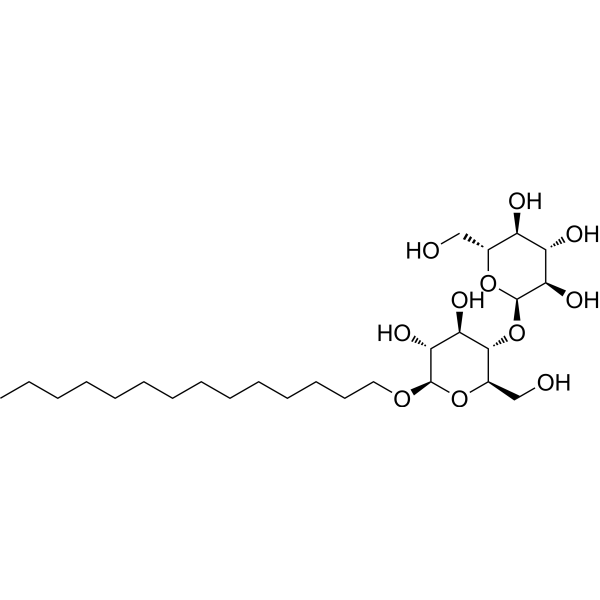
Chemical Structure
Tetradecyl-β-D-maltoside
- CAS. Nr.: 18449-82-6
- Formula:C26H50O11
- Molecular Weight:538.67
IUPAC Name: 3-(2-chlorophenyl)-1H-pyrazole-4-carbaldehyde
InChIKey: UKPROSIGWJBJGA-IWODYCRQSA-N
SMILES: CCCCCCCCCCCCCCO[C@H]1[C@@H]([C@H]([C@@H]([C@@H](CO)O1)O[C@@H]2[C@@H]([C@H]([C@@H]([C@@H](CO)O2)O)O)O)O)O
Biological Activity: Tetradecyl-β-D-maltoside is a nonionic alkyl glycoside surfactant and absorption enhancer. Tetradecyl-β-D-maltoside, as a neutral detergent partitioning agent, stimulates Sav1866 ATPase activity through hydrogen bonding between its maltoside head group and hydrogen bond donors of the transmembrane domain. Tetradecyl-β-D-maltoside partitions into the lipid bilayer and disrupts Caco-2 monolayer integrity, reducing transepithelial electrical resistance and increasing paracellular permeability. Tetradecyl-β-D-maltoside induces endocytosis, membrane lipid fluidization, asymmetric membrane insertion, and transcellular insulin movement in nasal epithelial cells. Tetradecyl-β-D-maltoside inhibits protein aggregation by binding to hydrophobic surface regions of proteins[1][2][3][4][5][6][7].
| Art. -Nr. | Produktname | Reinheit | Beschreibung | Pricing | |||||||||||||||||||
|---|---|---|---|---|---|---|---|---|---|---|---|---|---|---|---|---|---|---|---|---|---|---|---|
|
|
Tetradecyl-β-D-maltoside | 99.96% | Tetradecyl-β-D-maltoside is a nonionic alkyl glycoside surfactant and absorption enhancer. Tetradecyl-β-D-maltoside, as a neutral detergent partitioning agent, stimulates Sav1866 ATPase activity through hydrogen bonding between its maltoside head group and hydrogen bond donors of the transmembrane domain. Tetradecyl-β-D-maltoside partitions into the lipid bilayer and disrupts Caco-2 monolayer integrity, reducing transepithelial electrical resistance and increasing paracellular permeability. Tetradecyl-β-D-maltoside induces endocytosis, membrane lipid fluidization, asymmetric membrane insertion, and transcellular insulin movement in nasal epithelial cells. Tetradecyl-β-D-maltoside inhibits protein aggregation by binding to hydrophobic surface regions of proteins. | ||||||||||||||||||||
|
loading...
/
|
|||||||||||||||||||||||
References
- [1]. Manzella SM, et al. Dodecyl-beta-D-maltoside as a substrate for glucosyl and xylosyl transfer by glycogenin. Glycobiology. 1995 Mar;5(2):263-71.
- [2]. Beck A, et al. Sav1866 from Staphylococcus aureus and P-glycoprotein: similarities and differences in ATPase activity assessed with detergents as allocrites. Biochemistry. 2013 May 14;52(19):3297-309.
- [3]. Tan HY, et al. A multi-chamber microfluidic intestinal barrier model using Caco-2 cells for drug transport studies. PloS one. 2018;13(5):e0197101.
- [4]. Ahsan F. Effects of the permeability enhancers, tetradecylmaltoside and dimethyl-β-cyclodextrin, on insulin movement across human bronchial epithelial cells (16HBE14o−). European journal of pharmaceutical sciences. 2003 Sep 1;20(1):27-34.
- [5]. Arnold JJ, et al. Correlation of tetradecylmaltoside induced increases in nasal peptide drug delivery with morphological changes in nasal epithelial cells. Journal of pharmaceutical sciences. 2004 Sep;93(9):2205-13.
- [6]. Arnold JJ, et al. Reestablishment of the nasal permeability barrier to several peptides following exposure to the absorption enhancer tetradecyl-beta-D-maltoside. Journal of pharmaceutical sciences. 2010 Apr;99(4):1912-20. [Content Brief]
- [7]. Rabinowicz AL, et al. Improvement of Intranasal Drug Delivery with Intravail Alkylsaccharide Excipient as a Mucosal Absorption Enhancer Aiding in the Treatment of Conditions of the Central Nervous System. Drugs in R&D. 2021 Dec;21(4):361-369.



