



218600-44-3
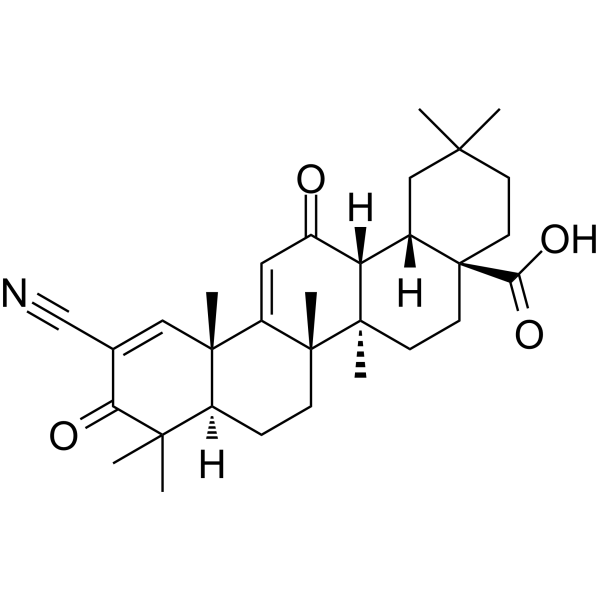
Chemical Structure
Bardoxolone
Synonym(s): CDDO; RTA 401
- CAS No.: 218600-44-3
- Formula:C31H41NO4
- Molecular Weight:491.66
IUPAC Name: (4aS,6aR,6bS,8aR,12aS,14aR,14bS)-11-cyano-2,2,6a,6b,9,9,12a-heptamethyl-10,14-dioxo-1,3,4,5,6,6a,6b,7,8,8a,9,10,12a,14,14a,14b-hexadecahydropicene-4a(2H)-carboxylic acid
InChIKey: TXGZJQLMVSIZEI-UQMAOPSPSA-N
SMILES: CC1(C)CC[C@@]2(C(O)=O)[C@@]([C@](C(C=C3[C@@]4(C)CC[C@]5([H])[C@]3(C)C=C(C#N)C(C5(C)C)=O)=O)([H])[C@@]4(C)CC2)([H])C1
Biological Activity: Bardoxolone (CDDO; RTA 401) is an Nrf2 pathway activator and SARS-CoV-2 3CLpro inhibitor. Bardoxolone exerts antiviral, anti-inflammatory, and apoptosis (Apoptosis)-inducing effects by reversibly covalently binding to SARS-CoV-2 3CLpro (Kd = 25.90 μM) and Keap1, forming a Michael adduct with IKK to inhibit NF-κB, binding to PPAR-γ to induce differentiation, and selectively inhibiting Lonp1 without inhibiting the proteasome. Bardoxolone can be used for research on COVID-19 and cancer[1][2][3][4].
| Cat. No. | Product Name | Purity | Description | Pricing | |||||||||||||||||||
|---|---|---|---|---|---|---|---|---|---|---|---|---|---|---|---|---|---|---|---|---|---|---|---|
|
|
Bardoxolone | 99.50% | Bardoxolone (CDDO; RTA 401) is an Nrf2 pathway activator and SARS-CoV-2 3CLpro inhibitor. Bardoxolone exerts antiviral, anti-inflammatory, and apoptosis (Apoptosis)-inducing effects by reversibly covalently binding to SARS-CoV-2 3CLpro (Kd = 25.90 μM) and Keap1, forming a Michael adduct with IKK to inhibit NF-κB, binding to PPAR-γ to induce differentiation, and selectively inhibiting Lonp1 without inhibiting the proteasome. Bardoxolone can be used for research on COVID-19 and cancer. | ||||||||||||||||||||
|
loading...
/
|
|||||||||||||||||||||||
|
|
Bardoxolone (Standard) | ≥98% | Bardoxolone (Standard) (CDDO (Standard); RTA 401 (Standard)) is the analytical standard of Bardoxolone (CDDO; RTA 401) (HY-14909). This product is intended for research and analytical applications. Bardoxolone (CDDO; RTA 401) is an Nrf2 pathway activator and SARS-CoV-2 3CLpro inhibitor. Bardoxolone exerts antiviral, anti-inflammatory, and apoptosis (Apoptosis)-inducing effects by reversibly covalently binding to SARS-CoV-2 3CLpro (Kd = 25.90 μM) and Keap1, forming a Michael adduct with IKK to inhibit NF-κB, binding to PPAR-γ to induce differentiation, and selectively inhibiting Lonp1 without inhibiting the proteasome. Bardoxolone can be used for research on COVID-19 and cancer. | ||||||||||||||||||||
|
loading...
/
|
|||||||||||||||||||||||
-
Similarity Score 0.91
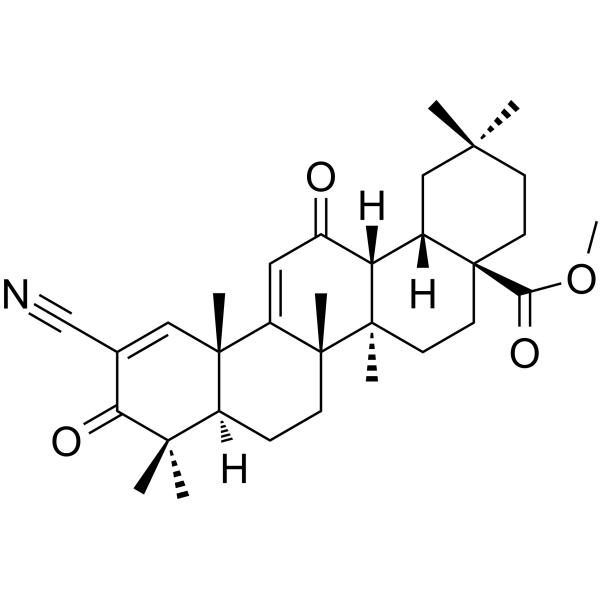 HY-13324Bardoxolone methyl
-
Similarity Score 0.85
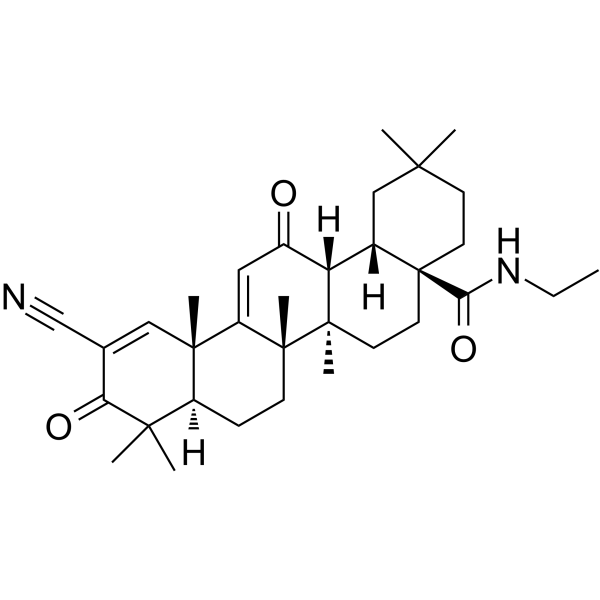 HY-12213CDDO-EA
-
Similarity Score 0.65
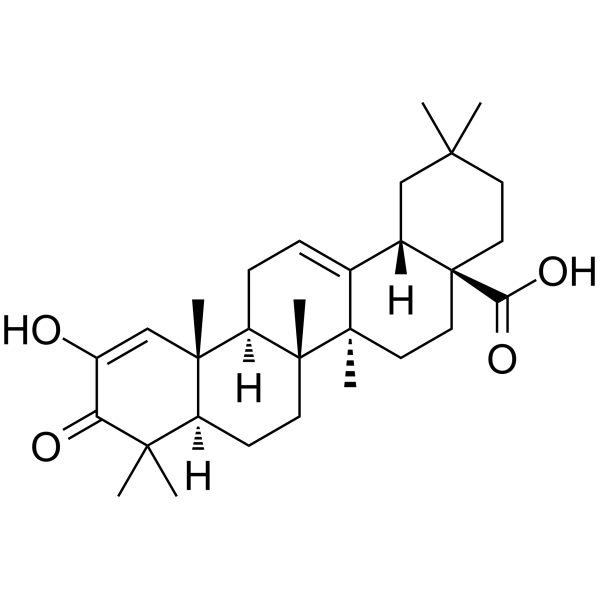 HY-144809Pancreatic lipase/Carboxylesterase 1-IN-1
-
Similarity Score 0.64
 HY-N174853-Oxooleana-1,12-dien-28-oic acid
-
Similarity Score 0.63
 HY-N175093β-Hydroxy-oleana-11,13(18)-dien-28-oic acid
-
Similarity Score 0.62
 HY-N1487ROleanonic acid (Standard)
-
Similarity Score 0.62
 HY-N9236Virgatic acid
-
Similarity Score 0.60
 HY-168053HMGB1-IN-3
-
Similarity Score 0.60
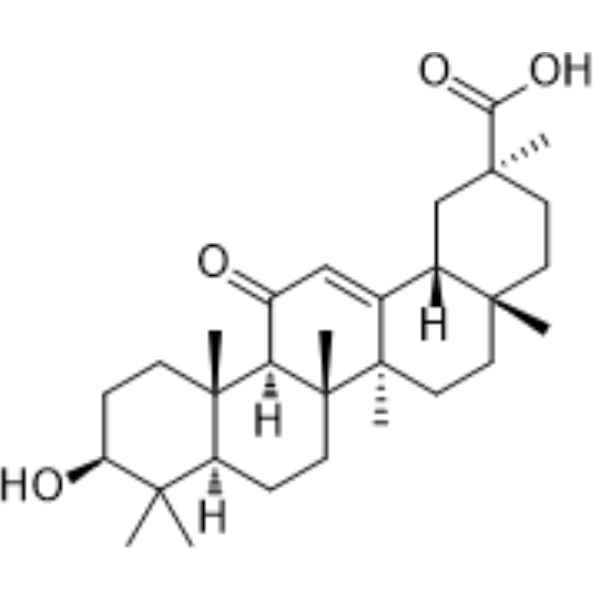 HY-N018018β-Glycyrrhetinic acid
-

Explore the MedChemAI to find more analogs


References
- [1]. Sun Q, et al. Bardoxolone and bardoxolone methyl, two Nrf2 activators in clinical trials, inhibit SARS-CoV-2 replication and its 3C-like protease. Signal Transduct Target Ther. 2021 May 29;6(1):212. [Content Brief]
- [2]. Borella R, et al. Synthesis and Anticancer Activity of CDDO and CDDO-Me, Two Derivatives of Natural Triterpenoids. Molecules. 2019;24(22):4097. Published 2019 Nov 13. [Content Brief]
- [3]. Wang Y, et al. Discovery of bardoxolone derivatives as novel orally active necroptosis inhibitors. Eur J Med Chem. 2021;212:113030. [Content Brief]
- [4]. Borella R, et al. Synthesis and Anticancer Activity of CDDO and CDDO-Me, Two Derivatives of Natural Triterpenoids. Molecules. 2019 Nov 13;24(22):4097. [Content Brief]



