



28500-02-9
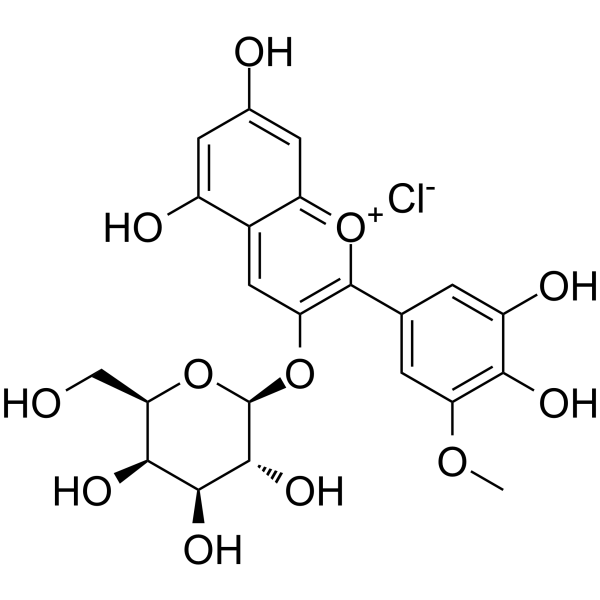
Chemical Structure
Petunidin-3-O-galactoside chloride
- No. CAS: 28500-02-9
- Formula:C22H23ClO12
- Molecular Weight:514.86
IUPAC Name: 2-(3,4-dihydroxy-5-methoxyphenyl)-5,7-dihydroxy-3-(((2S,3R,4S,5R,6R)-3,4,5-trihydroxy-6-(hydroxymethyl)tetrahydro-2H-pyran-2-yl)oxy)chromenylium chloride
InChIKey: HBKZHMZCXXQMOX-PKHNGRKTSA-N
SMILES: OC1=CC2=[O+]C(C3=CC(OC)=C(O)C(O)=C3)=C(O[C@H]4[C@@H]([C@H]([C@H]([C@@H](CO)O4)O)O)O)C=C2C(O)=C1.[Cl-]
Biological Activity: Petunidin-3-O-galactoside chloride is an α-glucosidase (α-Glycosidase) inhibitor (IC50 = 68.54 µM). Petunidin-3-O-galactoside chloride lowers postprandial blood glucose by slowing carbohydrate digestion and exerts antioxidant effects by scavenging free radicals; it also enhances glucose (D-Glucose) (HY-B0389) uptake, reduces intracellular total cholesterol and triglyceride (Trilaurin) (HY-126573) levels and lipid droplet accumulation in hepatocytes treated with high glucose/oleic acid (Oleic acid) (HY-N1446), and shows no significant cytotoxicity in hepatocytes. Petunidin-3-O-galactoside chloride is the major petunidin-type anthocyanin in tea and can be used in research on diabetic obesity[1][2][3][4][5][6].
| Referencia número | Nombre del producto | Pureza | Descripciòn | Pricing | |||||||||||||||||||
|---|---|---|---|---|---|---|---|---|---|---|---|---|---|---|---|---|---|---|---|---|---|---|---|
|
|
Petunidin-3-O-galactoside chloride | 99.19% | Petunidin-3-O-galactoside chloride is an α-glucosidase (α-Glycosidase) inhibitor (IC50 = 68.54 µM). Petunidin-3-O-galactoside chloride lowers postprandial blood glucose by slowing carbohydrate digestion and exerts antioxidant effects by scavenging free radicals; it also enhances glucose (D-Glucose) (HY-B0389) uptake, reduces intracellular total cholesterol and triglyceride (Trilaurin) (HY-126573) levels and lipid droplet accumulation in hepatocytes treated with high glucose/oleic acid (Oleic acid) (HY-N1446), and shows no significant cytotoxicity in hepatocytes. Petunidin-3-O-galactoside chloride is the major petunidin-type anthocyanin in tea and can be used in research on diabetic obesity. | ||||||||||||||||||||
|
loading...
/
|
|||||||||||||||||||||||
References
- [1]. Huang F, et al. (2022) Metabolomic and transcriptomic analyses reveal a MYB gene, CsAN1, involved in anthocyanins accumulation separation in F1 between ‘Zijuan’ (Camellia sinensis var. assamica) and ‘Fudingdabaicha’ (C. sinensis var. sinensis) tea plants. Front. Plant Sci. 13:1008588.
- [2]. Ha TJ, et al. Identification of anthocyanin compositions in black seed coated Korean adzuki bean (Vigna angularis) by NMR and UPLC-Q-Orbitrap-MS/MS and screening for their antioxidant properties using different solvent systems. Food chemistry. 2021 Jun 01;346:128882.
-
[3]. Chao Ma, et al. (2022)
Dynamics of anthocyanin profiles of the fruits of four blueberry (Vaccinium sp.) cultivars
during different growth stages, International Journal of Food Properties, 25:1, 1302-1316. - [4]. Zhu C, et al. (2023) Five blueberry anthocyanins and their antioxidant, hypoglycemic, and hypolipidemic effects in vitro. Front. Nutr. 10:1172982.
-
[5]. Andrea Bunea, et al. Anthocyanin determination in blueberry extracts from various cultivars and their antiproliferative and apoptotic properties in B16-F10 metastatic murine melanoma cells, Phytochemistry, Volume 95, 2013, Pages 436-444, ISSN 0031-9422.
- [6]. Yang Xu, et al. Malvidin-3‑O‑Glucoside from Blueberry Ameliorates Nonalcoholic Fatty Liver Disease by Regulating Transcription Factor EB-Mediated Lysosomal Function and Activating the Nrf2/ARE Signaling Pathway. J. Agric. Food Chem. 28 April 2021; 69 (16): 4663-4673.



