



354813-19-7
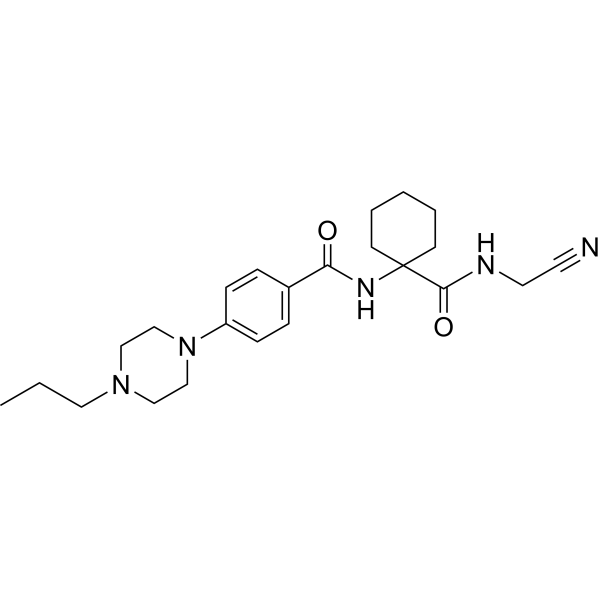
Chemical Structure
Balicatib
Synonym(s): AAE581
- CAS No.: 354813-19-7
- Formula:C23H33N5O2
- Molecular Weight:411.54
IUPAC Name: N-(1-((cyanomethyl)carbamoyl)cyclohexyl)-4-(4-propylpiperazin-1-yl)benzamide
InChIKey: LLCRBOWRJOUJAE-UHFFFAOYSA-N
SMILES: CCCN1CCN(C2=CC=C(C(NC3(C(NCC#N)=O)CCCCC3)=O)C=C2)CC1
Biological Activity: Balicatib (AAE581) is a potent, orally active and selective cathepsin K inhibitor with IC50 values of 22, 61, 48, 2900 nM for cathepsin K, cathepsin B, cathepsin L, cathepsin S, respectively. Balicatib inhibits bone turnover, decreases bone formation rates. Balicatib has the potential for the research of osteoporosis[1][2].
| Cat. No. | Product Name | Purity | Description | Pricing | |||||||||||||||||||
|---|---|---|---|---|---|---|---|---|---|---|---|---|---|---|---|---|---|---|---|---|---|---|---|
|
|
Balicatib | 98.25% | Balicatib (AAE581) is a potent, orally active and selective cathepsin K inhibitor with IC50 values of 22, 61, 48, 2900 nM for cathepsin K, cathepsin B, cathepsin L, cathepsin S, respectively. Balicatib inhibits bone turnover, decreases bone formation rates. Balicatib has the potential for the research of osteoporosis. | ||||||||||||||||||||
|
loading...
/
|
|||||||||||||||||||||||
-
Similarity Score 0.52
 HY-109743BP14979
-
Similarity Score 0.52
 HY-107590GR144053 trihydrochloride
-
Similarity Score 0.51
 HY-W714509AH 8507
-
Similarity Score 0.51
 HY-157563Dopamine D4 receptor ligand 2
-
Similarity Score 0.51
 HY-153711TRPA1-IN-2
-
Similarity Score 0.50
 HY-105542RNiaprazine (Standard)
-
Similarity Score 0.49
 HY-129661AH 7959
-
Similarity Score 0.49
 HY-123481JNJ-42253432
-
Similarity Score 0.49
 HY-115968Dopamine D3 receptor ligand-4
-

Explore the MedChemAI to find more analogs


References
- [1]. Jerome C, et al. Balicatib, a cathepsin K inhibitor, stimulates periosteal bone formation in monkeys. Osteoporos Int. 2012 Jan;23(1):339-49. [Content Brief]
- [2]. Gauthier JY, et al. The discovery of odanacatib (MK-0822), a selective inhibitor of cathepsin K. Bioorg Med Chem Lett. 2008 Feb 1;18(3):923-8. [Content Brief]



