



54350-48-0
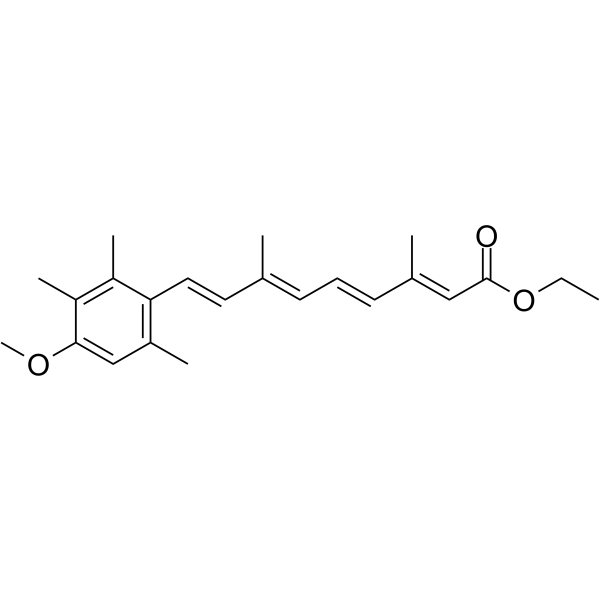
Chemical Structure
Etretinate
Synonym(s): Ro 10-9359
- CAS No.: 54350-48-0
- Formula:C23H30O3
- Molecular Weight:354.48
IUPAC Name: ethyl (2E,4E,6E,8E)-9-(4-methoxy-2,3,6-trimethylphenyl)-3,7-dimethylnona-2,4,6,8-tetraenoate
InChIKey: HQMNCQVAMBCHCO-DJRRULDNSA-N
SMILES: O=C(OCC)/C=C(C)/C=C/C=C(C)/C=C/C1=C(C)C=C(OC)C(C)=C1C
Biological Activity: Etretinate (Ro 10-9359) is an orally effective regulator of epidermal differentiation. Etretinate reduces procollagen mRNA expression and induces apoptosis of dermal infiltrating cells. Etretinate inhibits keratinization, normalizes epidermal cell renewal, increases stratum corneum hydration and transepidermal water loss, and exerts a mild keratolytic effect. Etretinate can be used in research on scleroderma, ichthyosis, and psoriasis[1][2][3][4][5][6][7][8][9][10].
| Cat. No. | Product Name | Purity | Description | Pricing | |||||||||||||||||||
|---|---|---|---|---|---|---|---|---|---|---|---|---|---|---|---|---|---|---|---|---|---|---|---|
|
|
Etretinate | 99.78% | Etretinate (Ro 10-9359) is an orally effective regulator of epidermal differentiation. Etretinate reduces procollagen mRNA expression and induces apoptosis of dermal infiltrating cells. Etretinate inhibits keratinization, normalizes epidermal cell renewal, increases stratum corneum hydration and transepidermal water loss, and exerts a mild keratolytic effect. Etretinate can be used in research on scleroderma, ichthyosis, and psoriasis. | ||||||||||||||||||||
|
loading...
/
|
|||||||||||||||||||||||
|
|
Etretinate (Standard) | ≥98% | Etretinate (Standard) (Ro 10-9359 (Standard)) is the analytical standard of Etretinate (HY-B0797). This product is intended for research and analytical applications. Etretinate (Ro 10-9359) is an orally effective regulator of epidermal differentiation. Etretinate reduces procollagen mRNA expression and induces apoptosis of dermal infiltrating cells. Etretinate inhibits keratinization, normalizes epidermal cell renewal, increases stratum corneum hydration and transepidermal water loss, and exerts a mild keratolytic effect. Etretinate can be used in research on scleroderma, ichthyosis, and psoriasis. | ||||||||||||||||||||
|
loading...
/
|
|||||||||||||||||||||||
|
|
Etretinate-d3 | Etretinate-d3 is the deuterated-labeled Etretinate (HY-B0797). Etretinate (Ro 10-9359) is an orally effective regulator of epidermal differentiation. Etretinate reduces procollagen mRNA expression and induces apoptosis of dermal infiltrating cells. Etretinate inhibits keratinization, normalizes epidermal cell renewal, increases stratum corneum hydration and transepidermal water loss, and exerts a mild keratolytic effect. Etretinate can be used in research on scleroderma, ichthyosis, and psoriasis. | |||||||||||||||||||||
|
loading...
/
|
|||||||||||||||||||||||
References
- [1]. Ikeda T, et al. Vitamin A derivative etretinate improves bleomycin-induced scleroderma. Allergology International. 2005 Jan 1;54(3):419-25.
- [2]. Lowe NJ, et al. Etretinate treatment for psoriasis inhibits epidermal ornithine decarboxylase. Journal of the American Academy of Dermatology. 1982 Apr;6(4 Pt 2 Suppl):697-8.
- [3]. Gomez EC, et al. Actions of isotretinoin and etretinate on the pilosebaceous unit. Journal of the American Academy of Dermatology. 1982 Apr;6(4 Pt 2 Suppl):746-50.
- [4]. Taruoura D, et al. Effects of a synthetic retinoid, etretinate (RO 10-9359), on the peripheral metabolism of thyroid hormones in rats. Food and chemical toxicology : an international journal published for the British Industrial Biological Research Association. 1991 Sep;29(9):595-9.
- [5]. Pearse AD, et al. The effects of an aromatic retinoid (etretinate) on epidermal cell production and metabolism in normal and ichthyotic patients. The British journal of dermatology. 1986 Mar;114(3):285-94.
- [6]. Dubertret L, et al. Inhibition of neutrophil migration by etretinate and its main metabolite. British Journal of Dermatology. 1982 Dec 1;107(6):681-5.
- [7]. Mori MS. Effects of retinoid (Ro 10-9359) on the plasma membrane of keratinocytes in patients with psoriasis: a freeze-fracture analysis. Journal of Investigative Dermatology. 1983 Mar 1;80(3):174-80.
- [8]. Tong PS, et al. Differential effects of retinoids on DNA synthesis in calcium-regulated murine epidermal keratinocyte cultures. The Journal of investigative dermatology. 1988 Jun;90(6):861-8.
- [9]. Bauer EA, et al. Retinoic acid inhibition of collagenase and gelatinase expression in human skin fibroblast cultures. Evidence for a dual mechanism. The Journal of investigative dermatology. 1983 Aug;81(2):162-9.
- [10]. Tagami H, et al. Functional assessment of the stratum corneum under the influence of oral aromatic retinoid (etretinate) in guinea-pigs and humans. Comparison with topical retinoic acid treatment. The British journal of dermatology. 1992 Nov;127(5):470-5.



