



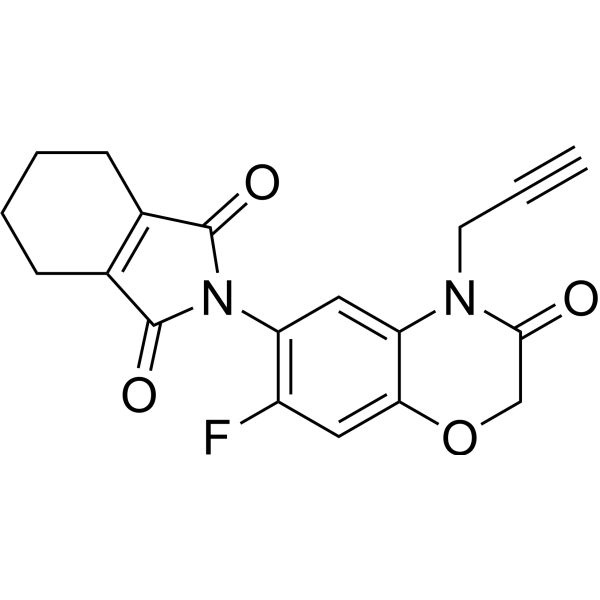
Flumioxazin

Based on 1 Customer Validation
Flumioxazin (V-53482) is a protoporphyrinogen IX oxidase (PPO) inhibitor with a rat target IC50 of 4.58 nM. Flumioxazin is found in its biological sources and is used for pre-emergence control of dicotyledonous weeds in soybean and peanut. Flumioxazin inhibits protoporphyrinogen oxidase, blocking chlorophyll and heme biosynthesis, leading to protoporphyrin IX accumulation, oxidative stress, membrane damage, and cell death. Flumioxazin is used in research on weed control.
Nos produits utilisent uniquement pour la recherche. Nous ne vendons pas aux patients.
- Pureté : 99.13%
- CAS No.: 103361-09-7
- Formule: C19H15FN2O4
- Masse moléculaire:354.33
-
Stockage:
4°C, protect from light
* In solvent : -80°C, 6 months; -20°C, 1 month (protect from light)

To place orders, for customer services and technical support, please contact: MedChemExpress USA
Tel: 609-228-6898 E-mail: [email protected] [email protected]


-
 Activité biologique
-
Chemical Information
-
Solvant et solubilité
- Protocole
- Pureté et documentation
- Références
-
 Help & FAQs




Activité biologique
Description
IC50 & Target
[1]|
PPO 4.58 nM (IC50) |
In Vitro
Flumioxazin potently inhibits rat hepatic mitochondrial PPO with an IC50 of 4.58 nM, demonstrating stronger activity than its metabolites[2].
Flumioxazin inhibits PPO in rat hepatocyte mitochondria more strongly than in human mitochondria, with the inhibitory activity being about 5 times lower in human[2].
Flumioxazin (0.01-5 µM; 8 days) inhibits heme synthesis and induces PPIX accumulation in a dose-dependent manner in rat REL cells[2].
Flumioxazin (0.01-5 µM; 8 days) does not affect heme synthesis in human K562 cells, though a slight PPIX accumulation occurs at the 5 µM concentration[2].
Flumioxazin (0.01-5 µM; 8 days) does not affect heme synthesis in human CD36+ cells, though a slight PPIX accumulation occurs at the 5 µM concentration[2].
Flumioxazin (up to 5 µM) does not inhibit heme synthesis in human iPS-derived erythroid cells but does inhibit it in rat ES-derived erythroid cells, demonstrating a clear species difference in a model closer to normal embryonic erythroids[2].
Flumioxazin (100 ng/mL; 0.25-32 days) undergoes relatively short soil persistence with half-lives of 17.9 and 16.0 days in Greenville sandy clay loam and 13.6 and 12.9 days in Tifton loamy sand at 15 and 25 °C, respectively, with microbial degradation being the primary dissipation pathway[3].
Flumioxazin (100 ng/mL; 16 days) dissipation is primarily microbially mediated, with 99% of the applied compound remaining in heat-treated Tifton loamy sand after 16 days due to reduced microbial degradation[3].
Flumioxazin (5 mg/kg; 1-64 days) mineralizes at low rates in soil, reaching 2.0% in Greenville sandy clay loam and 2.2% in Tifton loamy sand after 64 days at 25 °C, with the higher rate in Tifton soil attributable to reduced sorption and greater bioavailability for microbial degradation[3].
MedChemExpress (MCE) has not independently confirmed the accuracy of these methods. They are for reference only.


Chemical Information
-
CAS No. 103361-09-7
-
Appearance Solid
-
Masse moléculaire 354.33
-
Formule C19H15FN2O4
-
Color White to off-white
-
SMILES
O=C1N(C2=C(F)C=C(OCC(N3CC#C)=O)C3=C2)C(C4=C1CCCC4)=O
-
Synonyms
V-53482
-
Livraison
Room temperature in continental US; may vary elsewhere.
-
Stockage
4°C, protect from light
* In solvent : -80°C, 6 months; -20°C, 1 month (protect from light)


Solvant et solubilité
In Vitro:
DMSO : 100 mg/mL (282.22 mM; Need ultrasonic; Hygroscopic DMSO has a significant impact on the solubility of product, please use newly opened DMSO)
Please refer to the solubility information to select the appropriate solvent. Once prepared, please aliquot and store the solution to prevent product inactivation from repeated freeze-thaw cycles.
Storage method and period of stock solution: -80°C, 6 months; -20°C, 1 month (protect from light). When stored at -80°C, please use it within 6 months. When stored at -20°C, please use it within 1 month.
Please refer to the solubility information to select the appropriate solvent. Once prepared, please aliquot and store the solution to prevent product inactivation from repeated freeze-thaw cycles.
Storage method and period of stock solution: -80°C, 6 months; -20°C, 1 month (protect from light). When stored at -80°C, please use it within 6 months. When stored at -20°C, please use it within 1 month.
Concentration (start) × Volume (start) = Concentration (final) × Volume (final)
In Vivo:
Select the appropriate dissolution method based on your experimental animal and administration route.
- For the following dissolution methods, please ensure to first prepare a clear stock solution using an In Vitro approach and then sequentially add co-solvents:
- To ensure reliable experimental results, the clarified stock solution can be appropriately stored based on storage conditions. As for the working solution for In Vivo experiments, it is recommended to prepare freshly and use it on the same day.
- The percentages shown for the solvents indicate their volumetric ratio in the final prepared solution. If precipitation or phase separation occurs during preparation, heat and/or sonication can be used to aid dissolution.
Add each solvent one by one: 10% DMSO 40% PEG300 5% Tween-80 45% Saline
Solubility: ≥ 2.5 mg/mL (7.06 mM); Clear solution
This protocol yields a clear solution of ≥ 2.5 mg/mL (saturation unknown).
Taking 1 mL working solution as an example, add 100 μL DMSO stock solution (25.0 mg/mL) to 400 μL PEG300, and mix evenly; then add 50 μL Tween-80 and mix evenly; then add 450 μL Saline to adjust the volume to 1 mL.
Preparation of Saline: Dissolve 0.9 g sodium chloride in ddH₂O and dilute to 100 mL to obtain a clear Saline solution.
In Vivo Dissolution Calculator
Please enter the basic information of animal experiments:
-
-
-
-
Recommended: Prepare an additional quantity of animals to account for potential losses during experiments.
Please enter your animal formula composition:
-
%DMSO +
Recommended: Keep the proportion of DMSO in working solution below 2% if your animal is weak.
-
%+
-
+%Tween-80 + +
-
%Saline +
The co-solvents required include: DMSO, . All of co-solvents are available by MedChemExpress (MCE). , Tween 80. All of co-solvents are available by MedChemExpress (MCE).
Working solution concentration: 0.22 mg/mL
Method for preparing stock solution: mg drug dissolved in μL DMSO. Stock solution concentration: mg/mL. * In solvent : -80°C, 6 months; -20°C, 1 month (protect from light)
1. Take μL DMSO stock solution;
2. Add μL .
μL , mix evenly;
3. Then add μL Tween 80, mix evenly;
4. Then add μL
Please ensure that the stock solution in the first step is dissolved to a clear state, and add co-solvents in sequence. You can use ultrasonic heating (ultrasonic cleaner, recommended frequency 20-40 kHz), vortexing, etc. to assist dissolution.


Pureté et documentation
-
Fiche technique (290 KB)
-
SDS (622 KB)
- English - EN (622 KB)
- Français - FR (622 KB)
- Deutsch - DE (622 KB)
- Norwegian - NO (622 KB)
- Español - ES (622 KB)
- Swedish - SV (622 KB)
- Italian - IT (622 KB)
- Korean - KR (622 KB)
- Portuguese - PT (622 KB)
-
Instruction de manipulation (2659 KB)
Références


Complete Stock Solution Preparation Table
Please refer to the solubility information to select the appropriate solvent. Once prepared, please aliquot and store the solution to prevent product inactivation from repeated freeze-thaw cycles.
Storage method and period of stock solution: -80°C, 6 months; -20°C, 1 month (protect from light). When stored at -80°C, please use it within 6 months. When stored at -20°C, please use it within 1 month.
| Optional Solvent | Concentration Solvent Mass | 1 mg | 5 mg | 10 mg | 25 mg |
|---|---|---|---|---|---|
| DMSO | 1 mM | 2.8222 mL | 14.1111 mL | 28.2223 mL | 70.5557 mL |
| 5 mM | 0.5644 mL | 2.8222 mL | 5.6445 mL | 14.1111 mL | |
| 10 mM | 0.2822 mL | 1.4111 mL | 2.8222 mL | 7.0556 mL | |
| 15 mM | 0.1881 mL | 0.9407 mL | 1.8815 mL | 4.7037 mL | |
| 20 mM | 0.1411 mL | 0.7056 mL | 1.4111 mL | 3.5278 mL | |
| 25 mM | 0.1129 mL | 0.5644 mL | 1.1289 mL | 2.8222 mL | |
| 30 mM | 0.0941 mL | 0.4704 mL | 0.9407 mL | 2.3519 mL | |
| 40 mM | 0.0706 mL | 0.3528 mL | 0.7056 mL | 1.7639 mL | |
| 50 mM | 0.0564 mL | 0.2822 mL | 0.5644 mL | 1.4111 mL | |
| 60 mM | 0.0470 mL | 0.2352 mL | 0.4704 mL | 1.1759 mL | |
| 80 mM | 0.0353 mL | 0.1764 mL | 0.3528 mL | 0.8819 mL | |
| 100 mM | 0.0282 mL | 0.1411 mL | 0.2822 mL | 0.7056 mL |


Flumioxazin Related Classifications
HY-114507 Related Classifications
 Powered by Bioz
Keywords
- Flumioxazin
- 103361-09-7
- V-53482
- V53482
- V 53482
- Environmental Pollutants
- Herbicide
- Protoporphyrinogen IX oxidase
- Triticum aestivum
- oxidative stress
- protoporphyrinogen oxidase inhibitor
- micronuclei formation
- membrane damage
- cell death
- soybean
- peanut
- protoporphyrin IX accumulation
- dicotyledonous weed species
- Inhibitor
- inhibitor
- inhibit