
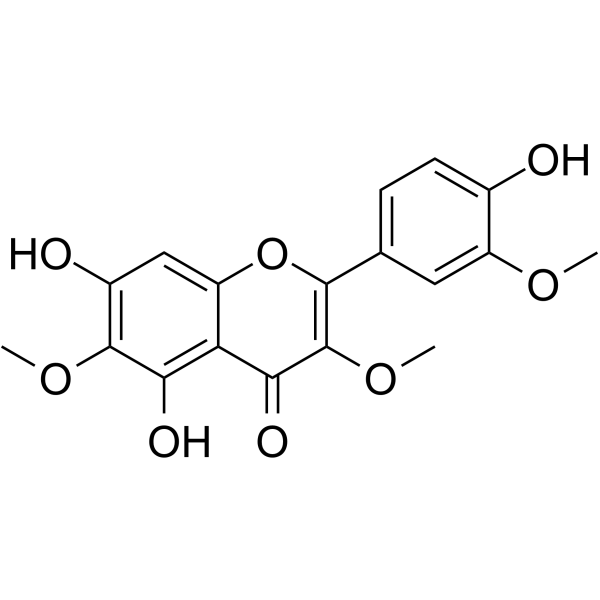
Jaceidin
Jaceidin is a promising lead molecule for potent VEGFR inhibitor with excellent membrane permeability and oral bioavailability. Jaceidin exhibits anti-tumor activities.
Nos produits utilisent uniquement pour la recherche. Nous ne vendons pas aux patients.
- CAS No.: 10173-01-0
- Formule: C18H16O8
- Masse moléculaire:360.31
-
Stockage:
Please store the product under the recommended conditions in the Certificate of Analysis.
Voir tous les produits spécifiques à Isoform EGFR
More
Activité biologique
Description
Chemical Information
-
CAS No. 10173-01-0
-
Masse moléculaire 360.31
-
Formule C18H16O8
-
SMILES
O=C1C(OC)=C(OC2=CC(O)=C(C(O)=C12)OC)C3=CC=C(C(OC)=C3)O
-
Structure Classification
-
Initial Source
-
Livraison
Room temperature in continental US; may vary elsewhere.
-
Stockage
Please store the product under the recommended conditions in the Certificate of Analysis.
Protocole
-
Protocol for Pharmacokinetic Study
Pharmacokinetic studies quantify how an organism handles a drug over time through absorption, distribution, metabolism, and excretion, and the core experimental readout is the concentration-time profile of parent drug and, when relevant, metabolites in biological matrices such as plasma, whole blood, urine, bile, or tissue. Pharmacokinetic analysis links dose, route, exposure, clearance, half-life, distribution, bioavailability, and systemic exposure to drug efficacy and toxicity hypotheses rather than measuring a signaling pathway directly. The literature links pharmacokinetics to drug-development phenotypes by showing that drug metabolism and pharmacokinetics influence compound progression, exposure-response interpretation, safety margins, dosing strategy, and failure risk during discovery and development. DMPK science contributes to compound optimization by integrating physicochemical properties, in vitro metabolism, transporter behavior, in vivo exposure, and pharmacodynamic contex
-
Transepithelial/transendothelial electrical resistance assay
TEER measures electrical resistance across epithelial or endothelial monolayers cultured on permeable supports, and the readout reflects ionic conductance through the cell barrier, especially the paracellular pathway regulated by junctional integrity. TEER can be measured without destroying the monolayer and is commonly used before or during transport, permeability, barrier-disruption, and barrier-maturation experiments. TEER values are influenced by biological maturation and technical conditions; reported factors include temperature, medium formulation, passage number, electrode geometry, membrane properties, and junctional length during early monolayer maturation. Therefore, TEER should be interpreted with blank-insert subtraction, area normalization, repeated readings, and, when possible, orthogonal barrier readouts such as FITC-dextran flux or tight-junction staining.
Pureté et documentation
Références
Calculators
Concentration (start) × Volume (start) = Concentration (final) × Volume (final)

