



JV-1-36
JV-1-36 is a growth hormone-releasing hormone (GHRH) antagonist. JV-1-36 inhibits the production of reactive oxygen species in A549 lung cancer cells. JV-1-36 can be used to study the effect of GHRH antagonists in vitro .
Nos produits utilisent uniquement pour la recherche. Nous ne vendons pas aux patients.
- CAS No.: 221377-79-3
- Formule: C172H284ClN53O41
- Masse moléculaire:3785.88
-
Stockage:
Please store the product under the recommended conditions in the Certificate of Analysis.

To place orders, for customer services and technical support, please contact: MedChemExpress USA
Tel: 609-228-6898 E-mail: [email protected] [email protected]


-
 Activité biologique
-
Chemical Information
- Protocole
- Pureté et documentation
- Références
-
 Help & FAQs




Activité biologique
Description
IC50 & Target
IC50: growth hormone-releasing hormone (GHRH)[1].
In Vitro
JV-1-36 (0.01-15 μM; 8 h) reduces cell viability in A549 cells at higher concentrations (5-15 μM), and (2-15 μM; 8 h) also decreases cell viability in Hela cells[1].
JV-1-36 (1 μM; 8 h) significantly reduces the production of ROS induced by H2O2 (0.1 mM; 8 h) in A549 lung cancer cells, exerting antioxidant effects[1].
MedChemExpress (MCE) has not independently confirmed the accuracy of these methods. They are for reference only. Further protocols information, click here.


Chemical Information
-
CAS No. 221377-79-3
-
Masse moléculaire 3785.88
-
Formule C172H284ClN53O41
-
Sequence
{N-(2-phenylacetyl)}-Tyr-{d-Arg}-Asp-Ala-Ile-{4-Cl-Phe}-Thr-Asn-{Har}-{Tyr(Me)}-Arg-Lys-Val-Leu-{Abu}-Gln-Leu-Ser-Ala-Arg-Lys-Leu-Leu-Gln-Asp-Ile-{Nle}-{d-Arg}-{Har}-NH2
-
Sequence Shortening
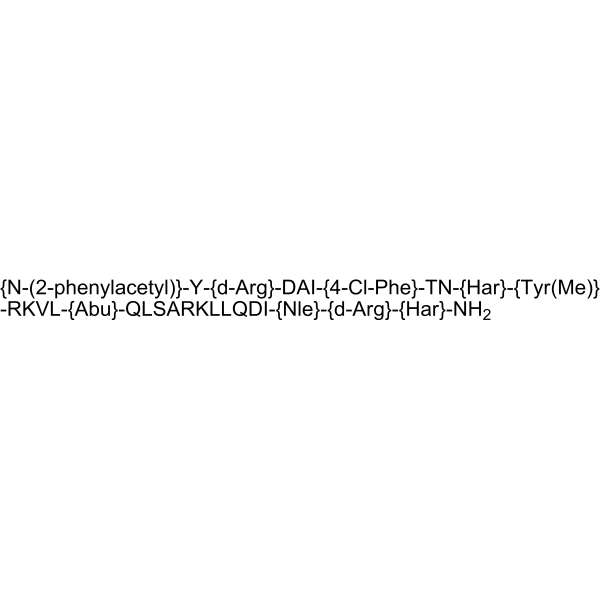
{N-(2-phenylacetyl)}-Y-{d-Arg}-DAI-{4-Cl-Phe}-TN-{Har}-{Tyr(Me)}-RKVL-{Abu}-QLSARKLLQDI-{Nle}-{d-Arg}-{Har}-NH2
-
Livraison
Room temperature in continental US; may vary elsewhere.
-
Stockage
Please store the product under the recommended conditions in the Certificate of Analysis.

Protocole
-
ROS/oxidative-stress fluorescent staining
ROS/oxidative-stress fluorescent staining uses cell-permeant fluorogenic probes that become fluorescent after oxidation inside cells or tissues; commonly used examples include DCFH-DA/DCFDA for broad cellular oxidant detection, DHE for superoxide-related signal detection, MitoSOX for mitochondrial superoxide-related signal detection, and CellROX probes for oxidative-stress-associated fluorescence readouts. The assay detects probe oxidation rather than a single ROS species unless the probe and analysis method have been chemically validated for that species. DCFH-DA enters cells, is deacetylated by intracellular esterases to DCFH, and produces fluorescent DCF after oxidation, so the readout is used as an operational measure of total cellular oxidative stress rather than a species-specific ROS measurement. DHE and MitoSOX can report superoxide-related oxidation, but red fluorescence alone can include non-specific ethidium-like oxidation products; HPLC or optimized spectral approaches are
-
Research Protocol for Endocrine Diseases
Endocrine diseases often arise from disrupted hormone production, hormone signaling, or target-tissue responsiveness; for diabetes-focused endocrine disease models, insulin signaling regulates glucose uptake, hepatic glucose output, lipid metabolism, and β-cell compensation. Type 2 diabetes develops through interacting defects in insulin resistance, β-cell dysfunction, adipose inflammation, hepatic glucose overproduction, altered incretin signaling, and ectopic lipid metabolism. A major unresolved question is whether endocrine dysfunction is driven primarily by target-tissue insulin resistance, intrinsic β-cell failure, immune/inflammatory stress, or combined multi-organ failure that differs by disease stage.


Pureté et documentation
Références

Calculators
Concentration (start) × Volume (start) = Concentration (final) × Volume (final)


JV-1-36 Related Classifications
HY-P3397 Related Classifications
 Powered by Bioz