96 Results for "

decrease mitochondrial membrane potential

" in MedChemExpress (MCE) Product Catalog:
Products (96)

96 Results for "decrease mitochondrial membrane potential" in MCE Product Catalog:

Cat. No.: HY-N6799R
CAS No.: 36519-25-2
Neosolaniol (Standard) is the analytical standard of Neosolaniol (HY-N6799). This product is intended for research and analytical applications. Neosolaniol is an orally active type A trichothecene mycotoxin, and it is a metabolite of T-2 Toxin (HY-N6792) in human cancer cells and renal epithelial cells. Neosolaniol targets Bax, Bcl-2, caspase 3, caspase 8, and cytochrome c, thereby inducing apoptosis, emesis and anorexia. Neosolaniol reduces intracellular ATP levels, elevates ROS levels, decreases mitochondrial membrane potential, induces mitochondrial damage, and exerts toxicity on Leydig cells. Neosolaniol downregulates the expression of intestinal tight junction proteins in broilers and increases the load of Salmonella enteritidis in the cecum of broilers. Neosolaniol can be used in research related to anorexia, lymphoma, Fusarium melonis rot, and Salmonella infection .
loading...
    loading...
Cat. No.: HY-173023
IDOi-Pt(IV) prodrug-1 (Compound 10) is an IDOi-Pt(IV) prodrug. IDOi-Pt(IV) prodrug-1 inhibits IDO expression. IDOi-Pt(IV) prodrug-1 induces apoptosis, decreases the mitochondrial membrane potential, inhibits tumor cell migration and invasion. IDOi-Pt(IV) prodrug-1 induces reactive oxygen species-mediated endoplasmic reticulum stress and secretion of damage-associated molecular patterns (DAMPs), thereby presenting immunogenic cell death (ICD) effects. IDOi-Pt(IV) prodrug-1 has high-efficiency and low-toxicity antitumor effects compared to Cisplatin (HY-17394) .
loading...
    loading...
Cat. No.: HY-N0597R
CAS No.: 32791-84-7
Panaxatriol (Standard) is the analytical standard of Panaxatriol. This product is intended for research and analytical applications. Panaxatriol is an orally active dammarane-type tetracyclic triterpene sapogenin. Panaxatriol enhances the phosphorylation levels of Akt, insulin receptor and p70S6K in skeletal muscle. Panaxatriol reduces the mRNA expression level of Atrogin1 in skeletal muscle. Panaxatriol induces apoptosis, pre-G1 cell cycle arrest and increased intracellular ROS levels in prostate cancer cells, decreases mitochondrial membrane potential, inhibits cell migration and reduces colony formation. Panaxatriol can be used in research related to insulin resistance, myocardial ischemia/reperfusion injury and prostate cancer .
loading...
    loading...
Cat. No.: HY-121337R
CAS No.: 61213-25-0
Synonyms: R-40244 (Standard)
Flurochloridone (Standard) (R-40244 (Standard)) is the analytical standard of Flurochloridone (HY-121337). This product is intended for research and analytical applications. Flurochloridone (R-40244) is an orally active herbicide and an inducer of ER stress, apoptosis, and cytotoxicity. Flurochloridone upregulates GRP78 and activates the PERK-eIF2α-ATF4 UPR axis, ATF6, CHOP, Bax, and Bim. Flurochloridone decreases Akt, p-Akt, GSK3β, and p-GSK3β levels, and induces ROS, oxidative stress, γ-glutamyl cycle activation, and GSH accumulation. Flurochloridone inhibits mitochondrial respiration and ATP production while enhancing glycolysis and cell viability inhibition. Flurochloridone inhibits spermatogonial proliferation, spermatocyte meiosis, and sperm mitochondrial membrane potential, and induces Sertoli cell apoptosis and mitochondrial damage. Flurochloridone non-competitively binds phytoene desaturase, blocking phytoene desaturation and carotenoid synthesis, leading to leaf bleaching and phytotoxicity. Flurochloridone can be used for research on male reproductive toxicity, hepatotoxicity, and as a herbicide .
loading...
    loading...
Cat. No.: HY-16958R
CAS No.: 72596-74-8
Paris saponin VII (Standard) is the analytical standard of Paris saponin VII. This product is intended for research and analytical applications. Paris saponin VII (Chonglou Saponin VII) is a steroidal saponin isolated from the roots and rhizomes of Trillium tschonoskii. Paris saponin VII-induced apoptosis in K562/ADR cells is associated with Akt/MAPK and the inhibition of P-gp. Paris saponin VII attenuates mitochondrial membrane potential, increases the expression of apoptosis-related proteins, such as Bax and cytochrome c, and decreases the protein expression levels of Bcl-2, caspase-9, caspase-3, PARP-1, and p-Akt. Paris saponin VII induces a robust autophagy in K562/ADR cells and provides a biochemical basis in the treatment of leukemia .
loading...
    loading...
Cat. No.: HY-N3584R
CAS No.: 68124-04-9
Synonyms: Chonglou Saponin VII (Standard)
Paris saponin VII (Standard) is the analytical standard of Paris saponin VII. This product is intended for research and analytical applications. Paris saponin VII (Chonglou Saponin VII) is a steroidal saponin isolated from the roots and rhizomes of Trillium tschonoskii. Paris saponin VII-induced apoptosis in K562/ADR cells is associated with Akt/MAPK and the inhibition of P-gp. Paris saponin VII attenuates mitochondrial membrane potential, increases the expression of apoptosis-related proteins, such as Bax and cytochrome c, and decreases the protein expression levels of Bcl-2, caspase-9, caspase-3, PARP-1, and p-Akt. Paris saponin VII induces a robust autophagy in K562/ADR cells and provides a biochemical basis in the treatment of leukemia .
loading...
    loading...
Cat. No.: HY-W015551R
CAS No.: 3913-81-3
Synonyms: (E)-Dec-2-enal (Standard)
trans-2-Decenal ((E)-Dec-2-enal)) Standard is the analytical standard of trans-2-Decenal (HY-W015551). This product is intended for research and analytical applications. trans-2-Decenal ((E)-Dec-2-enal) acts as a urease inhibitor and antibacterial agent against Helicobacter pylori, with an IC50 of 9.484 μg/mL against Helicobacter pylori urease. trans-2-Decenal reduces the urease activity of Helicobacter pylori, and possesses antibacterial, bactericidal, anti-biofilm and anti-migratory activities. It alters the morphology of Helicobacter pylori, induces bacterial rupture, inhibits biofilm formation, reduces the number of mature biofilms and impairs the migratory capacity of Helicobacter pylori. trans-2-Decenal disrupts the cell wall integrity of Phytophthora capsici, damages membrane integrity and permeability, triggers intracellular reactive oxygen species (ROS) accumulation, decreases glutathione levels and disrupts the mitochondrial membrane potential of Phytophthora capsici. trans-2-Decenal is applicable to studies related to Helicobacter pylori and plant diseases induced by and Phytophthora capsici.
loading...
    loading...
Cat. No.: HY-W015551S
CAS No.: 1335436-39-9
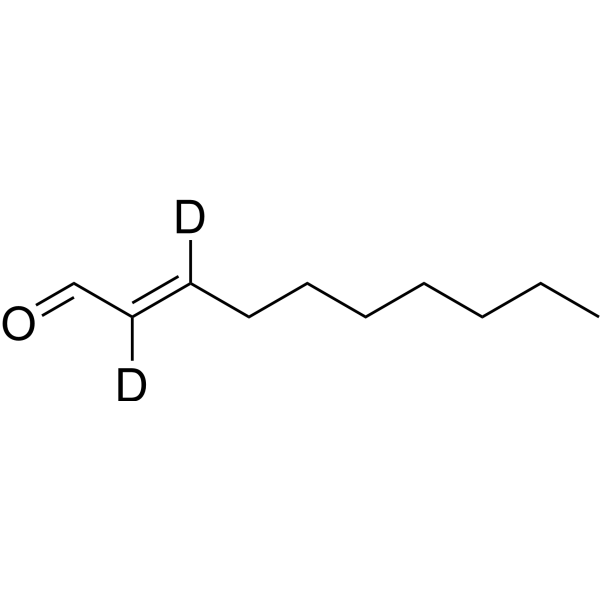
Synonyms: (E)-Dec-2-enal-d2
trans-2-Decenal-d2 ((E)-Dec-2-enal-d2) is deuterated labeled trans-2-Decenal (HY-W015551). trans-2-Decenal ((E)-Dec-2-enal) acts as a urease inhibitor and antibacterial agent against Helicobacter pylori, with an IC50 of 9.484 μg/mL against Helicobacter pylori urease. trans-2-Decenal reduces the urease activity of Helicobacter pylori, and possesses antibacterial, bactericidal, anti-biofilm and anti-migratory activities. It alters the morphology of Helicobacter pylori, induces bacterial rupture, inhibits biofilm formation, reduces the number of mature biofilms and impairs the migratory capacity of Helicobacter pylori. trans-2-Decenal disrupts the cell wall integrity of Phytophthora capsici, damages membrane integrity and permeability, triggers intracellular reactive oxygen species (ROS) accumulation, decreases glutathione levels and disrupts the mitochondrial membrane potential of Phytophthora capsici. trans-2-Decenal is applicable to studies related to Helicobacter pylori and plant diseases induced by and Phytophthora capsici .
loading...
    loading...
Cat. No.: HY-100977S
CAS No.: 3006902-95-7
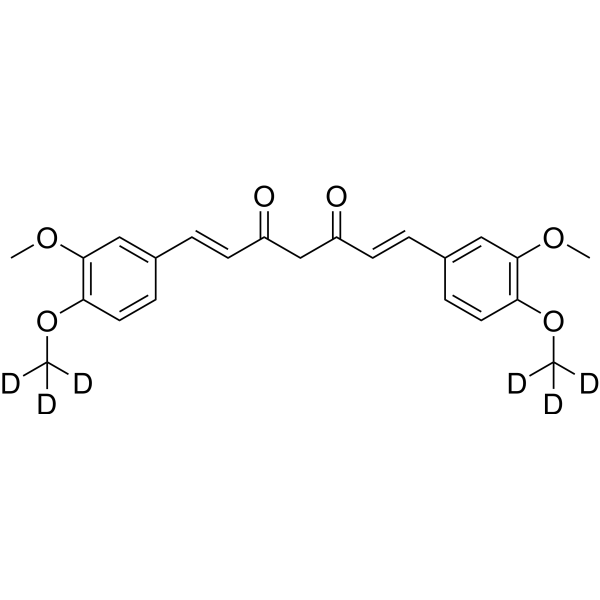
Synonyms: DiMC-d6; CHC 004-d6; Di-O-methylcurcumin-d6
Dimethoxycurcumin-d6 (DiMC-d6; CHC 004-d6; Di-O-methylcurcumin-d6) is the deuterated-labeled Dimethoxycurcumin (HY-100977). Dimethoxycurcumin (DiMC) is a curcuminoid compound found in Curcuma longa. Dimethoxycurcumin is also an orally active thioredoxin reductase inhibitor (IC50 = 5.4 μM) and androgen receptor antagonist. Dimethoxycurcumin inhibits thioredoxin reductase, leading to oxidized thioredoxin accumulation, ROS production, DNA damage, glutathione depletion, mitochondrial membrane potential decrease, ATP depletion, S phase arrest, and apoptosis. Dimethoxycurcumin inhibits NF-κB, NADPH oxidase subunits, ATP synthase subunits, CDK4, cyclin-D1, FASN, ACC, and the IRS2-PI3K-Akt pathway, while activating AMPK, ERK, and JNK. Dimethoxycurcumin can be used for research on cancer, arsenic-induced hepatotoxicity, and tuberculosis .
loading...
    loading...
Cat. No.: HY-178196
Target:  

Fungal MMP Apoptosis

Domaines de recherche:  

Infection

SDH-IN-32 is a succinate dehydrogenase (SDH) inhibitor with an IC50 of 2.74 μM. SDH-IN-32 exhibits excellent antifungal activity. SDH-IN-32 can destroy the cell membrane structure and increase the permeability of the cell membrane. SDH-IN-32 can decrease the mitochondrial membrane potential (MMP), thereby inducing cell apoptosis and inhibiting the normal growth of mycelia. SDH-IN-32 can be used for the research of infection .
loading...
    loading...
Cat. No.: HY-107855S2
CAS No.: 53771-22-5
Synonyms: (±)-Mevalonolactone-13C; Mevalolactone-13C
DL-Mevalonolactone- 13C ((±)-Mevalonolactone- 13C) is the 13C-labeled DL-Mevalonolactone (HY-107855). DL-Mevalonolactone ((±)-Mevalonolactone;Mevalolactone) is the δ-lactone form of mevalonic acid, a precursor in the mevalonate pathway. DL-Mevalonolactone is orally active against HMGCR mutation and statin caused myopathy. DL-Mevalonolactone induces inflammation and oxidative stress response with decreased mitochondrial membrane potential (MMP) and induces mitochondrial swelling.
loading...
    loading...
Cat. No.: HY-107855S4
CAS No.: 287111-36-8
Synonyms: (±)-Mevalonolactone-13C2; Mevalolactone-13C2
DL-Mevalonolactone- 13C2 ((±)-Mevalonolactone- 13C2) is the 13C-labeled DL-Mevalonolactone (HY-107855). DL-Mevalonolactone ((±)-Mevalonolactone;Mevalolactone) is the δ-lactone form of mevalonic acid, a precursor in the mevalonate pathway. DL-Mevalonolactone is orally active against HMGCR mutation and statin caused myopathy . DL-Mevalonolactone induces inflammation and oxidative stress response with decreased mitochondrial membrane potential (MMP) and induces mitochondrial swelling [2][4].
loading...
    loading...
Cat. No.: HY-W752587
CAS No.: 349553-98-6
Synonyms: (±)-Mevalonolactone-d4; Mevalolactone-d4
DL-Mevalonolactone-d4 ( (±)-Mevalonolactone-d4) is the deuterium labeled DL-Mevalonolactone (HY-107855). DL-Mevalonolactone ((±)-Mevalonolactone;Mevalolactone) is the δ-lactone form of mevalonic acid, a precursor in the mevalonate pathway. DL-Mevalonolactone is orally active against HMGCR mutation and statin caused myopathy . DL-Mevalonolactone induces inflammation and oxidative stress response with decreased mitochondrial membrane potential (MMP) and induces mitochondrial swelling .
loading...
    loading...
Cat. No.: HY-131453
CAS No.: 1352002-58-4
Mitochondrial respiration-IN-1 is a mitochondrial respiratory inhibitor. Mitochondrial respiration-IN-1 reduces platelet aggregation, adhesion, and platelet-induced coagulation responses. Mitochondrial respiration-IN-1 induces adaptive glycolysis, decreases mitochondrial membrane potential, selectively reduces ATP production derived from oxidative phosphorylation, and exerts bidirectional regulatory effects on cell proliferation. Mitochondrial respiration-IN-1 activates UPRmt and upregulates the expression of SDHA-1 and MT-CO1. Mitochondrial respiration-IN-1 restores metabolic homeostasis in type 2 diabetic mice. Mitochondrial respiration-IN-1 can be used to investigate diseases mediated by inappropriate platelet activation/aggregation and type 2 diabetes .
loading...
    loading...
Cat. No.: HY-182295
CAS No.: 82451-20-5
Negundoside is an iridoid glycoside compound. Negundoside exhibits hepatoprotective effects, reduces ROS, lipid peroxidation and intracellular calcium ion levels, and prevents the decrease of mitochondrial membrane potential (MMP) and apoptosis (apoptosis). Negundoside has neuroprotective effects, improves behavioral deficits, alleviates oxidative damage, and ameliorates cerebral infarction. Negundoside also possesses antibacterial and antiparasitic activities .
loading...
    loading...
Cat. No.: HY-189247
Target:  

Apoptosis NF-κB VEGFR

Domaines de recherche:  

Cancer

PRDX3-IN-1 is an orally active antagonist targeting mitochondrial PRDX3 (Kd=0.514 μM), where PRDX3 is a marker of ferroptosis. PRDX3-IN-1 causes PRDX3 inactivation and disrupts mitochondrial redox homeostasis, inducing apoptosis, ROS accumulation, and a decrease in mitochondrial membrane potential. PRDX3-IN-1 inhibits cell migration and invasion, and downregulates NF-κB and VEGF signaling pathways. PRDX3-IN-1 can be used for research on non-small cell lung cancer .
loading...
    loading...
Cat. No.: HY-187115
CAS No.: 20762-32-7
GGW is a tripeptide with neuroprotective activity. GGW blocks the mitochondria-mediated apoptosis pathway, reverses glutamate-induced upregulation of the pro-apoptotic protein Bax and downregulation of the anti-apoptotic protein Bcl-2. GGW reduces ROS production, reverses the depletion of SOD and Glutathione Peroxidase, decreases intracellular calcium concentration, and reverses the collapse of mitochondrial membrane potential. GGW can be used in studies related to memory impairment induced by sleep deprivation .
loading...
    loading...
Cat. No.: HY-180827
Target:  

VEGFR Apoptosis

Domaines de recherche:  

Cancer

VEGFR-2-IN-79 (Compound 17) is a VEGFR-2 inhibitor with an IC50 of 2.32 μM. VEGFR-2-IN-79 exhibits potent and broad-spectrum cytotoxicity and can induce apoptosis in MCF-7 cells. VEGFR-2-IN-79 does not cause a significant decrease in the mitochondrial membrane potential of MCF-7 cells. VEGFR-2-IN-79 can be used for research on breast cancer .
loading...
    loading...
Cat. No.: HY-N21727
CAS No.: 1094030-07-5
3-Hydroxyhericenone F is a neuroprotective agent. Hydroxyhericenone F protects cells against NaN3-induced toxicity, ultrastructural changes, and alterations in mitochondrial respiratory chain complexes. 3-Hydroxyhericenone F decreases intracellular ROS and calcium levels, increases mitochondrial membrane potential and ATP levels, attenuates NaN3 -induced changes in apoptosis-related proteins, and protects neuronal cells from endoplasmic reticulum stress-dependent cell death. 3-Hydroxyhericenone F can be used in research related to cancer, Alzheimer's disease, and neurodegenerative diseases .
loading...
    loading...
Cat. No.: HY-183312
Antitumor agent-217 is a dual mitochondria-targeted anticancer agent. Antitumor agent-217 exhibits potent and selective antiproliferative activity against bladder cancer cell line J82 (IC50 = 6.3 μM), and inhibits colony formation and migration of J82 cells. Antitumor agent-217 accumulates in mitochondria, alters mitochondrial morphology, reduces ATP production, increases ROS generation and decreases mitochondrial membrane potential. Antitumor agent-217 induces apoptosis (Apoptosis) and ferroptosis (Ferroptosis) in bladder cancer cells. Antitumor agent-217 can be used for the research of bladder cancer .
loading...
    loading...

