



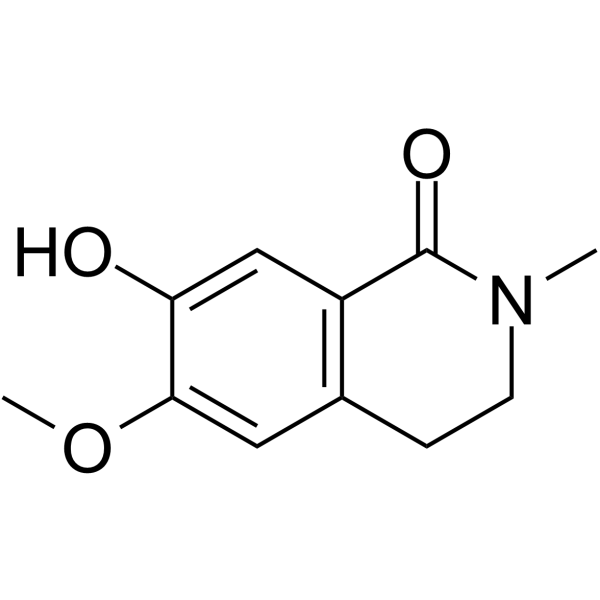
Thalifoline

Based on 1 Customer Validation
Thalifoline is an isoquinoline alkaloid. Thalifoline exerts cytotoxic effects on cancer cells. Thalifoline inhibits the growth of Fusarium oxysporum f. sp. lycopersici. Thalifoline can be used in research related to lung adenocarcinoma, colon cancer, oral epidermoid carcinoma, and fungal infections.
Nos produits utilisent uniquement pour la recherche. Nous ne vendons pas aux patients.
- Pureté : 99.19%
- CAS No.: 21796-15-6
- Formule: C11H13NO3
- Masse moléculaire:207.23
-
Stockage:
-20°C, protect from light
* In solvent : -80°C, 6 months; -20°C, 1 month (protect from light)

To place orders, for customer services and technical support, please contact: MedChemExpress USA
Tel: 609-228-6898 E-mail: [email protected] [email protected]


-
 Activité biologique
-
Chemical Information
- Protocole
- Pureté et documentation
- Références
-
 Help & FAQs




Activité biologique
Description
In Vitro
Thalifoline (3-6 days) shows no cytotoxic activity against P-388 cells in vitro (ED50 >50 μg/mL), but exhibits significant cytotoxic activity against KB16 (ED50 = 0.885 μg/mL), A549 (ED50 = 1.481 μg/mL) and HT-29 (ED50 = 1.745 μg/mL) cell lines[1].
Thalifoline (100 μg) inhibits the growth of Fusarium oxysporum f. sp. lycopersici[2].
MedChemExpress (MCE) has not independently confirmed the accuracy of these methods. They are for reference only. Further protocols information, click here.


Chemical Information
-
CAS No. 21796-15-6
-
Appearance Solid
-
Masse moléculaire 207.23
-
Formule C11H13NO3
-
Color Light yellow to yellow
-
SMILES
O=C1N(C)CCC2=C1C=C(O)C(OC)=C2
-
Structure Classification
-
Initial Source
-
Livraison
Room temperature in continental US; may vary elsewhere.
-
Stockage
-20°C, protect from light
* In solvent : -80°C, 6 months; -20°C, 1 month (protect from light)

Protocole
-
Cell Viability Determination by MTT Colorimetric Assay
The following protocol uses the MTT colorimetric assay as a classic literature-established method for assessing cell viability/metabolic activity in cultured mammalian cells. MTT[3-(4,5-dimethylthiazol-2-yl)-2,5-diphenyltetrazolium bromide] is reduced by metabolically active cells to a colored formazan product; the amount of formazan is quantified spectrophotometrically and provides an indirect measure of metabolically active viable cells. Importantly, MTT reduction reflects cellular oxidoreductase/metabolic activity rather than an absolute direct count of living cells, so changes in cellular metabolism can alter the signal independently of cell number.


Pureté et documentation
-
Fiche technique (272 KB)
-
SDS (251 KB)
- English - EN (251 KB)
- Français - FR (251 KB)
- Deutsch - DE (251 KB)
- Norwegian - NO (251 KB)
- Español - ES (251 KB)
- Swedish - SV (251 KB)
- Italian - IT (251 KB)
- Korean - KR (251 KB)
- Portuguese - PT (251 KB)
-
Instruction de manipulation (2659 KB)
Références
[1]. Chen IS, et al. New aporphine alkaloids and cytotoxic constituents of Hernandia nymphaeifolia. Planta Med. 1997;63(2):154-157. [Content Brief]
[3]. Nan ZD, et al. Nitrogenous chemical constituents and their antitumor activities evaluation in vitro from the aerial parts of Corydalis impatiens (pall.) Fisch. Nat Prod Res. 2025 Mar;39(5):1027-1038. [Content Brief]

Calculators
Concentration (start) × Volume (start) = Concentration (final) × Volume (final)


Thalifoline Related Classifications
HY-N8420 Related Classifications
 Powered by Bioz