



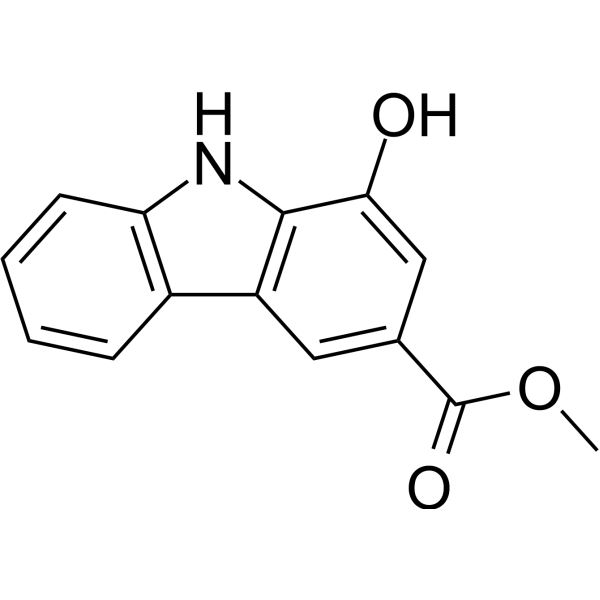
Clausine E
Clausine E, is a alkaloid which can be isolated from Clausena excavata, is a inhibitor of fat mass and obesity-associated protein (FTO) demethylase. Clausine E shows inhibitory activities against proliferation of synoviocytes and cancer cells.
For research use only. We do not sell to patients.
- CAS No.: 182261-83-2
- Formula: C14H11NO3
- Molecular Weight:241.24
-
Storage:
Please store the product under the recommended conditions in the Certificate of Analysis.

To place orders, for customer services and technical support, please contact: MedChemExpress USA
Tel: 609-228-6898 E-mail: [email protected] [email protected]


-
 Biological Activity
-
Chemical Information
- Protocols
- Purity & Documentation
- References
-
 Help & FAQs




Biological Activity
Description
Cellular Effect
|
Cell Line

|
Type | Value | Description | References |
|---|---|---|---|---|
| CNE-2 | IC50 |
16.9 μM
Compound: 3
|
Growth inhibition human CNE2 cells after 48 hrs by WST-8 based CCK8 assay
Growth inhibition human CNE2 cells after 48 hrs by WST-8 based CCK8 assay
|
[PMID: 22093759] |
| HCT-116 | IC50 |
1.9 μM
Compound: clausine E
|
Antiproliferative activity against human HCT116 cells after 72 hrs
Antiproliferative activity against human HCT116 cells after 72 hrs
|
[PMID: 17548198] |
| HeLa | IC50 |
13.3 μM
Compound: 3
|
Growth inhibition human HeLa cells after 48 hrs by WST-8 based CCK8 assay
Growth inhibition human HeLa cells after 48 hrs by WST-8 based CCK8 assay
|
[PMID: 22093759] |
| HepG2 | IC50 |
15.8 μM
Compound: 3
|
Growth inhibition of human HepG2 cells after 48 hrs by WST-8 based CCK8 assay
Growth inhibition of human HepG2 cells after 48 hrs by WST-8 based CCK8 assay
|
[PMID: 22093759] |
| KB | IC50 |
107.56 μM
Compound: 9
|
Cytotoxicity against human KB cells by resazurin microplate assay
Cytotoxicity against human KB cells by resazurin microplate assay
|
[PMID: 21302964] |
| L02 | IC50 |
>160 μM
Compound: 3
|
Cytotoxicity human L02 cells after 48 hrs by WST-8 based CCK8 assay
Cytotoxicity human L02 cells after 48 hrs by WST-8 based CCK8 assay
|
[PMID: 22093759] |
| MCF7 | IC50 |
0.6 μM
Compound: clausine E
|
Antiproliferative activity against human MCF7 cells after 72 hrs
Antiproliferative activity against human MCF7 cells after 72 hrs
|
[PMID: 17548198] |
| MDA-MB-231 | IC50 |
37.1 μM
Compound: 3
|
Growth inhibition human MDA-MB-231 cells after 48 hrs by WST-8 based CCK8 assay
Growth inhibition human MDA-MB-231 cells after 48 hrs by WST-8 based CCK8 assay
|
[PMID: 22093759] |
| MES-SA | IC50 |
35 μM
Compound: clausine E
|
Antiproliferative activity against human Mes-sa cells after 72 hrs
Antiproliferative activity against human Mes-sa cells after 72 hrs
|
[PMID: 17548198] |
| NCI-H187 | IC50 |
94.59 μM
Compound: 9
|
Cytotoxicity against human NCI-H187 by resazurin microplate assay
Cytotoxicity against human NCI-H187 by resazurin microplate assay
|
[PMID: 21302964] |
| SW48 | IC50 |
21 μM
Compound: clausine E
|
Antiproliferative activity against human SW48 cells after 72 hrs
Antiproliferative activity against human SW48 cells after 72 hrs
|
[PMID: 17548198] |
| SW480 | IC50 |
4.8 μM
Compound: clausine E
|
Antiproliferative activity against human SW480 cells after 72 hrs
Antiproliferative activity against human SW480 cells after 72 hrs
|
[PMID: 17548198] |
| T98G | IC50 |
71.6 μM
Compound: 3
|
Growth inhibition human T98G cells after 48 hrs by WST-8 based CCK8 assay
Growth inhibition human T98G cells after 48 hrs by WST-8 based CCK8 assay
|
[PMID: 22093759] |
| Vero | IC50 |
152.05 μM
Compound: 9
|
Cytotoxicity against african green monkey Vero cells by green fluorescent protein microplate assay
Cytotoxicity against african green monkey Vero cells by green fluorescent protein microplate assay
|
[PMID: 21302964] |


Chemical Information
-
CAS No. 182261-83-2
-
Molecular Weight 241.24
-
Formula C14H11NO3
-
SMILES
O=C(C1=CC2=C(NC3=C2C=CC=C3)C(O)=C1)OC
-
Synonyms
Clauszoline I
-
Structure Classification
-
Shipping
Room temperature in continental US; may vary elsewhere.
-
Storage
Please store the product under the recommended conditions in the Certificate of Analysis.


Purity & Documentation
References
[1]. Wang Y, Li J, Han X, et al. Identification of Clausine E as an inhibitor of fat mass and obesity-associated protein (FTO) demethylase activity. J Mol Recognit. 2019;32(10):e2800. [Content Brief]
[2]. Guo JM, Yu XM, Jiang B, et al. Zhongguo Zhong Yao Za Zhi. 2021;46(17):4438-4445. [Content Brief]
[3]. Liger F, Popowycz F, Besson T, Picot L, Galmarini CM, Joseph B. Synthesis and antiproliferative activity of clausine E, mukonine, and koenoline bioisosteres. Bioorg Med Chem. 2007;15(16):5615-5619. [Content Brief]

Calculators
Concentration (start) × Volume (start) = Concentration (final) × Volume (final)


Clausine E Related Classifications
HY-N10340 Related Classifications
 Powered by Bioz