



Clindamycin (Standard)
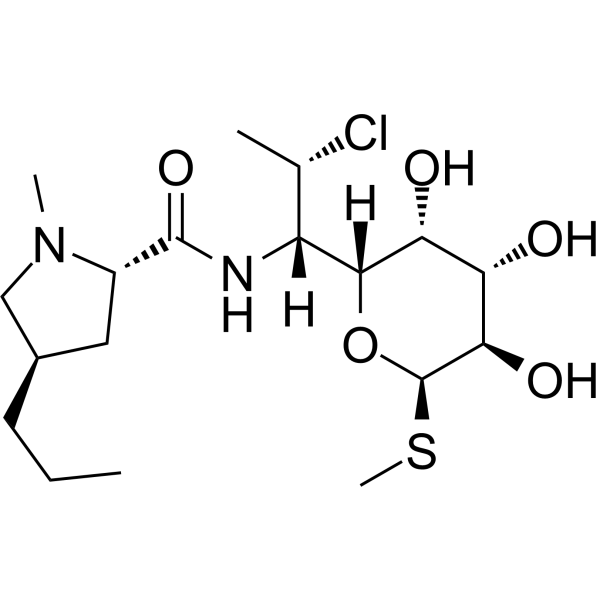
Clindamycin (Standard) is the analytical standard of Clindamycin. This product is intended for research and analytical applications. Clindamycin is an orally active and broad-spectrum bacteriostatic lincosamide antibiotic. Clindamycin can inhibit bacterial protein synthesis, possessing the ability to suppress the expression of virulence factors in Staphylococcus aureus at sub-inhibitory concentrations (sub-MICs). Clindamycin resistance results from enzymatic methylation of the antibiotic binding site in the 50S ribosomal subunit (23S rRNA). Clindamycin decreases the production of Panton-Valentine leucocidin (PVL), toxic-shock-staphylococcal toxin (TSST-1) or alpha-haemolysin (Hla). Clindamycin also can be used for researching malaria.
Nur für Forschungszwecke. Wir verkaufen nicht an Patienten.
- Reinheit : 98%
- CAS. Nr.: 18323-44-9
- Formel: C18H33ClN2O5S
- Molecular Weight:424.98
-
Speicherung:
Please store the product under the recommended conditions in the Certificate of Analysis.


To place orders, for customer services and technical support, please contact: MedChemExpress USA
Tel: 609-228-6898 E-mail: [email protected] [email protected]


-
 Product Information
-
Chemical Information
- Reinheit & Dokumentation
-
 Help & FAQs


-
HY-B1455
ClindamycinLincosamide Antibiotic -
HY-B0322
SulfamethoxazoleSulfonamide Antibiotic -
HY-B1454
Clindamycin palmitate hydrochlorideBacterial Inhibitor -

HY-B0322R
Sulfamethoxazole (Standard)Standard of Sulfamethoxazole -
HY-15662
Tulathromycin AMacrolide Antibiotic -

HY-B0322B
Sulfamethoxazole 1000 µg/mL in methanolSulfonamide Antibiotic -

HY-B1454R
Clindamycin palmitate hydrochloride (Standard)Bacterial Inhibitor -

HY-15662R
Tulathromycin A (Standard)Macrolide Antibiotic


Product Information
Information
Anwendung
The compound is the grade of analytical standard, which is the reference standard supplied assay. It is commonly used in qualitative, quantitative and methodological research experiments in HPLC, GC and MS.


Chemical Information
-
CAS. Nr. 18323-44-9
-
Molecular Weight 424.98
-
Formel C18H33ClN2O5S
-
SMILES
CN(C[C@H](CCC)C1)[C@@H]1C(N[C@@]([C@@H](Cl)C)([H])[C@@]2([H])O[C@H](SC)[C@H](O)[C@@H](O)[C@H]2O)=O
-
Versand
Room temperature in continental US; may vary elsewhere.
-
Speicherung
Please store the product under the recommended conditions in the Certificate of Analysis.


Reinheit & Dokumentation
Verweise
[1]. Hodille E, et al. Clindamycin suppresses virulence expression in inducible clindamycin-resistant Staphylococcus aureus strains. Ann Clin Microbiol Antimicrob. 2018 Oct 20;17(1):38. [Content Brief]
[2]. Kremsner PG. Clindamycin in malaria treatment. J Antimicrob Chemother. 1990 Jan;25(1):9-14. [Content Brief]
[3]. Kishi K, et al. Clindamycin suppresses endotoxin released by ceftazidime-treated Escherichia coli O55:B5 and subsequent production of tumor necrosis factor alpha and interleukin-1 beta. Antimicrob Agents Chemother. 1999 Mar;43(3):616-22. [Content Brief]
[4]. Veringa EM, et al. Clindamycin at subinhibitory concentrations enhances antibody- and complement-dependent phagocytosis by human polymorphonuclear leukocytes of Staphylococcus aureus. Chemotherapy. 1987;33(4):243-9. [Content Brief]
[5]. Naal FD, et al. The effects of clindamycin on human osteoblasts in vitro. Arch Orthop Trauma Surg. 2008 Mar;128(3):317-23. [Content Brief]
[6]. Yang SH, Lee MG. Dose-independent pharmacokinetics of clindamycin after intravenous and oral administration to rats: contribution of gastric first-pass effect to low bioavailability. Int J Pharm. 2007 Mar 6;332(1-2):17-23. [Content Brief]
[7]. Hirata N, et al. Pretreatment of mice with clindamycin improves survival of endotoxic shock by modulating the release of inflammatory cytokines. Antimicrob Agents Chemother. 2001 Sep;45(9):2638-42. [Content Brief]
[8]. Faggion PI, et al. Is the penetration of clindamycin into the masseter muscle really enough to treat odontogenic infections? Clin Oral Investig. 2021 May;25(5):3257-3266. [Content Brief]

Calculators
Konzentration (Stammlösung) × Volumen (Stammlösung) = Konzentration (Ziellösung) × Volumen (Ziellösung)


Clindamycin (Standard) Related Classifications
HY-B1455R Related Classifications
 Powered by Bioz