



D-Glucuronic acid (Standard)

Based on 1 Customer Validation
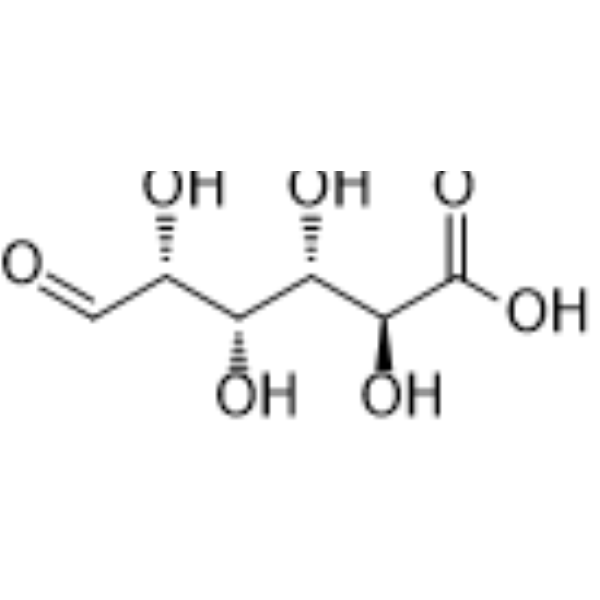
D-Glucuronic acid (Standard) is the analytical standard of D-Glucuronic acid. This product is intended for research and analytical applications. D-Glucuronic acid is a major component of many anti-inflammatory proteoglycans, which can promote embryonic development and inhibit cell aggregation. After being metabolized into ethyl glucuronide (HY-113093), D-Glucuronic acid activates Toll-like receptor 4 (TLR4), causing pain. D-Glucuronic acid and its derivative glucurono-lactone can serve as liver detoxifiers for human health prevention, and its derivatives also possess anti-tumor activity.
For research use only. We do not sell to patients.
- Purity : 99.93%
- CAS No.: 6556-12-3
- Formula: C6H10O7
- Molecular Weight:194.14
-
Storage:
Please store the product under the recommended conditions in the Certificate of Analysis.


To place orders, for customer services and technical support, please contact: MedChemExpress USA
Tel: 609-228-6898 E-mail: [email protected] [email protected]


-
 Product Information
-
Chemical Information
- Purity & Documentation
-
 Help & FAQs


-

HY-N1420AR
Rhamnose monohydrate (Standard)Monosaccharide -
HY-N6612
D-Glucuronic acidEndogenous Metabolite -
HY-N0210
D-GalactoseEndogenous Metabolite -

HY-W015611R
L-(+)-Arabinose (Standard) -
HY-W010042
L-GlucoseD-glucose Stereoisomer -
HY-N0379
D-MannoseEndogenous Metabolite -

HY-N0210R
D-Galactose (Standard)Endogenous Metabolite -
HY-N7092
D-FructoseEndogenous Metabolite -

HY-N0379R
D-Mannose (Standard)Endogenous Metabolite -
HY-N0537
XyloseEndogenous Metabolite -

HY-N7092R
D-Fructose (Standard)Endogenous Metabolite -
HY-N1420A
Rhamnose monohydrateMonosaccharide


Product Information
Information
Application
The compound is the grade of analytical standard, which is the reference standard supplied assay. It is commonly used in qualitative, quantitative and methodological research experiments in HPLC, GC and MS.


Chemical Information
-
CAS No. 6556-12-3
-
Appearance Solid
-
Molecular Weight 194.14
-
Formula C6H10O7
-
Color White to off-white
-
SMILES
O=C[C@@H]([C@H]([C@@H]([C@@H](C(O)=O)O)O)O)O
-
Structure Classification
-
Initial Source
-
Shipping
Room temperature in continental US; may vary elsewhere.
-
Storage
Please store the product under the recommended conditions in the Certificate of Analysis.


Purity & Documentation
-
SDS (393 KB)
- English - EN (393 KB)
- Français - FR (393 KB)
- Deutsch - DE (393 KB)
- Norwegian - NO (393 KB)
- Español - ES (393 KB)
- Swedish - SV (393 KB)
- Italian - IT (393 KB)
- Korean - KR (393 KB)
- Portuguese - PT (393 KB)
-
Handling Instructions (2659 KB)
References
[1]. Teng F, et al. Production of d-glucuronic acid from myo-inositol using Escherichia coli whole-cell biocatalyst overexpressing a novel myo-inositol oxygenase from Thermothelomyces thermophile. Enzyme Microb Technol. 2019 Aug;127:70-74. [Content Brief]
[2]. el-Nezhawy AO, et al. Design, synthesis and antitumor activity of novel D-glucuronic acid derivatives. Med Chem. 2011 Nov;7(6):624-38. [Content Brief]
[3]. Lee J, et al. Effect of D-Glucuronic Acid and N-acetyl-D-Glucosamine Treatment during In Vitro Maturation on Embryonic Development after Parthenogenesis and Somatic Cell Nuclear Transfer in Pigs. Animals (Basel). 2021 Apr 6;11(4):1034. [Content Brief]
[4]. Müller WE, et al. Purification and characterization of a species-specific aggregation factor in sponges. Exp Cell Res. 1973 Jul;80(1):95-104. [Content Brief]
[5]. Vaith P, et al. On the role of D-glucuronic acid in the aggregation of cells from the marine sponge Geodia cydonium. Dev Comp Immunol. 1979 Spring;3(2):259-75. [Content Brief]
[6]. Lewis SS, et al. Glucuronic acid and the ethanol metabolite ethyl-glucuronide cause toll-like receptor 4 activation and enhanced pain. Brain Behav Immun. 2013 May;30:24-32. [Content Brief]

Calculators
Concentration (start) × Volume (start) = Concentration (final) × Volume (final)


D-Glucuronic acid (Standard) Related Classifications
HY-N6612R Related Classifications
 Powered by Bioz