



D-Lysine monohydrochloride

Based on 1 Customer Validation
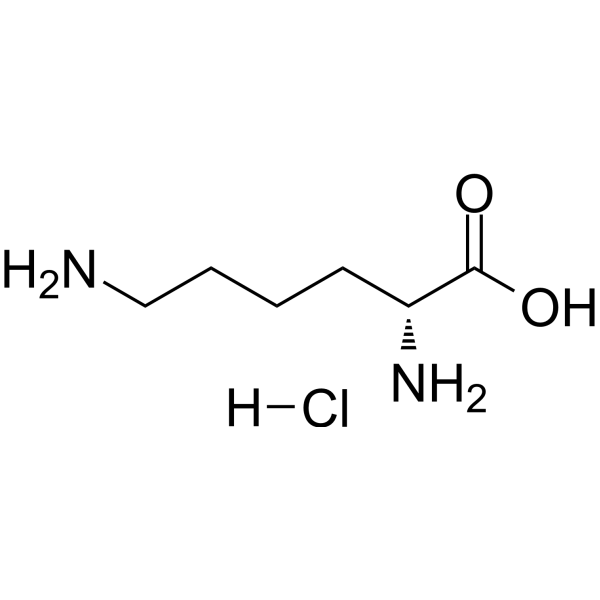
D-Lysine monohydrochloride is the D-enantiomer of L-Lysine (HY-N0469). D-Lysine monohydrochloride is metabolically inert and not utilized for protein synthesis by mammalian ribosomes. D-Lysine monohydrochloride blocks renal uptake of 111In/90Y-Octreotide (HY-P0036)-based probes without inhibiting uptake by tumor/receptor tissues, and thus acts as a renoprotective agent in diagnostic imaging and peptide receptor radionuclide therapy (PRRT). D-Lysine monohydrochloride specifically inhibits the early steps of non-enzymatic glycation by competing with glucose via its free amino group, theoretically, it can serve as a glycation competitor that "does not interfere with protein synthesis" under chronic hyperglycemia in diabetes. D-Lysine monohydrochloride can be used in research related to cancer and diabetes.
For research use only. We do not sell to patients.
- Purity : 99.72%
- CAS No.: 7274-88-6
- Formula: C6H15ClN2O2
- Molecular Weight:182.65
-
Storage:
4°C, sealed storage, away from moisture
* In solvent : -80°C, 6 months; -20°C, 1 month (sealed storage, away from moisture)

To place orders, for customer services and technical support, please contact: MedChemExpress USA
Tel: 609-228-6898 E-mail: [email protected] [email protected]


-
 Biological Activity
-
Chemical Information
-
Solvent & Solubility
- Protocols
- Purity & Documentation
- References
-
 Help & FAQs





Biological Activity
Description
IC50 & Target
|
Human Endogenous Metabolite |
In Vitro
D-Lysine (0.25-4.0 mM; 10-20 days) monohydrochloride significantly inhibits the non-enzymatic binding of glucose to human albumin, IgG, collagen, and isolated human glomerular basement membrane in vitro. Its inhibitory effect is directly correlated with the concentration of D-Lysine and is enhanced with increasing glucose concentrations (statistically significant under 10 and 20 mM glucose conditions)[2].
D-Lysine (0.25-2.0 mM; 10 days) monohydrochloride reduces the formation of ketamines in human albumin (50 g/L) co-incubated with 10 mM glucose in a dose-dependent manner in vitro, and a linear correlation exists between the concentration of D-Lysine and the reduction in fructosamine levels[2].
D-Lysine (0.25-2.0 mM; 10 days) monohydrochloride inhibits non-enzymatic binding of glucose to human albumin at physiological concentration (50 g/L) in vitro. In undiluted samples, inhibitory effects are detectable at 0.25 mM, while in diluted samples, detection requires a concentration of 0.5 mM[2].
MedChemExpress (MCE) has not independently confirmed the accuracy of these methods. They are for reference only. Further protocols information, click here.
In Vivo
D-Lysine (400 mg/kg; i.v.; single co-injection) monohydrochloride reduces renal uptake of 90Y-DOTATOC (HY-106033) by 65% without altering radiopharmaceutical distribution in blood or somatostatin receptor-positive organs[1].
MedChemExpress (MCE) has not independently confirmed the accuracy of these methods. They are for reference only.
-
Animal Model:Wistar rats (male, 200-250 g)[1]
-
Dosage:400 mg/kg (i.v. co-injection); 800 mg/kg (i.v. co-injection); 400 mg/kg (p.o. 15 min prior); 400 mg/kg (p.o. 30 min prior)
-
Administration:i.v.; single co-injection; p.o.; single injection 15 minutes prior; p.o.; single injection 30 minutes prior
-
Result:Reduced renal uptake of 111In-DTPA-Octreotide by more than 50% at 1, 4, and 24 hours post-injection (400 mg/kg i.v.).
Reduced renal uptake of 111In-DTPA-Octreotide by more than 50% at 1, 4, and 24 hours post-injection (800 mg/kg i.v.).
Reduced renal uptake of 111In-DTPA-Octreotide by 20% (400 mg/kg p.o., 15 minutes prior).
Reduced renal uptake of 111In-DTPA-Octreotide by 30% (400 mg/kg p.o., 30 minutes prior).
Had no significant effect on 111In-DTPA-Octreotide clearance from blood or uptake in somatostatin receptor-positive organs (pancreas, adrenal glands).
-
Animal Model:Wistar rats (male, 200-250 g)[1]
-
Dosage:400 mg/kg
-
Administration:i.v.; single co-injection
-
Result:Reduced renal uptake of 90Y-DOTATOC to 34.8% of control values, representing a 65% reduction.
Left radioactivity levels in blood, pancreas, and adrenal glands unaffected.


Chemical Information
-
CAS No. 7274-88-6
-
Appearance Solid
-
Molecular Weight 182.65
-
Formula C6H15ClN2O2
-
Color White to off-white
-
Structure Classification
-
Initial Source
-
Shipping
Room temperature in continental US; may vary elsewhere.
-
Storage
4°C, sealed storage, away from moisture
* In solvent : -80°C, 6 months; -20°C, 1 month (sealed storage, away from moisture)


Solvent & Solubility
In Vitro:
H2O : 100 mg/mL (547.50 mM; Need ultrasonic)
Please refer to the solubility information to select the appropriate solvent. Once prepared, please aliquot and store the solution to prevent product inactivation from repeated freeze-thaw cycles.
Storage method and period of stock solution: -80°C, 6 months; -20°C, 1 month (sealed storage, away from moisture). When stored at -80°C, please use it within 6 months. When stored at -20°C, please use it within 1 month.
* Note: If you choose water as the stock solution, please dilute it to the working solution, then filter and sterilize it with a 0.22 μm filter before use.
Please refer to the solubility information to select the appropriate solvent. Once prepared, please aliquot and store the solution to prevent product inactivation from repeated freeze-thaw cycles.
Storage method and period of stock solution: -80°C, 6 months; -20°C, 1 month (sealed storage, away from moisture). When stored at -80°C, please use it within 6 months. When stored at -20°C, please use it within 1 month.
* Note: If you choose water as the stock solution, please dilute it to the working solution, then filter and sterilize it with a 0.22 μm filter before use.
Concentration (start) × Volume (start) = Concentration (final) × Volume (final)

Protocols
-
Research Protocol for Metabolic Diseases
AMP-activated protein kinase, AMPK, is a conserved cellular energy sensor that responds to reduced cellular energy status and coordinates metabolism by increasing ATP-generating catabolic pathways while suppressing ATP-consuming anabolic processes. In metabolic disease research, the AMPK pathway is experimentally relevant because it regulates hepatic lipid synthesis, fatty acid oxidation, glucose production, skeletal-muscle glucose disposal, mTORC1-linked biosynthesis, autophagy, mitochondrial homeostasis, and whole-body energy balance. The central pathway logic is that energy stress, metformin, exercise-like stimulation, or direct AMPK activators increase AMPKα Thr172 phosphorylation and downstream substrate phosphorylation, including ACC and RAPTOR. Phosphorylation of ACC suppresses lipogenesis and supports fatty acid oxidation, whereas phosphorylation of RAPTOR suppresses mTORC1 signaling and links cellular energy status to growth and protein synthesis control. The pathway is linked


Purity & Documentation
-
Data Sheet (272 KB)
-
SDS (393 KB)
- English - EN (393 KB)
- Français - FR (393 KB)
- Deutsch - DE (393 KB)
- Norwegian - NO (393 KB)
- Español - ES (393 KB)
- Swedish - SV (393 KB)
- Italian - IT (393 KB)
- Korean - KR (393 KB)
- Portuguese - PT (393 KB)
-
Handling Instructions (2659 KB)
References
[1]. Bernard BF, et al. D-lysine reduction of indium-111 octreotide and yttrium-90 octreotide renal uptake. Journal of nuclear medicine : official publication, Society of Nuclear Medicine. 1997 Dec;38(12):1929-33. [Content Brief]
[2]. Sensi M, et al. D-lysine effectively decreases the non-enzymic glycation of proteins in vitro. Clinical chemistry. 1989 Mar;35(3):384-7. [Content Brief]


Complete Stock Solution Preparation Table
Please refer to the solubility information to select the appropriate solvent. Once prepared, please aliquot and store the solution to prevent product inactivation from repeated freeze-thaw cycles.
Storage method and period of stock solution: -80°C, 6 months; -20°C, 1 month (sealed storage, away from moisture). When stored at -80°C, please use it within 6 months. When stored at -20°C, please use it within 1 month.
| Optional Solvent | Concentration Solvent Mass | 1 mg | 5 mg | 10 mg | 25 mg |
|---|---|---|---|---|---|
| H2O | 1 mM | 5.4750 mL | 27.3748 mL | 54.7495 mL | 136.8738 mL |
| 5 mM | 1.0950 mL | 5.4750 mL | 10.9499 mL | 27.3748 mL | |
| 10 mM | 0.5475 mL | 2.7375 mL | 5.4750 mL | 13.6874 mL | |
| 15 mM | 0.3650 mL | 1.8250 mL | 3.6500 mL | 9.1249 mL | |
| 20 mM | 0.2737 mL | 1.3687 mL | 2.7375 mL | 6.8437 mL | |
| 25 mM | 0.2190 mL | 1.0950 mL | 2.1900 mL | 5.4750 mL | |
| 30 mM | 0.1825 mL | 0.9125 mL | 1.8250 mL | 4.5625 mL | |
| 40 mM | 0.1369 mL | 0.6844 mL | 1.3687 mL | 3.4218 mL | |
| 50 mM | 0.1095 mL | 0.5475 mL | 1.0950 mL | 2.7375 mL | |
| 60 mM | 0.0912 mL | 0.4562 mL | 0.9125 mL | 2.2812 mL | |
| 80 mM | 0.0684 mL | 0.3422 mL | 0.6844 mL | 1.7109 mL | |
| 100 mM | 0.0547 mL | 0.2737 mL | 0.5475 mL | 1.3687 mL |
* Note: If you choose water as the stock solution, please dilute it to the working solution, then filter and sterilize it with a 0.22 μm filter before use.


D-Lysine monohydrochloride Related Classifications
HY-Y1804 Related Classifications
 Powered by Bioz
Keywords