



Dansyl hydrazine

Based on 1 Customer Validation
Dansyl hydrazine is a carbohydrate-specific fluorescent dye (Ex/Em = 340 nm/525 nm). Dansyl hydrazine undergoes a condensation reaction with aldehyde groups generated by periodate oxidation on carbohydrate-containing structures to form fluorescent hydrazone compounds. Dansyl hydrazine selectively stains polysaccharides in formalin-fixed, paraffin-embedded human post-mortem brain tissues, revealing detailed structural features. Dansyl hydrazine is applicable to research related to Alzheimer's disease, Lafora disease, and polyglucosan body disease.
Nur für Forschungszwecke. Wir verkaufen nicht an Patienten.
- Reinheit : 99.98%
- CAS. Nr.: 33008-06-9
- Formel: C12H15N3O2S
- Molecular Weight:265.34
-
Speicherung:
4°C, protect from light
* In solvent : -80°C, 6 months; -20°C, 1 month (protect from light)

To place orders, for customer services and technical support, please contact: MedChemExpress USA
Tel: 609-228-6898 E-mail: [email protected] [email protected]


-
 Biologische Aktivität
-
Chemical Information
-
Lösungsmittel & Löslichkeit
- Protokoll
- Reinheit & Dokumentation
- Verweise
-
 Help & FAQs


-
HY-W011618
N-(9-Acridinyl)maleimideFluorescent Thiol Reagent -
HY-66019
FITCFluorochrome -
HY-D0017
Dansyl chlorideFluorescent Dye -
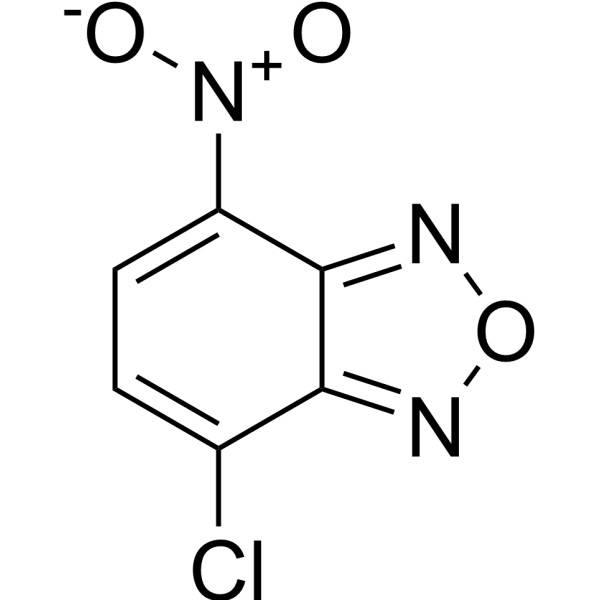
HY-D0042
NBD-ClNonfluorescent Reagent -
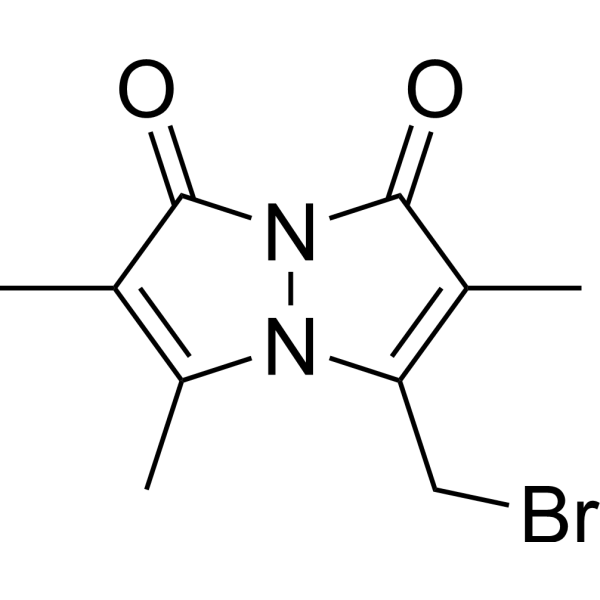
HY-100041
BromobimaneDye Reagent -
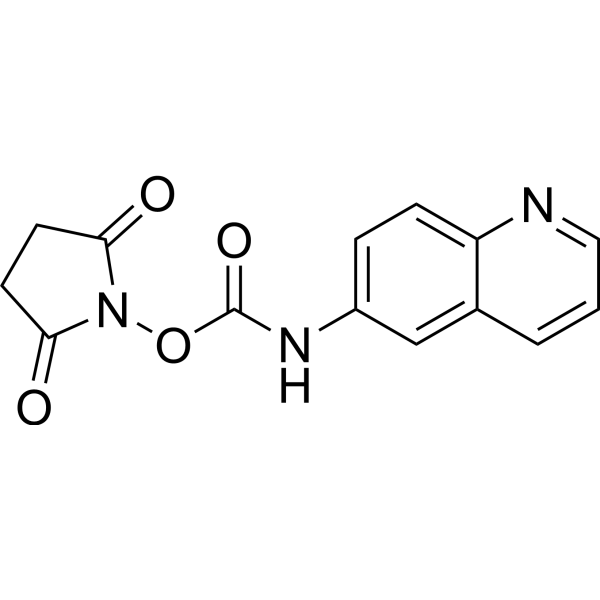
HY-117695
AQCAmino Acid Sequence Detection Reagent -
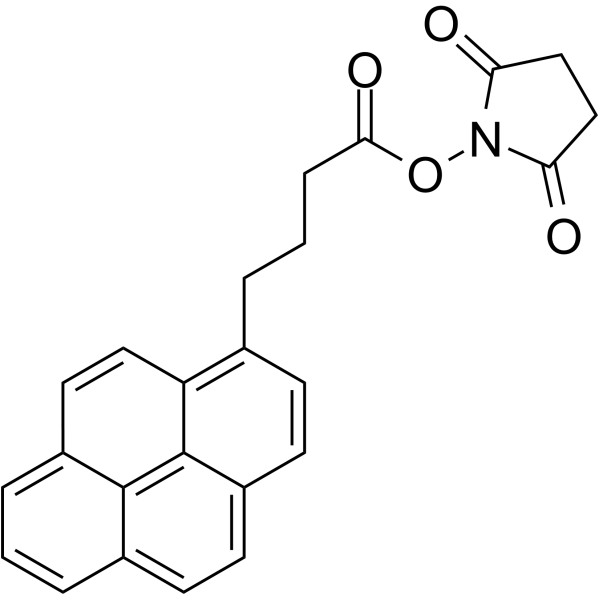
HY-W013151
1-Pyrenebutyric acid N-hydroxysuccinimide esterLinker -
HY-D0785
NBD-FAmino Acid Analysis -

HY-W012887
OxalyldihydrazideCrosslinking Agent -
HY-D0890
ABEIBiochemical Assay Reagent -

HY-DY1007
FITC (solution)Fluorochrome -
HY-W013275
MCLA hydrochloride


Biologische Aktivität
Beschreibung
In Vitro
Dansyl hydrazine (5 mg) enables sensitive, low-background fluorescent staining of polyglucosan bodies (amyloid bodies in Alzheimer's disease/aged brains, Lafora bodies in Lafora disease, and polyglucosan bodies in adult polyglucosan body disease) in formalin-fixed, paraffin-embedded human brain tissues, and reveals unique structural details of each body type[1].
Dansyl hydrazine (1%) forms highly fluorescent hydrazones with aldoses (including D-glucose), and the products can be quantitatively analyzed by thin-layer chromatography (TLC) and fluorometry[2].
Dansyl hydrazine serves as the starting material for Dz-Jul, a Zn2+ -selective fluorescent chemosensor. It enables the detection of Zn2+ in solutions and water samples, and also allows qualitative monitoring via test strips[3].
Guide (The following is our recommended protocol, which serves only as a guide and should be modified according to your specific needs).
Fluorescent Staining of Polysaccharides in Tissue Sections[1]
1. Applicable Scenarios: Specific labeling of corpora amylacea, Lafora bodies, glycogen, etc., in paraffin sections.
2. Reagent Preparation:
Periodic acid solution: 0.7% periodic acid (dissolved in 5% aqueous acetic acid).
Dansyl Hydrazine working solution: Dissolve 5 mg dansyl hydrazine in 1.67 mL absolute ethanol, then add 3.33 mL 0.1 M sodium acetate buffer (pH 5.5) and mix well (final concentration is approximately 1 mg/mL).
3. Procedure:
Deparaffinization and hydration: Deparaffinize paraffin sections with xylene, then rehydrate through a graded ethanol series (100%-95%-80%-70%) to water.
Oxidation: Immerse sections in 0.7% periodic acid solution and incubate at room temperature in the dark for 1 hour.
Washing: Rinse with distilled water 3 times, 10 minutes each time.
Labeling: Add Dansyl Hydrazine working solution to cover the tissue, and incubate at room temperature in the dark for 1 hour.
Washing: Rinse with distilled water 3 times, 10 minutes each time.
Mounting: Dehydrate through a graded ethanol series (70%-80%-95%-100%), replace the dehydrant in the tissue with an organic solvent such as xylene to render the tissue transparent, then mount the sections with a fluorescent mounting medium such as Acrymount or DPX.
4. Result Observation:
Excitation/emission: Use a BV-2A or similar filter.
Fluorescence color: Polysaccharide structures show bright yellow-green fluorescence against a black background.
MedChemExpress (MCE) has not independently confirmed the accuracy of these methods. They are for reference only.


Chemical Information
-
CAS. Nr. 33008-06-9
-
Appearance Solid
-
Molecular Weight 265.34
-
Formel C12H15N3O2S
-
Color Light yellow to brown
-
SMILES
NNS(C1=CC=CC2=C(C=CC=C21)N(C)C)(=O)=O
-
Versand
Room temperature in continental US; may vary elsewhere.
-
Speicherung
4°C, protect from light
* In solvent : -80°C, 6 months; -20°C, 1 month (protect from light)


Lösungsmittel & Löslichkeit
In Vitro:
DMSO : 100 mg/mL (376.87 mM; ultrasonic and warming and heat to 60°C; Hygroscopic DMSO has a significant impact on the solubility of product, please use newly opened DMSO)
Please refer to the solubility information to select the appropriate solvent. Once prepared, please aliquot and store the solution to prevent product inactivation from repeated freeze-thaw cycles.
Storage method and period of stock solution: -80°C, 6 months; -20°C, 1 month (protect from light). When stored at -80°C, please use it within 6 months. When stored at -20°C, please use it within 1 month.
Please refer to the solubility information to select the appropriate solvent. Once prepared, please aliquot and store the solution to prevent product inactivation from repeated freeze-thaw cycles.
Storage method and period of stock solution: -80°C, 6 months; -20°C, 1 month (protect from light). When stored at -80°C, please use it within 6 months. When stored at -20°C, please use it within 1 month.
Konzentration (Stammlösung) × Volumen (Stammlösung) = Konzentration (Ziellösung) × Volumen (Ziellösung)


Reinheit & Dokumentation
-
Data Sheet (277 KB)
-
SDS (604 KB)
- English - EN (604 KB)
- Français - FR (604 KB)
- Deutsch - DE (604 KB)
- Norwegian - NO (604 KB)
- Español - ES (604 KB)
- Swedish - SV (604 KB)
- Italian - IT (604 KB)
- Korean - KR (604 KB)
- Portuguese - PT (604 KB)
-
Handling Instructions (2659 KB)
Verweise
[1]. Sparkman DR, et al. Dansyl hydrazine labeling of polysaccharide bodies in human brain. Biotech Histochem. 1993;68(2):99-103. [Content Brief]
[2]. Avigad G, et al. Dansyl hydrazine as a fluorimetric reagent for thin-layer chromatographic analysis of reducing sugars. J Chromatogr. 1977;139(2):343-347. [Content Brief]
[3]. Ahamed AA, et al. A Julolidine Aldehyde Dansyl Hydrazine Schiff Base as Fluorescence Chemosensor for Zn2+ ions Recognition and its Application. J Fluoresc. 2025;35(6):4547-4557. [Content Brief]


Complete Stock Solution Preparation Table
Please refer to the solubility information to select the appropriate solvent. Once prepared, please aliquot and store the solution to prevent product inactivation from repeated freeze-thaw cycles.
Storage method and period of stock solution: -80°C, 6 months; -20°C, 1 month (protect from light). When stored at -80°C, please use it within 6 months. When stored at -20°C, please use it within 1 month.
| Optional Solvent | Concentration Solvent Mass | 1 mg | 5 mg | 10 mg | 25 mg |
|---|---|---|---|---|---|
| DMSO | 1 mM | 3.7687 mL | 18.8437 mL | 37.6875 mL | 94.2187 mL |
| 5 mM | 0.7537 mL | 3.7687 mL | 7.5375 mL | 18.8437 mL | |
| 10 mM | 0.3769 mL | 1.8844 mL | 3.7687 mL | 9.4219 mL | |
| 15 mM | 0.2512 mL | 1.2562 mL | 2.5125 mL | 6.2812 mL | |
| 20 mM | 0.1884 mL | 0.9422 mL | 1.8844 mL | 4.7109 mL | |
| 25 mM | 0.1507 mL | 0.7537 mL | 1.5075 mL | 3.7687 mL | |
| 30 mM | 0.1256 mL | 0.6281 mL | 1.2562 mL | 3.1406 mL | |
| 40 mM | 0.0942 mL | 0.4711 mL | 0.9422 mL | 2.3555 mL | |
| 50 mM | 0.0754 mL | 0.3769 mL | 0.7537 mL | 1.8844 mL | |
| 60 mM | 0.0628 mL | 0.3141 mL | 0.6281 mL | 1.5703 mL | |
| 80 mM | 0.0471 mL | 0.2355 mL | 0.4711 mL | 1.1777 mL | |
| 100 mM | 0.0377 mL | 0.1884 mL | 0.3769 mL | 0.9422 mL |


Dansyl hydrazine Related Classifications
HY-W009411 Related Classifications
 Powered by Bioz