



Naloxone (Standard)
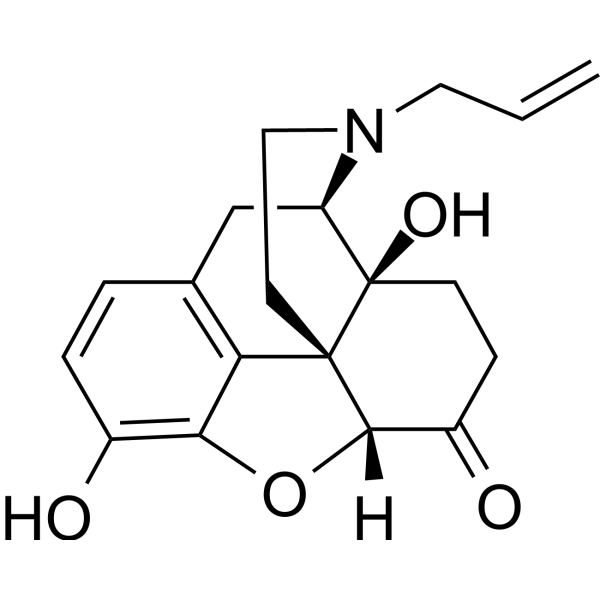
Naloxone Standard is the analytical standard of Naloxone (HY-17417A). This product is intended for research and analytical applications. Naloxone is an opioid receptor antagonist. Naloxone attenuates spinal cord stimulation‑associated anti‑hyperalgesic effects, antagonizes physiologic effects of endogenous opioid peptides linked to central nervous system injury sequelae, functions as a pressor agent to induce modest elevations in mean arterial blood pressure, exerts neuroprotective effects to improve post‑traumatic neurologic motor function, blocks opioid receptor‑mediated amnesic pathways, enhances memory consolidation, reverses Adrenocorticotropic hormone (ACTH) (HY-106373)‑ and epinephrine‑induced amnesia, and potentiates the memory‑facilitatory effects of ACTH and epinephrine.
Nur für Forschungszwecke. Wir verkaufen nicht an Patienten.
- Reinheit : 98%
- CAS. Nr.: 465-65-6
- Formel: C19H21NO4
- Molecular Weight:327.37
-
Speicherung:
Please store the product under the recommended conditions in the Certificate of Analysis.


To place orders, for customer services and technical support, please contact: MedChemExpress USA
Tel: 609-228-6898 E-mail: [email protected] [email protected]


-
 Product Information
-
Chemical Information
- Reinheit & Dokumentation
-
 Help & FAQs




Product Information
Information
Anwendung
The compound is the grade of analytical standard, which is the reference standard supplied assay. It is commonly used in qualitative, quantitative and methodological research experiments in HPLC, GC and MS.


Chemical Information
-
CAS. Nr. 465-65-6
-
Molecular Weight 327.37
-
Formel C19H21NO4
-
SMILES
OC1=C(O2)C([C@]([C@]2([H])C(CC3)=O)(CCN4CC=C)[C@]3(O)[C@H]4C5)=C5C=C1
-
Versand
Room temperature in continental US; may vary elsewhere.
-
Speicherung
Please store the product under the recommended conditions in the Certificate of Analysis.


Reinheit & Dokumentation
Verweise
[1]. Sun L, et al. Endocannabinoid activation of CB receptors contributes to long-lasting reversal of neuropathic pain by repetitive spinal cord stimulation. European journal of pain (London, England). 2017 May;21(5):804-814. [Content Brief]
[2].
McIntosh TK, et al. Beneficial effect of the nonselective opiate antagonist naloxone hydrochloride and the thyrotropin-releasing hormone (TRH) analog YM-14673 on long-term neurobehavioral outcome following experimental brain injury in the rat. J Neurotrauma. 1993 Winter;10(4):373-84.
[Content Brief]
[3]. Izquierdo I, et al. Effect of ACTH, epinephrine, beta-endorphin, naloxone, and of the combination of naloxone or beta-endorphin with ACTH or epinephrine on memory consolidation. Psychoneuroendocrinology. 1983;8(1):81-7. [Content Brief]

Calculators
Konzentration (Stammlösung) × Volumen (Stammlösung) = Konzentration (Ziellösung) × Volumen (Ziellösung)


Naloxone (Standard) Related Classifications
HY-17417AR Related Classifications
 Powered by Bioz