



NNMT-IN-3
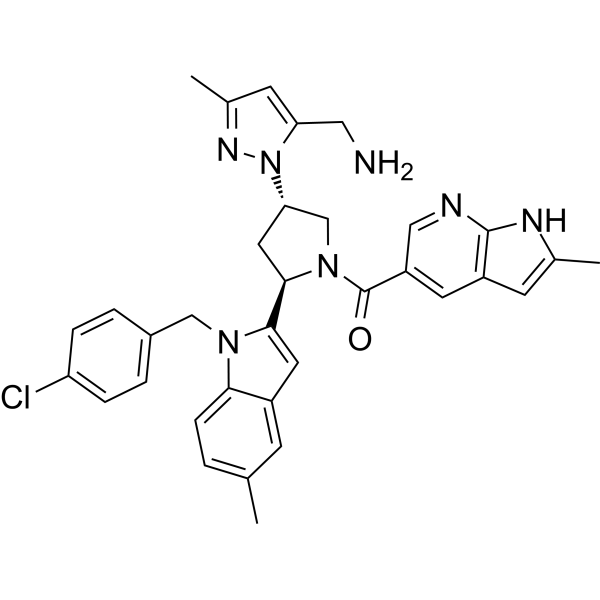
NNMT-IN-3 (Compound 14) is a potent and selective nicotinamide N-methyltransferase (NNMT) inhibitor, with IC50 values of 1.1 nM and 0.4 μM in cell-free and cell-based assays, respectively. NNMT-IN-3 can be used in the research of diseases such as obesity, type 2 diabetes and cancer.
For research use only. We do not sell to patients.
- CAS No.: 3031493-74-7
- Formula: C34H34ClN7O
- Molecular Weight:592.13
-
Storage:Powder -20°C, 3 years , 4°C, 2 years ; In solvent -80°C, 6 months , -20°C, 1 month

To place orders, for customer services and technical support, please contact: MedChemExpress USA
Tel: 609-228-6898 E-mail: [email protected] [email protected]


-
 Biological Activity
-
Chemical Information
- Protocols
- Purity & Documentation
- References
-
 Help & FAQs




Biological Activity
Description
IC50 & Target
IC50: 1.1 nM (NNMT, cell-free), 0.4 μM (NNMT, cell-based)[1]
In Vitro
NNMT-IN-3 (22-24 h) potently inhibits recombinant human NNMT in cell-free assays, with an IC50 of 0.0011 μM[1].
NNMT-IN-3 inhibits NNMT activity in NNMT-overexpressing HEK293 cells, with an IC50 of 0.40 μM[1].
MedChemExpress (MCE) has not independently confirmed the accuracy of these methods. They are for reference only.


Chemical Information
-
CAS No. 3031493-74-7
-
Appearance Solid
-
Molecular Weight 592.13
-
Formula C34H34ClN7O
-
Color Off-white to light yellow
-
SMILES
CC1=CC=C2C(C=C(N2CC3=CC=C(C=C3)Cl)[C@H]4C[C@@H](CN4C(C5=CC6=C(NC(C)=C6)N=C5)=O)N7N=C(C=C7CN)C)=C1
-
Shipping
Room temperature in continental US; may vary elsewhere.
-
Storage
Powder -20°C 3 years 4°C 2 years In solvent -80°C 6 months -20°C 1 month


Purity & Documentation
-
Data Sheet (272 KB)
-
SDS (252 KB)
- English - EN (252 KB)
- Français - FR (252 KB)
- Deutsch - DE (252 KB)
- Norwegian - NO (252 KB)
- Español - ES (252 KB)
- Swedish - SV (252 KB)
- Italian - IT (252 KB)
- Korean - KR (252 KB)
- Portuguese - PT (252 KB)
-
Handling Instructions (2659 KB)
References

Calculators
Concentration (start) × Volume (start) = Concentration (final) × Volume (final)


NNMT-IN-3 Related Classifications
HY-151193 Related Classifications
 Powered by Bioz