



Dibutyl phosphate

Based on 1 Customer Validation
Dibutyl phosphate (DBUP) is a urinary metabolite of organophosphate esters (OPEs). Dibutyl phosphate is positively correlated with an increased risk of sarcopenia.
For research use only. We do not sell to patients.
- Purity : 98.0%
- CAS No.: 107-66-4
- Formula: C8H19O4P
- Molecular Weight:210.21
-
Storage:Pure form -20°C, 3 years , 4°C, 2 years ; In solvent -80°C, 6 months , -20°C, 1 month


To place orders, for customer services and technical support, please contact: MedChemExpress USA
Tel: 609-228-6898 E-mail: [email protected] [email protected]


-
 Biological Activity
-
Chemical Information
-
Solvent & Solubility
- Purity & Documentation
- References
-
 Help & FAQs


-
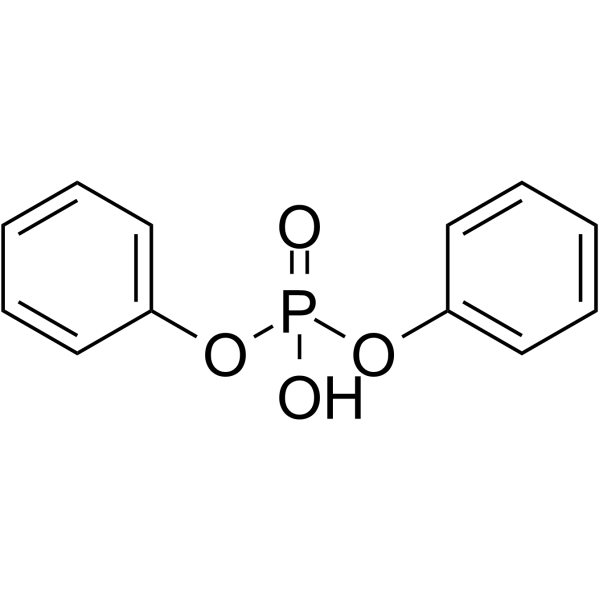
HY-W008151
Diphenyl PhosphateMetabolic Inhibitor -

HY-107859
Tris(2-chloroethyl) phosphateFlame-retardant Plasticizer -

HY-W008151R
Diphenyl Phosphate (Standard)Metabolic Inhibitor -

HY-W016414
Triethyl phosphateSmooth Muscle Relaxant -

HY-Y1322
Triphenyl phosphateEndocrine Disruptor -

HY-W013205
Bis(4-nitrophenyl) phosphateEsterase Inhibitor -
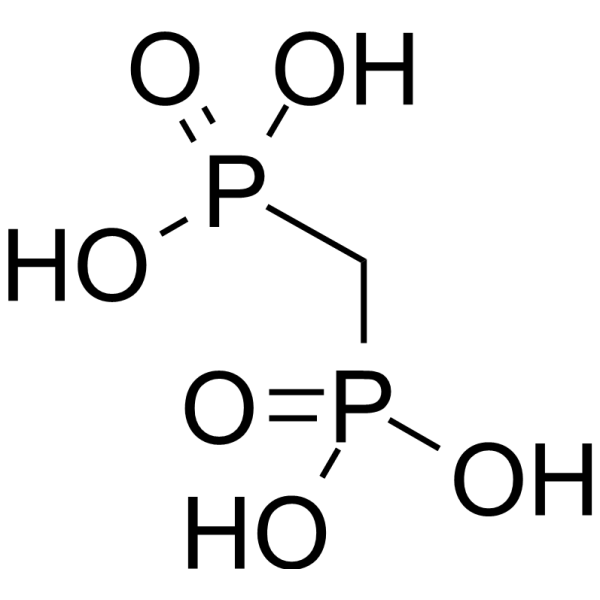
HY-108309
Medronic acidImaging Agent -
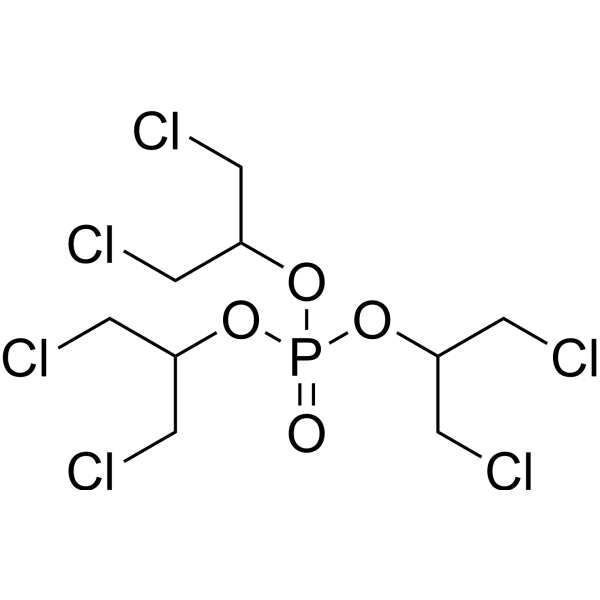
HY-108712
TDCPPFlame Retardant -

HY-W106688
Triisopropyl phosphateEstradiol Inhibitor -

HY-108309R
Medronic acid (Standard)Imaging Agent -
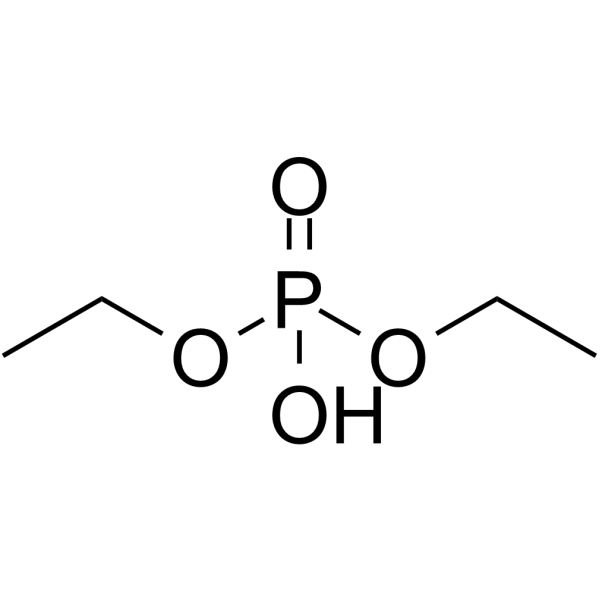
HY-101417
Diethyl phosphateEndogenous Metabolite -
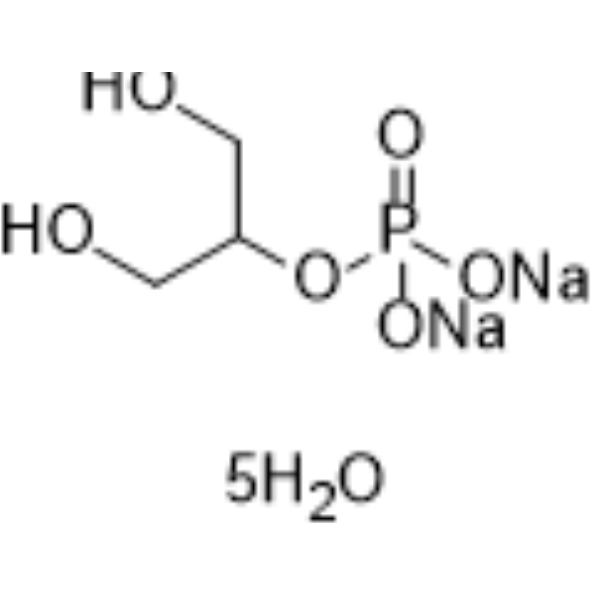
HY-D0886
β-Glycerophosphate disodium salt pentahydratePhosphatase Inhibitor


Biological Activity
Description


Chemical Information
-
CAS No. 107-66-4
-
Appearance Liquid
-
Molecular Weight 210.21
-
Formula C8H19O4P
-
Color Colorless to light yellow
-
SMILES
O=P(OCCCC)(O)OCCCC
-
Synonyms
DBUP
-
Shipping
Room temperature in continental US; may vary elsewhere.
-
Storage
Pure form -20°C 3 years 4°C 2 years In solvent -80°C 6 months -20°C 1 month


Solvent & Solubility
In Vitro:
DMSO : 200 mg/mL (951.43 mM; Need ultrasonic; Hygroscopic DMSO has a significant impact on the solubility of product, please use newly opened DMSO)
Please refer to the solubility information to select the appropriate solvent. Once prepared, please aliquot and store the solution to prevent product inactivation from repeated freeze-thaw cycles.
Storage method and period of stock solution: -80°C, 6 months; -20°C, 1 month. When stored at -80°C, please use it within 6 months. When stored at -20°C, please use it within 1 month.
Please refer to the solubility information to select the appropriate solvent. Once prepared, please aliquot and store the solution to prevent product inactivation from repeated freeze-thaw cycles.
Storage method and period of stock solution: -80°C, 6 months; -20°C, 1 month. When stored at -80°C, please use it within 6 months. When stored at -20°C, please use it within 1 month.
Concentration (start) × Volume (start) = Concentration (final) × Volume (final)
In Vivo:
Select the appropriate dissolution method based on your experimental animal and administration route.
- For the following dissolution methods, please ensure to first prepare a clear stock solution using an In Vitro approach and then sequentially add co-solvents:
- To ensure reliable experimental results, the clarified stock solution can be appropriately stored based on storage conditions. As for the working solution for In Vivo experiments, it is recommended to prepare freshly and use it on the same day.
- The percentages shown for the solvents indicate their volumetric ratio in the final prepared solution. If precipitation or phase separation occurs during preparation, heat and/or sonication can be used to aid dissolution.
Add each solvent one by one: 10% DMSO 90% (20% SBE-β-CD in Saline)
Solubility: ≥ 5 mg/mL (23.79 mM); Clear solution
This protocol yields a clear solution of ≥ 5 mg/mL (saturation unknown).
Taking 1 mL working solution as an example, add 100 μL DMSO stock solution (50.0 mg/mL) to 900 μL 20% SBE-β-CD in Saline, and mix evenly.
Preparation of 20% SBE-β-CD in Saline (4°C, storage for one week): 2 g SBE-β-CD powder is dissolved in 10 mL Saline, completely dissolve until clear.
In Vivo Dissolution Calculator
Please enter the basic information of animal experiments:
-
-
-
-
Recommended: Prepare an additional quantity of animals to account for potential losses during experiments.
Please enter your animal formula composition:
-
%DMSO +
Recommended: Keep the proportion of DMSO in working solution below 2% if your animal is weak.
-
%+
-
+%Tween-80 + +
-
%Saline +
The co-solvents required include: DMSO, . All of co-solvents are available by MedChemExpress (MCE). , Tween 80. All of co-solvents are available by MedChemExpress (MCE).
Working solution concentration: 0.22 mg/mL
Method for preparing stock solution: mg drug dissolved in μL DMSO. Stock solution concentration: mg/mL.
1. Take μL DMSO stock solution;
2. Add μL .
μL , mix evenly;
3. Then add μL Tween 80, mix evenly;
4. Then add μL
Please ensure that the stock solution in the first step is dissolved to a clear state, and add co-solvents in sequence. You can use ultrasonic heating (ultrasonic cleaner, recommended frequency 20-40 kHz), vortexing, etc. to assist dissolution.


Purity & Documentation
-
Data Sheet (268 KB)
-
SDS (640 KB)
- English - EN (640 KB)
- Français - FR (640 KB)
- Deutsch - DE (640 KB)
- Norwegian - NO (640 KB)
- Español - ES (640 KB)
- Swedish - SV (640 KB)
- Italian - IT (640 KB)
- Korean - KR (640 KB)
- Portuguese - PT (640 KB)
-
Handling Instructions (2659 KB)
References
[1]. Wu YJ, et al. Dipeptidyl peptidase-4 inhibitor, vildagliptin, inhibits pancreatic beta cell apoptosis in associationwith its effects suppressing endoplasmic reticulum stress in db/db mice. Metabolism. 2015 Feb;64(2):226-35. [Content Brief]
[2]. Villhauer EB, et al. 1-[[(3-hydroxy-1-adamantyl)amino]acetyl]-2-cyano-(S)-pyrrolidine: a potent, selective, and orally bioavailable dipeptidyl peptidase IV inhibitor with antihyperglycemic properties. J Med Chem. 2003 Jun 19;46(13):2774-89. [Content Brief]
[3]. Nan W, Peng Z, Yi T, Ouyang M, Hu J. Association between exposure to organophosphate esters metabolites and sarcopenia prevalence: A cross-sectional study using NHANES data. Ecotoxicol Environ Saf. 2024 Oct 15;285:117041. [Content Brief]


Complete Stock Solution Preparation Table
Please refer to the solubility information to select the appropriate solvent. Once prepared, please aliquot and store the solution to prevent product inactivation from repeated freeze-thaw cycles.
Storage method and period of stock solution: -80°C, 6 months; -20°C, 1 month. When stored at -80°C, please use it within 6 months. When stored at -20°C, please use it within 1 month.
| Optional Solvent | Concentration Solvent Mass | 1 mg | 5 mg | 10 mg | 25 mg |
|---|---|---|---|---|---|
| DMSO | 1 mM | 4.7571 mL | 23.7857 mL | 47.5715 mL | 118.9287 mL |
| 5 mM | 0.9514 mL | 4.7571 mL | 9.5143 mL | 23.7857 mL | |
| 10 mM | 0.4757 mL | 2.3786 mL | 4.7571 mL | 11.8929 mL | |
| 15 mM | 0.3171 mL | 1.5857 mL | 3.1714 mL | 7.9286 mL | |
| 20 mM | 0.2379 mL | 1.1893 mL | 2.3786 mL | 5.9464 mL | |
| 25 mM | 0.1903 mL | 0.9514 mL | 1.9029 mL | 4.7571 mL | |
| 30 mM | 0.1586 mL | 0.7929 mL | 1.5857 mL | 3.9643 mL | |
| 40 mM | 0.1189 mL | 0.5946 mL | 1.1893 mL | 2.9732 mL | |
| 50 mM | 0.0951 mL | 0.4757 mL | 0.9514 mL | 2.3786 mL | |
| 60 mM | 0.0793 mL | 0.3964 mL | 0.7929 mL | 1.9821 mL | |
| 80 mM | 0.0595 mL | 0.2973 mL | 0.5946 mL | 1.4866 mL | |
| 100 mM | 0.0476 mL | 0.2379 mL | 0.4757 mL | 1.1893 mL |


Dibutyl phosphate Related Classifications
HY-135604 Related Classifications
 Powered by Bioz