



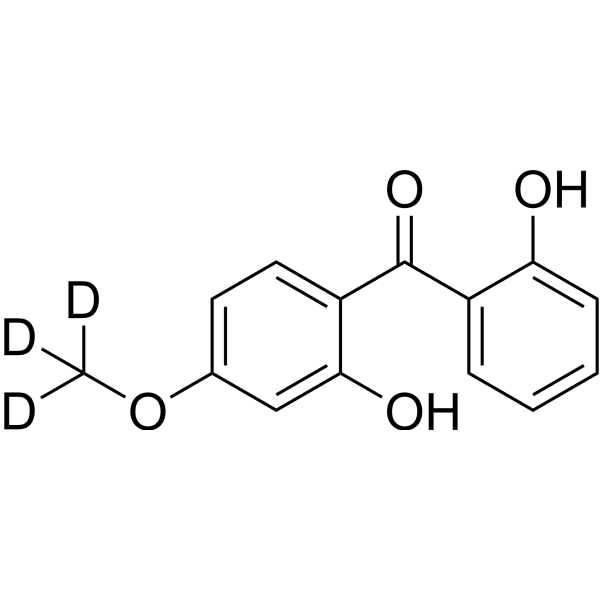
Dioxybenzone-d3

Based on 1 Customer Validation
Dioxybenzone-d3 is deuterium labeled Dioxybenzone. Dioxybenzone (Benzophenone-8; UV-24) is an organic compound used to block UVB and short-wave UVA (ultraviolet) radiation. Dioxybenzone has orally activity. Dioxybenzone exhibits estrogenic disrupting effect. Dioxybenzone up-regulates inflammatory cytokines. Dioxybenzone can be used for cancer, reproductive system disease and inflammatory disease study.
For research use only. We do not sell to patients.
- Formula: C14H9D3O4
- Molecular Weight:247.26
-
Storage:
Please store the product under the recommended conditions in the Certificate of Analysis.

To place orders, for customer services and technical support, please contact: MedChemExpress USA
Tel: 609-228-6898 E-mail: [email protected] [email protected]


-
 Biological Activity
-
Chemical Information
- Protocols
- Purity & Documentation
- References
-
 Help & FAQs




Biological Activity
Description
In Vitro
Stable heavy isotopes of hydrogen, carbon, and other elements have been incorporated into drug molecules, largely as tracers for quantitation during the drug development process. Deuteration has gained attention because of its potential to affect the pharmacokinetic and metabolic profiles of drugs[1].
MedChemExpress (MCE) has not independently confirmed the accuracy of these methods. They are for reference only.
Application
1. This compound can be used as a tracer
2. This compound can be used as an internal standard for quantitative analysis by NMR, GC-MS, or LC-MS.


Chemical Information
-
Unlabeled CAS 131-53-3
-
Molecular Weight 247.26
-
Formula C14H9D3O4
-
SMILES
O=C(C1=CC=C(OC([2H])([2H])[2H])C=C1O)C2=CC=CC=C2O
-
Synonyms
Benzophenone-8-d3; UV-24-d3
-
Shipping
Room temperature in continental US; may vary elsewhere.
-
Storage
Please store the product under the recommended conditions in the Certificate of Analysis.


Purity & Documentation
References
[1]. Russak EM, et al. Impact of Deuterium Substitution on the Pharmacokinetics of Pharmaceuticals. Ann Pharmacother. 2019;53(2):211-216. [Content Brief]
[2]. Rao GS, et al. Oral chemoprevention of skin cancer in mice by benzophenone sunscreens dioxybenzone and octabenzone in drinking water. Anticancer Res. 2013 Jun;33(6):2535-40. [Content Brief]
[3]. Zhan T, et al. Transcriptome aberration in mice uterus associated with steroid hormone response and inflammation induced by dioxybenzone and its metabolites. Environ Pollut. 2021 Oct 1;286:117294. [Content Brief]
[4]. Sherwood VF, et al. Altered UV absorbance and cytotoxicity of chlorinated sunscreen agents. Cutan Ocul Toxicol. 2012 Dec;31(4):273-9. [Content Brief]

Calculators
Concentration (start) × Volume (start) = Concentration (final) × Volume (final)


Dioxybenzone-d3 Related Classifications
HY-B0966S Related Classifications
 Powered by Bioz