



Anrikefon
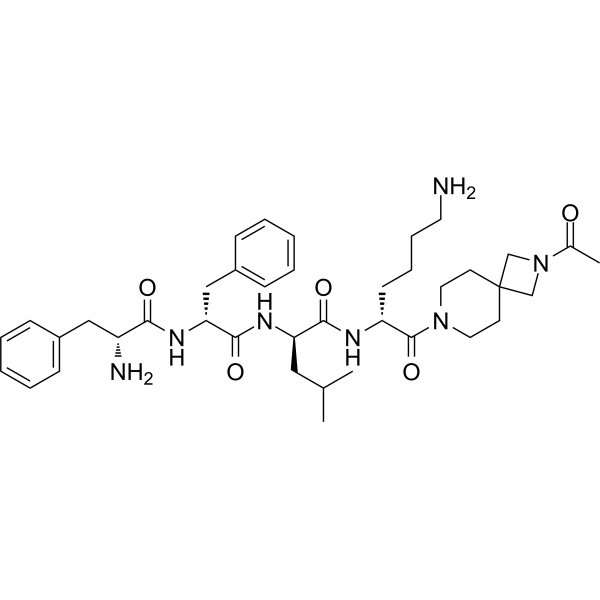
Anrikefon is a peripherally restricted kappa opioid receptor (KOR) agonist, with an IC50 of 0.54 nM, an EC50 of 2.41 pM, and a Ka of 0.068 nM against human KOR, and it exhibits high selectivity over μ and δ opioid receptors. Anrikefon exerts analgesic effects by inhibiting behaviors associated with inflammatory, postoperative and neuropathic pain, and also exerts antipruritic effects by reducing itch-related behaviors. Anrikefon can be used in research on pain, pruritus, and pruritus associated with chronic kidney disease.
For research use only. We do not sell to patients.
- CAS No.: 2269511-95-5
- Formula: C39H57N7O5
- Molecular Weight:703.91
-
Storage:
Please store the product under the recommended conditions in the Certificate of Analysis.

To place orders, for customer services and technical support, please contact: MedChemExpress USA
Tel: 609-228-6898 E-mail: [email protected] [email protected]


-
 Biological Activity
-
Chemical Information
- Purity & Documentation
- References
-
 Help & FAQs


All Opioid Receptor Isoforms
More

Biological Activity
Description
IC50 & Target
|
κ Opioid Receptor/KOR |
In Vitro
Anrikefon (HSK21542) (0.01-10 nM, 0.123-1.23 nM; 60 min, 120 min) potently binds to human KOR in isolated HEK-293 cell membranes with an IC50 of 0.54 nM, a Kd of 0.068 nM, and a long dissociation half-life of 90.6 min[1].
Anrikefon (HSK21542) (0.001-10 nM; 30 min) potently inhibits forskolin-induced cAMP accumulation in human KOR-expressing HEK-293 cells with an EC50 of 2.41 pM[1].
Anrikefon (HSK21542) (10 μM) exhibits high off-target selectivity, with only weak binding to the cannabinoid CB1 receptor at a high concentration of 10 μM and no activity against 85 other tested targets[1].
MedChemExpress (MCE) has not independently confirmed the accuracy of these methods. They are for reference only. .
In Vivo
Anrikefon (HSK21542) (0.1-10 mg/kg; i.v.; single dose) produces dose-dependent antiallodynic effects in a rat hindpaw incision post-surgical pain model, with efficacy detectable for at least 24 hours post-administration at doses of 3 mg/kg and 10 mg/kg[1].
Anrikefon (HSK21542) (0.1-3 mg/kg; i.v.; single dose) produces sustained, dose-dependent antiallodynic effects in a rat CCI neuropathic pain model, with a minimum effective dose of 0.3 mg/kg and efficacy lasting at least 24 hours post-administration at doses of 1 mg/kg and 3 mg/kg[1].
Anrikefon (HSK21542) (0.01-3 mg/kg; i.v.; single dose) produces potent, dose-dependent antipruritic effects in a mouse compound 48/80-induced scratching model, with a minimum effective dose of 0.03 mg/kg and near-complete inhibition at 1 mg/kg[1].
Anrikefon (HSK21542) (3.75-7.5 mg/kg; i.v.; single dose) exhibits weak central antinociceptive effects in a mouse hot-plate test, with a minimum effective dose of 7.5 mg/kg, which is substantially higher than doses required for peripheral antinociceptive and antipruritic activity[1].
Anrikefon (HSK21542) (0.4-2 mg/kg; i.v.; single dose) produces mild sedative effects in Rattus norvegicus (rats) only at higher doses (2 mg/kg), with no significant effects at doses up to 0.4 mg/kg[1].
Anrikefon (HSK21542) (0.4-2 mg/kg; i.v.; single dose) does not significantly alter respiratory rate in mice at doses up to 2 mg/kg, indicating a favorable respiratory safety profile[1].
Anrikefon (1-10 mg/kg/day; i.v.; twice a day at 6-hour intervals) has no toxicologically significant effects on male rat fertility or early embryonic development at doses up to 10 mg/kg/day, but increases female rat estrous cycle length and disorder rate at all tested doses, resulting in a NOAEL for female fertility toxicity of less than 1 mg/kg/day[2].
Anrikefon (0.2-4 mg/kg/day; i.v.; twice a day at 6-hour intervals) has a NOAEL of 1 mg/kg/day for embryo-fetal development in rats, with only a minor increase in incomplete thoracic vertebral centrum ossification observed at the 4 mg/kg/day dose[2].
Anrikefon (0.3-2 μg/kg/day; i.v.; daily) has a NOAEL of 2 μg/kg/day for embryo-fetal development in rabbits, with no toxicologically significant adverse effects observed at any tested dose[2].
Anrikefon (0.2-4 mg/kg/day; i.v.; twice a day at 6-hour intervals) has a NOAEL of 4 mg/kg/day for pre- and post-natal development in Rattus norvegicus? No, wait, original text says "rats" - correction: Anrikefon (0.2-4 mg/kg/day; i.v.; twice a day at 6-hour intervals) has a NOAEL of 4 mg/kg/day for pre- and post-natal development in rats, with no toxicologically significant adverse effects on maternal or offspring parameters observed at any tested dose[2].\n\nWait, rechecking the original text and rules: the only entity to tag here is the citation. The subject "Anrikefon" is not tagged per rule 3. "Rats" is not a Latin species name (the full Latin would be Rattus norvegicus, but the text uses common name "rats" so no italic). No other entities fit the tagging rules. Correct formatted text:\n\nAnrikefon (0.2-4 mg/kg/day; i.v.; twice a day at 6-hour intervals) has a NOAEL of 4 mg/kg/day for pre- and post-natal development in rats, with no toxicologically significant adverse effects on maternal or offspring parameters observed at any tested dose[2].
MedChemExpress (MCE) has not independently confirmed the accuracy of these methods. They are for reference only.
-
Animal Model:ICR (18-22 g, 8-10 weeks old, half male and half female; acetic acid-induced writhing modeling)[1]
-
Dosage:0.03-30 mg/kg
-
Administration:i.v.; single dose
-
Result:Induced a 27.46% inhibitory rate on writhing behaviors at 0.03 mg/kg (15 minutes post-dosing). Produced dose-dependent increases in inhibitory efficacy at 0.1 mg/kg and higher doses (15 minutes post-dosing), with effects comparable to CR845 at equivalent doses. Reached a median effective dose (ED50) of 0.09 mg/kg (95% CI: 0.06-0.12 mg/kg) at 15 minutes post-dosing. Induced a 32.75% inhibitory rate at 0.3 mg/kg (24 hours post-dosing). Induced a 49.67% inhibitory rate at 1 mg/kg (24 hours post-dosing). Induced a 55.60% inhibitory rate at 3 mg/kg (24 hours post-dosing). Induced a 68.12% inhibitory rate at 10 mg/kg (24 hours post-dosing). Induced a 75.16% inhibitory rate at 30 mg/kg (24 hours post-dosing). Reached an ED50 of 1.48 mg/kg (95% CI: 0.62-2.45 mg/kg) at 24 hours post-dosing. Showed antinociceptive effects at 0.3 mg/kg and 1 mg/kg that were completely reversed by pre-treatment with nor-binaltorphimine.
-
Animal Model:Sprague Dawley (SD) (160-180 g, 8-10 weeks old, male; hindpaw incision modeling)[1]
-
Dosage:0.1-10 mg/kg
-
Administration:i.v.; single dose
-
Result:Induced a 10.5-fold increase in 50% paw withdrawal threshold (PWT; 7.51 g vs. 0.72 g in vehicle controls) at 1 mg/kg (15 minutes post-dosing). Produced maximum antiallodynic activity at 10 mg/kg (15 minutes post-dosing). Had a minimum effective dose (MED) of 1 mg/kg. Maintained statistically significant increases in mechanical pain thresholds at 3 mg/kg and 10 mg/kg compared to vehicle controls (24 hours post-dosing).
-
Animal Model:Sprague Dawley (SD) (160-180 g, 8-10 weeks old, male; chronic constriction injury [CCI] modeling)[1]
-
Dosage:0.1-3 mg/kg
-
Administration:i.v.; single dose
-
Result:Induced a 5.15-fold increase in 50% PWT (6.62 g vs. 1.29 g in vehicle controls) at 0.3 mg/kg (15 minutes post-dosing). Produced peak 50% PWT values at 2 hours post-dosing at 1 mg/kg and 3 mg/kg, which gradually declined but remained significantly elevated compared to vehicle controls at 24 hours post-dosing. Showed a significantly increased AUC for 50% PWT over time at all doses tested, with the MED defined as 0.3 mg/kg.
-
Animal Model:ICR (18-22 g, 8-10 weeks old, male; compound 48/80-induced scratching modeling)[1]
-
Dosage:0.01-3 mg/kg
-
Administration:i.v.; single dose
-
Result:Produced dose-dependent inhibition of scratching behaviors. Induced a 34.89% inhibitory rate at 0.03 mg/kg. Induced a 53.02% inhibitory rate at 0.1 mg/kg. Induced a 73.75% inhibitory rate at 0.3 mg/kg. Induced a peak 99.78% inhibitory rate at 1 mg/kg. Had a MED of 0.03 mg/kg, and an ED50 of 0.09 mg/kg (95% CI: 0.04-0.16 mg/kg), with efficacy comparable to CR845 at equivalent doses.
-
Animal Model:C57BL/6J (18-22 g, 8-10 weeks old, female)[1]
-
Dosage:3.75-7.5 mg/kg
-
Administration:i.v.; single dose
-
Result:Did not produce a significant increase in % MPE at 3.75 mg/kg. Induced a 29.60% MPE at 7.5 mg/kg, which was statistically significant compared to vehicle controls. Reached an ED50 of 10.49 mg/kg (95% CI: 7.58-15.37 mg/kg).
-
Animal Model:Sprague Dawley (SD) (160-180 g, 8-10 weeks old, half male and half female)[1]
-
Dosage:0.4 mg/kg; 2 mg/kg
-
Administration:i.v.; single dose
-
Result:Did not produce a significant reduction in total distance traveled compared to vehicle controls at 0.4 mg/kg. Induced a statistically significant reduction in locomotor activity at 2 mg/kg.
-
Animal Model:ICR (18-22 g, 8-10 weeks old, half male and half female)[1]
-
Dosage:0.4 mg/kg; 2 mg/kg
-
Administration:i.v.; single dose
-
Result:Did not produce a statistically significant change in respiratory rate compared to vehicle controls at 0.4 mg/kg or 2 mg/kg at any time point tested.
-
Animal Model:Sprague-Dawley rats (8-11 weeks, both sexes, fertility and early embryonic development model)[2]
-
Dosage:1 mg/kg/day; 3 mg/kg/day; 10 mg/kg/day
-
Administration:i.v.; twice a day at 6-hour intervals; males: 4 weeks prior to mating through mating period until day before necropsy; females: 2 weeks prior to mating through mating period until gestation day 15
-
Result:Increased male rat sperm count to 440.6 ×10^6 (1 mg/kg/day) and 436.7 ×10^6 (10 mg/kg/day).\nIncreased male rat sperm density to 704.1 ×10^6/g (1 mg/kg/day) and 722.4 ×10^6/g (10 mg/kg/day).\nLeft male rat sperm motility and malformation rate unchanged across all doses.\nIncreased female rat estrous cycle length to 4.4 days (1 mg/kg/day), 4.5 days (3 mg/kg/day), and 4.6 days (10 mg/kg/day).\nIncreased female rat estrous cycle disorder rate to 65.4% (1 mg/kg/day), 61.5% (3 mg/kg/day), and 57.7% (10 mg/kg/day).\nIncreased female rat precoital interval to 3.2 days (10 mg/kg/day).\nDecreased female rat gravid uterus weight to 15.805 g (1 mg/kg/day).\nLeft female rat copulation index, conception index, fertility index, corpora lutea count, implantation sites, resorptions, viable embryos, and pre/post-implantation loss unchanged across all doses.
-
Animal Model:Sprague-Dawley rats (pregnant females, embryo-fetal developmental model)[2]
-
Dosage:0.2 mg/kg/day; 1 mg/kg/day; 4 mg/kg/day
-
Administration:i.v.; twice a day at 6-hour intervals; gestation day 6 through gestation day 17
-
Result:Caused transient, mild decreases in maternal rat body weight (3.56-6.33%) from GD 8 to GD 10 in the 1 and 4 mg/kg/day groups.\nDecreased maternal rat food consumption from GD 6 to GD 7 across all doses.\nLeft maternal rat corpora lutea count, implantation sites, resorptions, viable fetuses, post-implantation loss, and organ weights unchanged across all doses.\nLeft fetal rat weight and crown-rump length unchanged across all doses.\nIncreased the incidence of fetuses with incomplete ossification of thoracic vertebral centrum by 3.5% in the 4 mg/kg/day group.\nDecreased incomplete ossification of pubis, hyoid bone, and 5th/6th sternebra in the 1 mg/kg/day group, and decreased incomplete ossification of hyoid bone in the 4 mg/kg/day group (deemed not toxicologically significant).\nIncreased 14th rudimentary ribs in the 4 mg/kg/day group (deemed incidental).
-
Animal Model:New Zealand white rabbits (5-6 months, pregnant females, embryo-fetal developmental model)[2]
-
Dosage:0.3 μg/kg/day; 1 μg/kg/day; 2 μg/kg/day
-
Administration:i.v.; daily; gestation day 7 through gestation day 19
-
Result:Left maternal rabbit body weight, food consumption, corpora lutea count, implantation sites, resorptions, viable fetuses, post-implantation loss, and organ weights unchanged across all doses.\nLeft fetal rabbit weight and crown-rump length unchanged across all doses.\nDecreased male fetus ratio to 32% in the 2 μg/kg/day group (deemed not toxicologically significant).\nLeft fetal rabbit external, visceral, and skeletal malformations or variations unchanged across all doses.
-
Animal Model:Sprague-Dawley rats (pregnant females and their offspring, pre- and post-natal development model)[2]
-
Dosage:0.2 mg/kg/day; 1 mg/kg/day; 4 mg/kg/day
-
Administration:i.v.; twice a day at 6-hour intervals; gestation day 6 through postnatal day 21
-
Result:Caused transient, mild decreases in maternal rat body weight (4.04-6.56%) from GD 8 to GD 17 in the 1 and 4 mg/kg/day groups (deemed not treatment-related).\nDecreased maternal rat food consumption from GD 6 to GD 7 in the 1 and 4 mg/kg/day groups, and increased food consumption from GD 10 to GD 11 in the 1 mg/kg/day group (deemed not treatment-related).\nIncreased maternal rat resorptions in the 1 mg/kg/day group (deemed not toxicologically significant).\nLeft maternal rat gestation length, corpora lutea count, implantation sites, viable fetuses, post-implantation loss, litter size, and live birth/viability/lactation indices unchanged across all doses.\nLeft offspring pre-weaning and post-weaning body weights largely unchanged, with minor, non-toxicologically significant increases in female offspring body weight on PND 63 and 70 at 1 and 4 mg/kg/day.\nLeft offspring reflex development, locomotor activity, learning behavior, sexual maturation, and reproductive capacity unchanged across all doses.\nIncreased offspring placenta weight in the 4 mg/kg/day group (deemed not toxicologically significant).


Chemical Information
-
CAS No. 2269511-95-5
-
Molecular Weight 703.91
-
Formula C39H57N7O5
-
Synonyms
HSK21542
-
Shipping
Room temperature in continental US; may vary elsewhere.
-
Storage
Please store the product under the recommended conditions in the Certificate of Analysis.


Purity & Documentation
References
[1]. Wang X, et al. Antinociceptive and Antipruritic Effects of HSK21542, a Peripherally-Restricted Kappa Opioid Receptor Agonist, in Animal Models of Pain and Itch. Front Pharmacol. 2021;12:773204. Published 2021 Nov 16. [Content Brief]
[2]. Gou X, et al. Reproductive and developmental toxicity assessment of HSK21542, a novel peripherally-restricted kappa opioid receptor agonist in rats and rabbits. Regul Toxicol Pharmacol. 2025;159:105811. [Content Brief]

Calculators
Concentration (start) × Volume (start) = Concentration (final) × Volume (final)


Anrikefon Related Classifications
HY-P3445 Related Classifications
 Powered by Bioz