



DSPE-PEG2000-TCO

Based on 1 Customer Validation
DSPE-PEG2000-TCO is a click chemistry coupling partner. DSPE-PEG2000-TCO undergoes a reverse electron-demand Diels-Alder click reaction to form a covalent linkage with tetrazine-modified Cetuximab (HY-P9905). DSPE-PEG2000-TCO maintains the stability of lipid nanoparticles (LNPs) and has high mRNA encapsulation efficiency, which supports cellular uptake and mRNA transfection. DSPE-PEG2000-TCO is used to prepare EGFR-targeted and APN-targeted mRNA-loaded LNPs, mediating receptor-dependent endocytosis, mRNA delivery, and intestinal epithelial transcytosis.
For research use only. We do not sell to patients.
- Purity : 99.96%
- CAS No.: 1480940-53-1
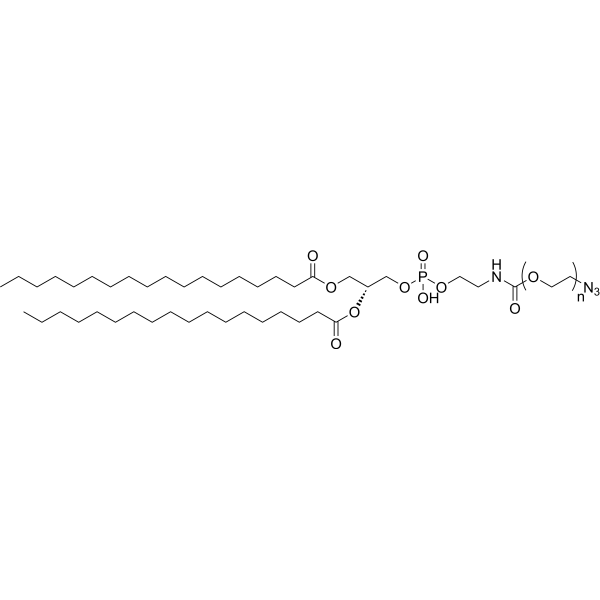
- Formula: (C2H4O)nC53H99N2O12P
- Molecular Weight:2000 (Average)
-
Storage:
-20°C, stored under nitrogen
* In solvent : -80°C, 6 months; -20°C, 1 month (stored under nitrogen)


To place orders, for customer services and technical support, please contact: MedChemExpress USA
Tel: 609-228-6898 E-mail: [email protected] [email protected]


-
 Biological Activity
-
Chemical Information
- Protocols
- Purity & Documentation
- References
-
 Help & FAQs




Biological Activity
Description
In Vitro
DSPE-PEG2000-TCO forms micelles with Cetuximab (HY-P9905) that modify LNPs to mediate EGFR-dependent, near-complete (97-99%) transfection of HeLa cells with GFP mRNA, achieving 3-fold higher MFI than untargeted controls, with dose-dependent increases in intracellular mRNA payload and sensitivity to soluble Cetuximab inhibition[1].
LNPs containing DSPE-PEG2000-TCO, functionalized with αAPN-VHH, are transcytosed across the porcine intestinal epithelial barrier in apical-out enteroids, with mRNA delivered to both epithelial and subepithelial compartments resulting in GFP expression[2].
MedChemExpress (MCE) has not independently confirmed the accuracy of these methods. They are for reference only. Further protocols information, click here.
In Vivo
MedChemExpress (MCE) has not independently confirmed the accuracy of these methods. They are for reference only.


Chemical Information
-
CAS No. 1480940-53-1
-
Appearance Solid
-
Molecular Weight 2000 (Average)
-
Formula (C2H4O)nC53H99N2O12P
-
Color White to light yellow
-
SMILES
O=C(OCCOCCNC(OC1CCC/C=C/CC1)=O)NCCOP(O)(OC[C@H](OC(CCCCCCCCCCCCCCCCC)=O)COC(CCCCCCCCCCCCCCCCC)=O)=O.[n]
-
Shipping
Room temperature in continental US; may vary elsewhere.
-
Storage
-20°C, stored under nitrogen
* In solvent : -80°C, 6 months; -20°C, 1 month (stored under nitrogen)

Protocols
-
EdU Incorporation Assay (Click Chemistry-Based DNA Synthesis Measurement)
The EdU incorporation assay measures DNA synthesis by adding the thymidine analog 5-ethynyl-2′-deoxyuridine to cells or tissues, where it is incorporated into newly synthesized DNA during S phase. Incorporated EdU is detected by copper-catalyzed azide-alkyne cycloaddition, in which a fluorescent azide covalently reacts with the ethynyl group on EdU, allowing S-phase cells to be detected by fluorescence microscopy, flow cytometry, or high-content imaging. EdU detection does not require DNA denaturation or anti-BrdU antibody access, which preserves sample structure and improves compatibility with immunostaining and multiparameter cytometry compared with BrdU-based detection. EdU can be cytotoxic in a cell-type- and exposure-dependent manner, so pulse duration, concentration, and continuous-labeling designs should be validated for each cell type.
-
RNA extraction experimental
By lysing cells, releasing RNA, and removing impurities such as proteins and DNA, high-purity RNA products are finally obtained. The commonly used traditional method is the guanidine isothiocyanate/phenol/chloroform method (Trizol), which is suitable for a variety of animal materials including animal tissues, microorganisms, cultured cells, etc., and most plant materials.


Purity & Documentation
-
Data Sheet (269 KB)
-
SDS (252 KB)
- English - EN (252 KB)
- Français - FR (252 KB)
- Deutsch - DE (252 KB)
- Norwegian - NO (252 KB)
- Español - ES (252 KB)
- Swedish - SV (252 KB)
- Italian - IT (252 KB)
- Korean - KR (252 KB)
- Portuguese - PT (252 KB)
-
Handling Instructions (2659 KB)
References
[1]. Patel J, et al. Preparation of Targeted Lipid Nanoparticles by Insertion of Either Tetrazine-trans-Cyclooctene or Thiol-Maleimide Micelles. Bioconjug Chem. 2026;37(2):406-417. [Content Brief]
[2]. Chen L, et al. Cell-specific mRNA delivery via nanobody-functionalized lipid nanoparticles. J Control Release. 2025;388(Pt 2):114365. [Content Brief]

Calculators
Concentration (start) × Volume (start) = Concentration (final) × Volume (final)


DSPE-PEG2000-TCO Related Classifications
HY-170704 Related Classifications
 Powered by Bioz