



E-4031 free base
Based on 9 publication(s) in Google Scholar
E-4031 free base is a selective hERG potassium channel blocker for use in class III anti-arrhythmic studies.
Nur für Forschungszwecke. Wir verkaufen nicht an Patienten.
- Reinheit : 98.92%
- CAS. Nr.: 113558-89-7
- Formel: C21H27N3O3S
- Molecular Weight:401.52
-
Speicherung:Powder -20°C, 3 years ; In solvent -80°C, 6 months , -20°C, 1 month


To place orders, for customer services and technical support, please contact: MedChemExpress USA
Tel: 609-228-6898 E-mail: [email protected] [email protected]


-
 Biologische Aktivität
-
Chemical Information
-
Lösungsmittel & Löslichkeit
- Reinheit & Dokumentation
- Verweise
-
 Help & FAQs


Publications Citing Use of MedChemExpress (MCE) E-4031 free base
More- Biofabrication. 2022 Oct 28;15(1). [Abstract]
- Free Radic Biol Med. 2026 Jun:249:14-26. [Abstract]
- ACS Appl Mater Interfaces. 2023 Apr 12;15(14):17518-17531. [Abstract]
- JCI Insight. 2025 Sep 30:e191697. [Abstract]
- J Mol Cell Biol. 2025 May 22;16(11):mjae051. [Abstract]
- Int J Mol Sci. 2026 Apr 21;27(8):3701. [Abstract]
- World J Stem Cells. 2026 May 26;18(5).
- Toxicol Appl Pharmacol. 2021 Nov 15:431:115731. [Abstract]
- bioRxiv. 2026 Feb 13:2026.02.11.705466. [Abstract]
 Customer Validation & Images

-
WB
-
Bio/Physico-chemical Assay
-
Bio/Physico-chemical Assay
-
Bio/Physico-chemical Assay
-
Bio/Physico-chemical Assay


Biologische Aktivität
Beschreibung
Cellular Effect
|
Cell Line

|
Type | Value | Description | References |
|---|---|---|---|---|
| CHO-K1 | IC50 |
0.024 μM
Compound: E-4031
|
Inhibition of human ERG expressed in CHOK1 cells assessed as inhibition of tail current after 5 mins by automated whole-cell patch clamp assay
Inhibition of human ERG expressed in CHOK1 cells assessed as inhibition of tail current after 5 mins by automated whole-cell patch clamp assay
|
[PMID: 27105029] |
| COS-7 | IC50 |
10.2 nM
Compound: E-4031
|
Inhibition of hERG Voltage-gated potassium channel subunit Kv11.1 expressed in COS7 cells by electrophysiological whole cell assay
Inhibition of hERG Voltage-gated potassium channel subunit Kv11.1 expressed in COS7 cells by electrophysiological whole cell assay
|
[PMID: 15084130] |
| HEK293 | IC50 |
0.027 μM
Compound: E-4031
|
Inhibition of human ERG expressed in HEK293 cells by patch clamp assay
Inhibition of human ERG expressed in HEK293 cells by patch clamp assay
|
[PMID: 32298114] |
| Ventricular myocyte | IC50 |
441 μM
Compound: E-4031
|
Inhibition of L-type calcium channel measured using whole-cell patch clamp in guinea pig ventricular myocytes
Inhibition of L-type calcium channel measured using whole-cell patch clamp in guinea pig ventricular myocytes
|
[PMID: 22761000] |
| Vero C1008 | IC50 |
>2.0 × 10⁵M
Compound: COVC-3899201806
|
Antiviral activity determined as inhibition of SARS-CoV-2 induced cytotoxicity of VERO-6 cells at 10 uM after 48 hours exposure to 0.01 MOI SARS CoV-2 virus by high content imaging
Antiviral activity determined as inhibition of SARS-CoV-2 induced cytotoxicity of VERO-6 cells at 10 uM after 48 hours exposure to 0.01 MOI SARS CoV-2 virus by high content imaging
|
10.6019/CHEMBL4651402 |


Chemical Information
-
CAS. Nr. 113558-89-7
-
Appearance Solid
-
Molecular Weight 401.52
-
Formel C21H27N3O3S
-
Color White to off-white
-
SMILES
CS(=O)(NC1=CC=C(C(C2CCN(CCC3=NC(C)=CC=C3)CC2)=O)C=C1)=O
-
Versand
Room temperature in continental US; may vary elsewhere.
-
Speicherung
Powder -20°C 3 years In solvent -80°C 6 months -20°C 1 month


Publications (9)
-
Journal Impact Factor
-
Most Recent
-
Biofabrication
Heart-on-a-chip using human iPSC-derived cardiomyocytes with integrated vascular endothelial layer based on culture patch as a potential platform for drug evaluation. [Abstract]2022 Oct 28;15(1). PMID: 36195063
E-4031 free base purchased from MedChemExpress. Usage Cited in: Biofabrication. 2022 Oct 28;15(1). [Abstract]
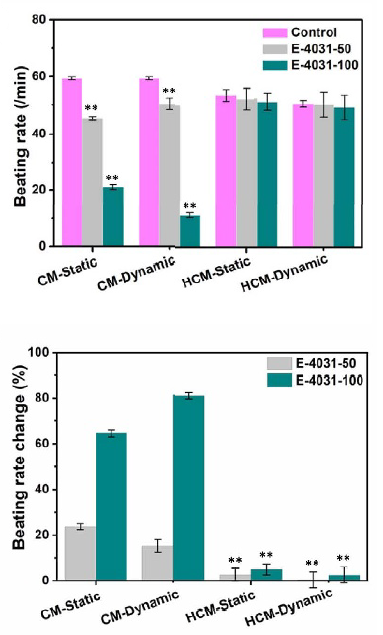
E-4031 (50-100 nM) notably decreased the beating frequency when acting directly on the hiPSC-CMs layer (CM-static and CM-dynamic).
-
Free Radic Biol Med
Repurposing the hERG activator NS-1643 as a ferroptosis-targeting therapeutic against doxorubicin cardiotoxicity. [Abstract]2026 Jun:249:14-26. PMID: 41794151 -
ACS Appl Mater Interfaces
Aligned Nanofibrous Net Deposited Perpendicularly on Microridges Supports Endothelium Formation and Promotes the Structural Maturation of hiPSC-Derived Cardiomyocytes. [Abstract]2023 Apr 12;15(14):17518-17531. PMID: 36992621
E-4031 free base purchased from MedChemExpress. Usage Cited in: ACS Appl Mater Interfaces. 2023 Apr 12;15(14):17518-17531. [Abstract]
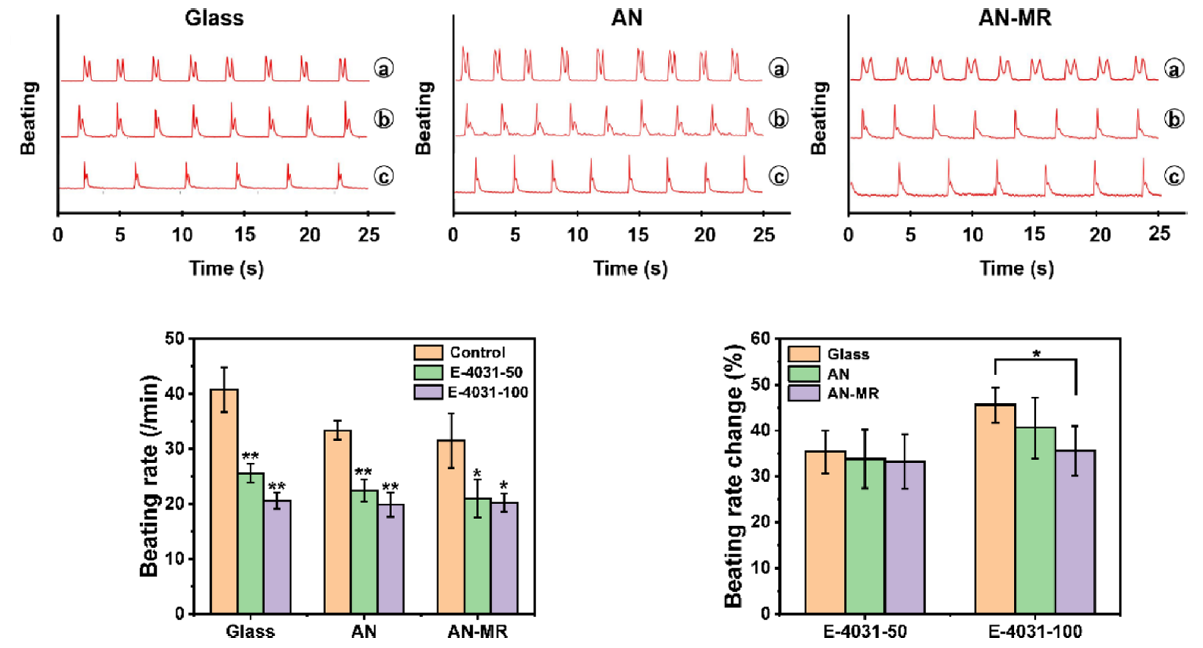
E-4031 (50-100 nM) obviously decreased beating frequency and velocity for hiPSC-CMs on glass, AN, and AN-MR substrates. The beating rate of hiPSC-CMs decreased by 32.33 and 45.55% on glass, 33.78 and 40.6% on AN group, and 33.29 and 35.59% on AN-MR group at 50 and 100 nM conditions, respectively.
-
JCI Insight
2025 Sep 30:e191697. PMID: 41026531
E-4031 free base purchased from MedChemExpress. Usage Cited in: JCI Insight. 2025 Sep 30:e191697. [Abstract]
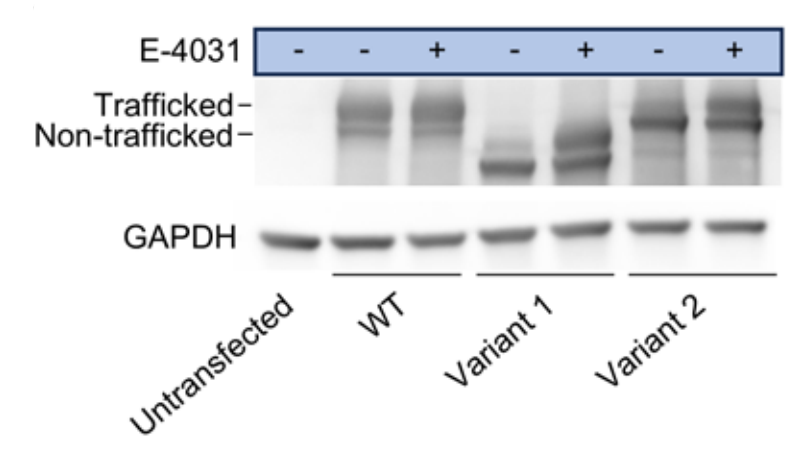
Western blot showing trafficked (fully glycosylated, ~155 kDa) and non-trafficked (core glycosylated, ~135 kDa) Kv11.1 protein. E4031 (10 μM; 24 h) increaseed trafficking in 2 variants.
-
J Mol Cell Biol
2025 May 22;16(11):mjae051. PMID: 39848918
E-4031 free base purchased from MedChemExpress. Usage Cited in: J Mol Cell Biol. 2025 May 22;16(11):mjae051. [Abstract]
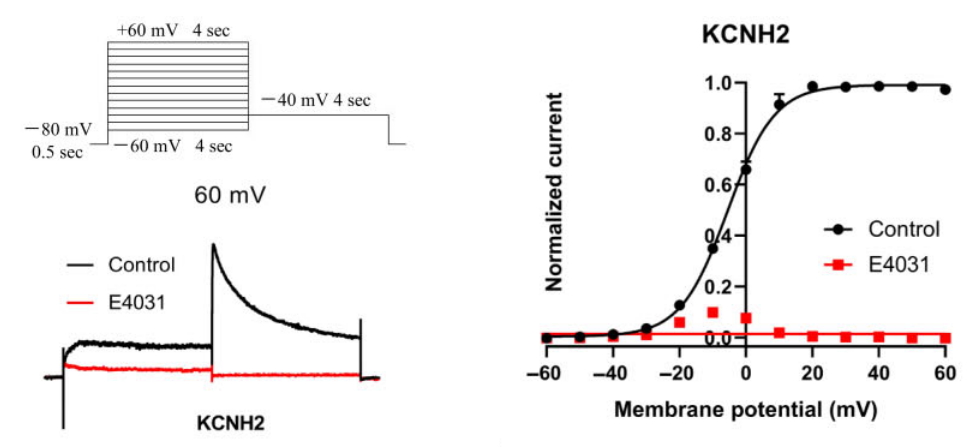
Representative whole-cell hERG currents in KCNH2-transfected HEK293T cells were recorded in the absence or presence of E-4031.
-
Int J Mol Sci
Establishment and Characterization of a Stable hERG Cell Line for High-Throughput Drug Cardiac Safety Screening. [Abstract]2026 Apr 21;27(8):3701. PMID: 42074339 -
-
Toxicol Appl Pharmacol
Proarrhythmic effects induced by benzethonium chloride and domiphen bromide in vitro and in vivo. [Abstract]2021 Nov 15:431:115731. PMID: 34592322
E-4031 free base purchased from MedChemExpress. Usage Cited in: Toxicol Appl Pharmacol. 2021 Nov 15:431:115731. [Abstract]
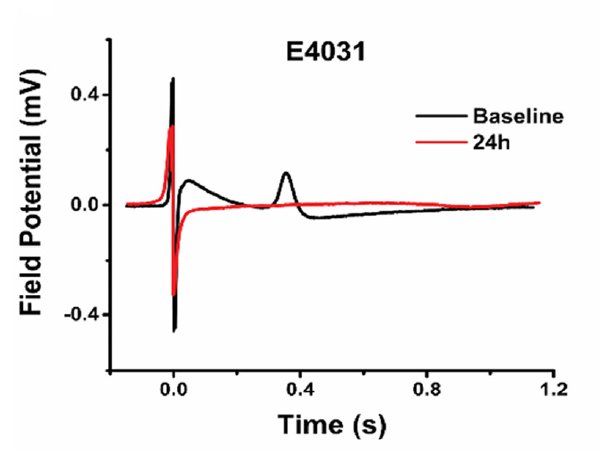
For the field potential property of hiPSC-CMs cultured for 30 days, the onset of E-4031 (100 nM) was very quick, usually within 5 min. E-4031 significantly prolonged FPDc of hiPSC-CMs.
-
bioRxiv
Human-engineered heart tissues recapitulate tissue-scale mechanisms underlying ventricular tachycardia. [Abstract]2026 Feb 13:2026.02.11.705466. PMID: 41727060


Lösungsmittel & Löslichkeit
In Vitro:
DMSO : 100 mg/mL (249.05 mM; Need ultrasonic; Hygroscopic DMSO has a significant impact on the solubility of product, please use newly opened DMSO)
Please refer to the solubility information to select the appropriate solvent. Once prepared, please aliquot and store the solution to prevent product inactivation from repeated freeze-thaw cycles.
Storage method and period of stock solution: -80°C, 6 months; -20°C, 1 month. When stored at -80°C, please use it within 6 months. When stored at -20°C, please use it within 1 month.
Please refer to the solubility information to select the appropriate solvent. Once prepared, please aliquot and store the solution to prevent product inactivation from repeated freeze-thaw cycles.
Storage method and period of stock solution: -80°C, 6 months; -20°C, 1 month. When stored at -80°C, please use it within 6 months. When stored at -20°C, please use it within 1 month.
Konzentration (Stammlösung) × Volumen (Stammlösung) = Konzentration (Ziellösung) × Volumen (Ziellösung)
In Vivo:
Select the appropriate dissolution method based on your experimental animal and administration route.
- For the following dissolution methods, please ensure to first prepare a clear stock solution using an In Vitro approach and then sequentially add co-solvents:
- To ensure reliable experimental results, the clarified stock solution can be appropriately stored based on storage conditions. As for the working solution for In Vivo experiments, it is recommended to prepare freshly and use it on the same day.
- The percentages shown for the solvents indicate their volumetric ratio in the final prepared solution. If precipitation or phase separation occurs during preparation, heat and/or sonication can be used to aid dissolution.
Add each solvent one by one: 10% DMSO 40% PEG300 5% Tween-80 45% Saline
Solubility: ≥ 2.5 mg/mL (6.23 mM); Clear solution
This protocol yields a clear solution of ≥ 2.5 mg/mL (saturation unknown).
Taking 1 mL working solution as an example, add 100 μL DMSO stock solution (25.0 mg/mL) to 400 μL PEG300, and mix evenly; then add 50 μL Tween-80 and mix evenly; then add 450 μL Saline to adjust the volume to 1 mL.
Preparation of Saline: Dissolve 0.9 g sodium chloride in ddH₂O and dilute to 100 mL to obtain a clear Saline solution.
Add each solvent one by one: 10% DMSO 90% (20% SBE-β-CD in Saline)
Solubility: ≥ 2.5 mg/mL (6.23 mM); Clear solution
This protocol yields a clear solution of ≥ 2.5 mg/mL (saturation unknown).
Taking 1 mL working solution as an example, add 100 μL DMSO stock solution (25.0 mg/mL) to 900 μL 20% SBE-β-CD in Saline, and mix evenly.
Preparation of 20% SBE-β-CD in Saline (4°C, storage for one week): 2 g SBE-β-CD powder is dissolved in 10 mL Saline, completely dissolve until clear.
In Vivo Dissolution Calculator
Please enter the basic information of animal experiments:
-
-
-
-
Recommended: Prepare an additional quantity of animals to account for potential losses during experiments.
Please enter your animal formula composition:
-
%DMSO +
Recommended: Keep the proportion of DMSO in working solution below 2% if your animal is weak.
-
%+
-
+%Tween-80 + +
-
%Saline +
The co-solvents required include: DMSO, . All of co-solvents are available by MedChemExpress (MCE). , Tween 80. All of co-solvents are available by MedChemExpress (MCE).
Working solution concentration: 0.22 mg/mL
Method for preparing stock solution: mg drug dissolved in μL DMSO. Stock solution concentration: mg/mL.
1. Take μL DMSO stock solution;
2. Add μL .
μL , mix evenly;
3. Then add μL Tween 80, mix evenly;
4. Then add μL
Please ensure that the stock solution in the first step is dissolved to a clear state, and add co-solvents in sequence. You can use ultrasonic heating (ultrasonic cleaner, recommended frequency 20-40 kHz), vortexing, etc. to assist dissolution.


Reinheit & Dokumentation
-
Data Sheet (271 KB)
-
SDS (252 KB)
- English - EN (252 KB)
- Français - FR (252 KB)
- Deutsch - DE (252 KB)
- Norwegian - NO (252 KB)
- Español - ES (252 KB)
- Swedish - SV (252 KB)
- Italian - IT (252 KB)
- Korean - KR (252 KB)
- Portuguese - PT (252 KB)
-
Handling Instructions (2659 KB)
Verweise
[1]. Daisuke Izumi, et al. Effects of bepridil versus E-4031 on transmural ventricular repolarization and inducibility of ventricular tachyarrhythmias in the dog. Pacing Clin Electrophysiol. 2010 Aug;33(8):950-9. [Content Brief]
[2]. E E Verheijck, et al. Effects of delayed rectifier current blockade by E-4031 on impulse generation in single sinoatrial nodal myocytes of the rabbit. Circ Res. 1995 Apr;76(4):607-15. [Content Brief]


Complete Stock Solution Preparation Table
Please refer to the solubility information to select the appropriate solvent. Once prepared, please aliquot and store the solution to prevent product inactivation from repeated freeze-thaw cycles.
Storage method and period of stock solution: -80°C, 6 months; -20°C, 1 month. When stored at -80°C, please use it within 6 months. When stored at -20°C, please use it within 1 month.
| Optional Solvent | Concentration Solvent Mass | 1 mg | 5 mg | 10 mg | 25 mg |
|---|---|---|---|---|---|
| DMSO | 1 mM | 2.4905 mL | 12.4527 mL | 24.9054 mL | 62.2634 mL |
| 5 mM | 0.4981 mL | 2.4905 mL | 4.9811 mL | 12.4527 mL | |
| 10 mM | 0.2491 mL | 1.2453 mL | 2.4905 mL | 6.2263 mL | |
| 15 mM | 0.1660 mL | 0.8302 mL | 1.6604 mL | 4.1509 mL | |
| 20 mM | 0.1245 mL | 0.6226 mL | 1.2453 mL | 3.1132 mL | |
| 25 mM | 0.0996 mL | 0.4981 mL | 0.9962 mL | 2.4905 mL | |
| 30 mM | 0.0830 mL | 0.4151 mL | 0.8302 mL | 2.0754 mL | |
| 40 mM | 0.0623 mL | 0.3113 mL | 0.6226 mL | 1.5566 mL | |
| 50 mM | 0.0498 mL | 0.2491 mL | 0.4981 mL | 1.2453 mL | |
| 60 mM | 0.0415 mL | 0.2075 mL | 0.4151 mL | 1.0377 mL | |
| 80 mM | 0.0311 mL | 0.1557 mL | 0.3113 mL | 0.7783 mL | |
| 100 mM | 0.0249 mL | 0.1245 mL | 0.2491 mL | 0.6226 mL |


E-4031 free base Related Classifications
HY-15551A Related Classifications
 Powered by Bioz