



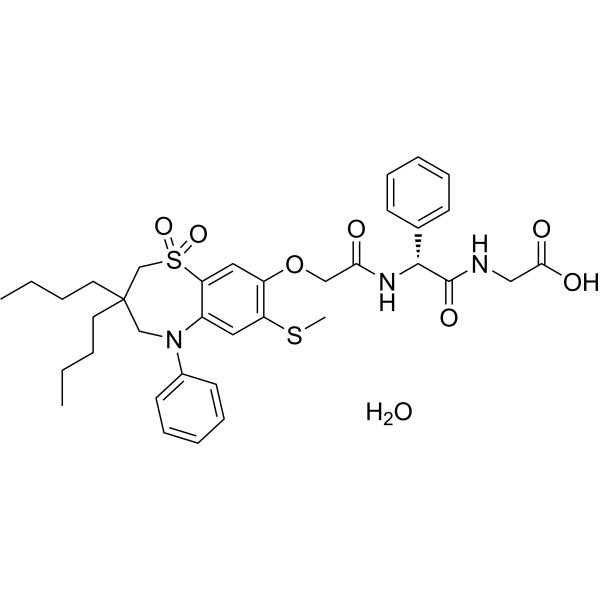
Elobixibat hydrate
Based on 2 publication(s) in Google Scholar
Elobixibat (A 3309; AZD 7806) hydrate is an orally active, bile acid transporter (IBAT) inhibitor with IC50 values ??of 0.53 nM (human IBAT), 0.13 nM (mouse IBAT), and 5.8 nM (canine IBAT). Elobixibat hydrate can lower LDL cholesterol, increase serum GLP-1, promote colonic motility, and has the potential to study metabolic syndrome. Elobixibat hydrate can be used in the study of chronic functional constipation (CIC), dyslipidemia, non-alcoholic hepatitis, and liver tumors in the elderly.
For research use only. We do not sell to patients.
- Purity : 99.34%
- CAS No.: 1633824-78-8
- Formula: C36H47N3O8S2
- Molecular Weight:713.90
-
Storage:
4°C, sealed storage, away from moisture
* In solvent : -80°C, 6 months; -20°C, 1 month (sealed storage, away from moisture)

To place orders, for customer services and technical support, please contact: MedChemExpress USA
Tel: 609-228-6898 E-mail: [email protected] [email protected]


-
 Biological Activity
-
Chemical Information
-
Solvent & Solubility
- Protocols
- Purity & Documentation
- References
-
 Help & FAQs


Publications Citing Use of MedChemExpress (MCE) Elobixibat hydrate
More

Biological Activity
Description
IC50 & Target
IC50: 0.53±0.17 nM (human IBAT), 0.13±0.03 nM (mouse IBAT), 5.8±1.6 nM (canine IBAT)[1].
In Vivo
Elobixibat (0.2, 0.6, 1.2 mg/kg/d; gavage; 5 days per week) hydrate improves NASH-related histopathology, reduces cytokine (TNF-α, IL-6, and TGF-β) expression, and normalizes gut microbial composition in a non-steatohepatitis (NASH) mouse model[3].
MedChemExpress (MCE) has not independently confirmed the accuracy of these methods. They are for reference only.
-
Animal Model:Mouse Model of Nonalcoholic Steatohepatitis (three-week-old male C57BL/6J mice)[2]
-
Dosage:0.27 mg/kg/day Elobixibat
-
Administration:p.o.; for 20 weeks
-
Result:Reduced the number and size of tumors.
Significantly reduced the number of Gram-positive bacteria in the phyla Firmicutes, Deferobacteria and Actinobacteria and increased the number of Proteobacteria.
Clinical Trial
| NCT Number | Sponsor | Condition | Start Date |
Phase

|
|---|---|---|---|---|
| NCT01329991 | 2011-05 | PHASE1 |


Chemical Information
-
CAS No. 1633824-78-8
-
Appearance Solid
-
Molecular Weight 713.90
-
Formula C36H47N3O8S2
-
Color White to off-white
-
SMILES
O=C(O)CNC([C@@H](C1=CC=CC=C1)NC(COC2=C(SC)C=C(C3=C2)N(C4=CC=CC=C4)CC(CCCC)(CCCC)CS3(=O)=O)=O)=O.O
-
Synonyms
A 3309 hydrate; AZD 7806 hydrate
-
Shipping
Room temperature in continental US; may vary elsewhere.
-
Storage
4°C, sealed storage, away from moisture
* In solvent : -80°C, 6 months; -20°C, 1 month (sealed storage, away from moisture)


Publications (2)
-
Journal Impact Factor
-
Most Recent
-
Nat Metab
Alterations in intestinal bile acid transport provide a therapeutic target in patients with post-bariatric hypoglycaemia. [Abstract]2025 Apr;7(4):792-807. PMID: 40186075 -


Solvent & Solubility
In Vitro:
DMSO : 100 mg/mL (140.08 mM; Need ultrasonic; Hygroscopic DMSO has a significant impact on the solubility of product, please use newly opened DMSO)
Please refer to the solubility information to select the appropriate solvent. Once prepared, please aliquot and store the solution to prevent product inactivation from repeated freeze-thaw cycles.
Storage method and period of stock solution: -80°C, 6 months; -20°C, 1 month (sealed storage, away from moisture). When stored at -80°C, please use it within 6 months. When stored at -20°C, please use it within 1 month.
Please refer to the solubility information to select the appropriate solvent. Once prepared, please aliquot and store the solution to prevent product inactivation from repeated freeze-thaw cycles.
Storage method and period of stock solution: -80°C, 6 months; -20°C, 1 month (sealed storage, away from moisture). When stored at -80°C, please use it within 6 months. When stored at -20°C, please use it within 1 month.
Concentration (start) × Volume (start) = Concentration (final) × Volume (final)
In Vivo:
Select the appropriate dissolution method based on your experimental animal and administration route.
- For the following dissolution methods, please ensure to first prepare a clear stock solution using an In Vitro approach and then sequentially add co-solvents:
- To ensure reliable experimental results, the clarified stock solution can be appropriately stored based on storage conditions. As for the working solution for In Vivo experiments, it is recommended to prepare freshly and use it on the same day.
- The percentages shown for the solvents indicate their volumetric ratio in the final prepared solution. If precipitation or phase separation occurs during preparation, heat and/or sonication can be used to aid dissolution.
Add each solvent one by one: 10% DMSO 40% PEG300 5% Tween-80 45% Saline
Solubility: ≥ 2.5 mg/mL (3.50 mM); Clear solution
This protocol yields a clear solution of ≥ 2.5 mg/mL (saturation unknown).
Taking 1 mL working solution as an example, add 100 μL DMSO stock solution (25.0 mg/mL) to 400 μL PEG300, and mix evenly; then add 50 μL Tween-80 and mix evenly; then add 450 μL Saline to adjust the volume to 1 mL.
Preparation of Saline: Dissolve 0.9 g sodium chloride in ddH₂O and dilute to 100 mL to obtain a clear Saline solution.
In Vivo Dissolution Calculator
Please enter the basic information of animal experiments:
-
-
-
-
Recommended: Prepare an additional quantity of animals to account for potential losses during experiments.
Please enter your animal formula composition:
-
%DMSO +
Recommended: Keep the proportion of DMSO in working solution below 2% if your animal is weak.
-
%+
-
+%Tween-80 + +
-
%Saline +
The co-solvents required include: DMSO, . All of co-solvents are available by MedChemExpress (MCE). , Tween 80. All of co-solvents are available by MedChemExpress (MCE).
Working solution concentration: 0.22 mg/mL
Method for preparing stock solution: mg drug dissolved in μL DMSO. Stock solution concentration: mg/mL. * In solvent : -80°C, 6 months; -20°C, 1 month (sealed storage, away from moisture)
1. Take μL DMSO stock solution;
2. Add μL .
μL , mix evenly;
3. Then add μL Tween 80, mix evenly;
4. Then add μL
Please ensure that the stock solution in the first step is dissolved to a clear state, and add co-solvents in sequence. You can use ultrasonic heating (ultrasonic cleaner, recommended frequency 20-40 kHz), vortexing, etc. to assist dissolution.


Purity & Documentation
-
Data Sheet (276 KB)
-
SDS (252 KB)
- English - EN (252 KB)
- Français - FR (252 KB)
- Deutsch - DE (252 KB)
- Norwegian - NO (252 KB)
- Español - ES (252 KB)
- Swedish - SV (252 KB)
- Italian - IT (252 KB)
- Korean - KR (252 KB)
- Portuguese - PT (252 KB)
-
Handling Instructions (2659 KB)
References
[1]. Wong BS, et al. Elobixibat for the treatment of constipation. Expert Opin Investig Drugs. 2013 Feb; 22(2):277-84. [Content Brief]
[2]. Sugiyama Y, et al. Impact of elobixibat on liver tumors, microbiome, and bile acid levels in a mouse model of nonalcoholic steatohepatitis. Hepatol Int. 2023 Dec;17(6):1378-1392. [Content Brief]
[3]. Yamauchi R, et al. Elobixibat, an ileal bile acid transporter inhibitor, ameliorates non-alcoholic steatohepatitis in mice. Hepatol Int. 2021 Apr;15(2):392-404. [Content Brief]


Complete Stock Solution Preparation Table
Please refer to the solubility information to select the appropriate solvent. Once prepared, please aliquot and store the solution to prevent product inactivation from repeated freeze-thaw cycles.
Storage method and period of stock solution: -80°C, 6 months; -20°C, 1 month (sealed storage, away from moisture). When stored at -80°C, please use it within 6 months. When stored at -20°C, please use it within 1 month.
| Optional Solvent | Concentration Solvent Mass | 1 mg | 5 mg | 10 mg | 25 mg |
|---|---|---|---|---|---|
| DMSO | 1 mM | 1.4008 mL | 7.0038 mL | 14.0076 mL | 35.0189 mL |
| 5 mM | 0.2802 mL | 1.4008 mL | 2.8015 mL | 7.0038 mL | |
| 10 mM | 0.1401 mL | 0.7004 mL | 1.4008 mL | 3.5019 mL | |
| 15 mM | 0.0934 mL | 0.4669 mL | 0.9338 mL | 2.3346 mL | |
| 20 mM | 0.0700 mL | 0.3502 mL | 0.7004 mL | 1.7509 mL | |
| 25 mM | 0.0560 mL | 0.2802 mL | 0.5603 mL | 1.4008 mL | |
| 30 mM | 0.0467 mL | 0.2335 mL | 0.4669 mL | 1.1673 mL | |
| 40 mM | 0.0350 mL | 0.1751 mL | 0.3502 mL | 0.8755 mL | |
| 50 mM | 0.0280 mL | 0.1401 mL | 0.2802 mL | 0.7004 mL | |
| 60 mM | 0.0233 mL | 0.1167 mL | 0.2335 mL | 0.5836 mL | |
| 80 mM | 0.0175 mL | 0.0875 mL | 0.1751 mL | 0.4377 mL | |
| 100 mM | 0.0140 mL | 0.0700 mL | 0.1401 mL | 0.3502 mL |


Elobixibat hydrate Related Classifications
HY-15790A Related Classifications
 Powered by Bioz