



ELOVL6-IN-1

Based on 1 Customer Validation
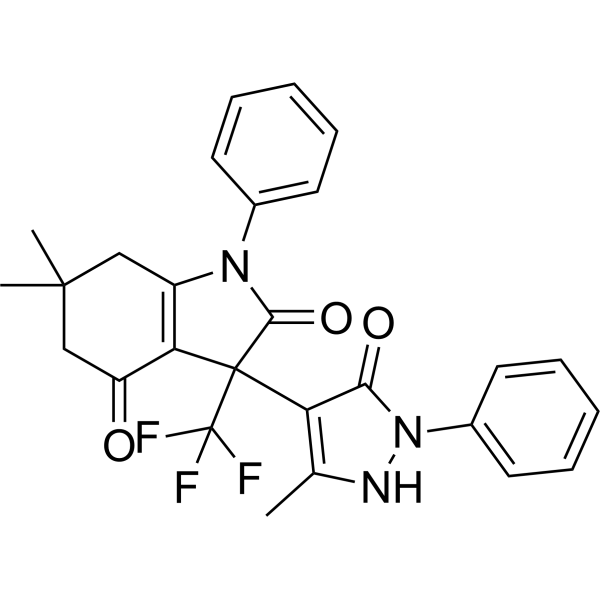
ELOVL6-IN-1 is a selective ELOVL6 inhibitor with an IC50 of 290 nM for the human target. ELOVL6-IN-1 can be used for research related to type 2 diabetes.
For research use only. We do not sell to patients.
- Purity : 99.19%
- CAS No.: 712346-06-0
- Formula: C27H24F3N3O3
- Molecular Weight:495.49
-
Storage:Powder -20°C, 3 years ; In solvent -80°C, 6 months , -20°C, 1 month

To place orders, for customer services and technical support, please contact: MedChemExpress USA
Tel: 609-228-6898 E-mail: [email protected] [email protected]


-
 Biological Activity
-
Chemical Information
-
Solvent & Solubility
- Protocols
- Purity & Documentation
- References
-
 Help & FAQs


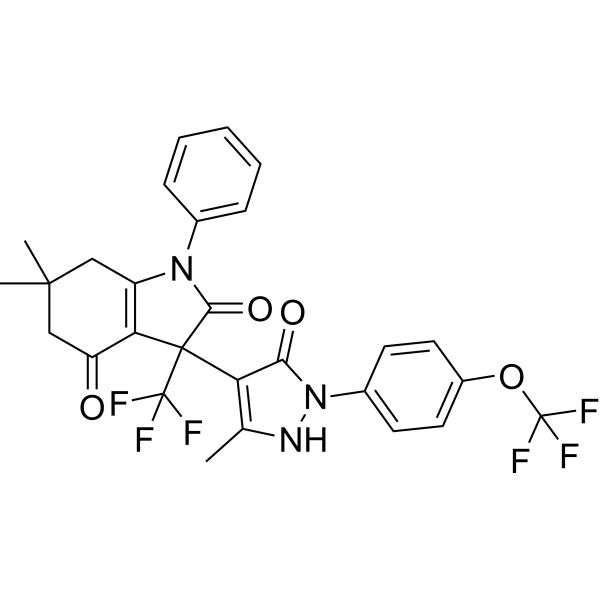

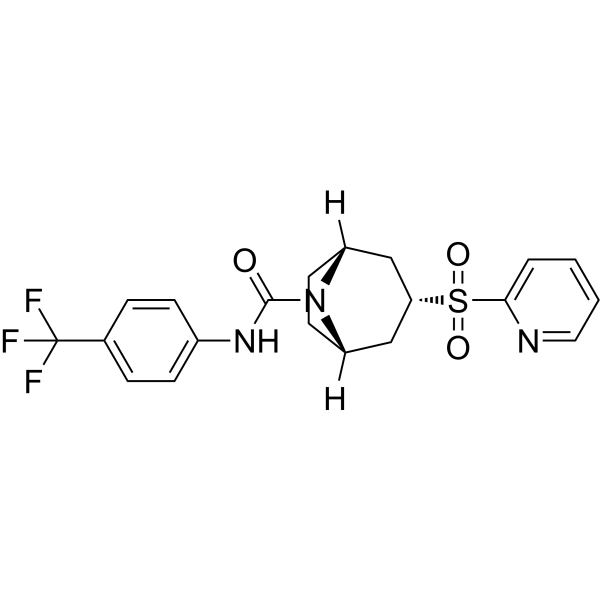


Biological Activity
Description
IC50 & Target
[1]|
ELOVL-6 290 nM (IC50) |
ELOVL3 >10 μM (IC50) |
Cellular Effect
|
Cell Line

|
Type | Value | Description | References |
|---|---|---|---|---|
| COS-7 | IC50 |
>10 nM
Compound: 1
|
Inhibition of human ELOVL3 expressed in african green monkey COS7 cells assessed as stearoyl-CoA elongation
Inhibition of human ELOVL3 expressed in african green monkey COS7 cells assessed as stearoyl-CoA elongation
|
[PMID: 19388647] |
| COS-7 | IC50 |
290 nM
Compound: 1
|
Inhibition of human ELOVL6 expressed in african green monkey COS7 cells assessed as palmitoyl-CoA elongation
Inhibition of human ELOVL6 expressed in african green monkey COS7 cells assessed as palmitoyl-CoA elongation
|
[PMID: 19388647] |
In Vitro
Compound 1 is a novel indoledione lead that inhibits human ELOVL6 with an IC50 of 290 nM[1].
Compound 1 selectively inhibits human ELOVL6 (IC50 = 290 nM) over human ELOVL3 (IC50 > 10 μM)[1].
MedChemExpress (MCE) has not independently confirmed the accuracy of these methods. They are for reference only. Further protocols information, click here.


Chemical Information
-
CAS No. 712346-06-0
-
Appearance Solid
-
Molecular Weight 495.49
-
Formula C27H24F3N3O3
-
Color White to off-white
-
SMILES
O=C1C(C2(C(F)(F)F)C(N(C3=C2C(CC(C)(C3)C)=O)C4=CC=CC=C4)=O)=C(C)NN1C5=CC=CC=C5
-
Shipping
Room temperature in continental US; may vary elsewhere.
-
Storage
Powder -20°C 3 years In solvent -80°C 6 months -20°C 1 month


Solvent & Solubility
In Vitro:
DMSO : 50 mg/mL (100.91 mM; ultrasonic and warming and heat to 60°C; Hygroscopic DMSO has a significant impact on the solubility of product, please use newly opened DMSO)
Please refer to the solubility information to select the appropriate solvent. Once prepared, please aliquot and store the solution to prevent product inactivation from repeated freeze-thaw cycles.
Storage method and period of stock solution: -80°C, 6 months; -20°C, 1 month. When stored at -80°C, please use it within 6 months. When stored at -20°C, please use it within 1 month.
Please refer to the solubility information to select the appropriate solvent. Once prepared, please aliquot and store the solution to prevent product inactivation from repeated freeze-thaw cycles.
Storage method and period of stock solution: -80°C, 6 months; -20°C, 1 month. When stored at -80°C, please use it within 6 months. When stored at -20°C, please use it within 1 month.
Concentration (start) × Volume (start) = Concentration (final) × Volume (final)

Protocols
-
Cell Cytotoxicity Assay
Cytotoxicity assays are usually based on the assessment of cell membrane damage, which can also be indirectly detected by measuring cell viability. Detection methods include MTT assay, CKK-8 assay, LDH assay and ATP assay, etc.
-
Research Protocol for Metabolic Diseases
AMP-activated protein kinase, AMPK, is a conserved cellular energy sensor that responds to reduced cellular energy status and coordinates metabolism by increasing ATP-generating catabolic pathways while suppressing ATP-consuming anabolic processes. In metabolic disease research, the AMPK pathway is experimentally relevant because it regulates hepatic lipid synthesis, fatty acid oxidation, glucose production, skeletal-muscle glucose disposal, mTORC1-linked biosynthesis, autophagy, mitochondrial homeostasis, and whole-body energy balance. The central pathway logic is that energy stress, metformin, exercise-like stimulation, or direct AMPK activators increase AMPKα Thr172 phosphorylation and downstream substrate phosphorylation, including ACC and RAPTOR. Phosphorylation of ACC suppresses lipogenesis and supports fatty acid oxidation, whereas phosphorylation of RAPTOR suppresses mTORC1 signaling and links cellular energy status to growth and protein synthesis control. The pathway is linked


Purity & Documentation
-
Data Sheet (318 KB)
-
SDS (252 KB)
- English - EN (252 KB)
- Français - FR (252 KB)
- Deutsch - DE (252 KB)
- Norwegian - NO (252 KB)
- Español - ES (252 KB)
- Swedish - SV (252 KB)
- Italian - IT (252 KB)
- Korean - KR (252 KB)
- Portuguese - PT (252 KB)
-
Handling Instructions (2659 KB)
References


Complete Stock Solution Preparation Table
Please refer to the solubility information to select the appropriate solvent. Once prepared, please aliquot and store the solution to prevent product inactivation from repeated freeze-thaw cycles.
Storage method and period of stock solution: -80°C, 6 months; -20°C, 1 month. When stored at -80°C, please use it within 6 months. When stored at -20°C, please use it within 1 month.
| Optional Solvent | Concentration Solvent Mass | 1 mg | 5 mg | 10 mg | 25 mg |
|---|---|---|---|---|---|
| DMSO | 1 mM | 2.0182 mL | 10.0910 mL | 20.1820 mL | 50.4551 mL |
| 5 mM | 0.4036 mL | 2.0182 mL | 4.0364 mL | 10.0910 mL | |
| 10 mM | 0.2018 mL | 1.0091 mL | 2.0182 mL | 5.0455 mL | |
| 15 mM | 0.1345 mL | 0.6727 mL | 1.3455 mL | 3.3637 mL | |
| 20 mM | 0.1009 mL | 0.5046 mL | 1.0091 mL | 2.5228 mL | |
| 25 mM | 0.0807 mL | 0.4036 mL | 0.8073 mL | 2.0182 mL | |
| 30 mM | 0.0673 mL | 0.3364 mL | 0.6727 mL | 1.6818 mL | |
| 40 mM | 0.0505 mL | 0.2523 mL | 0.5046 mL | 1.2614 mL | |
| 50 mM | 0.0404 mL | 0.2018 mL | 0.4036 mL | 1.0091 mL | |
| 60 mM | 0.0336 mL | 0.1682 mL | 0.3364 mL | 0.8409 mL | |
| 80 mM | 0.0252 mL | 0.1261 mL | 0.2523 mL | 0.6307 mL | |
| 100 mM | 0.0202 mL | 0.1009 mL | 0.2018 mL | 0.5046 mL |


ELOVL6-IN-1 Related Classifications
HY-139451 Related Classifications
 Powered by Bioz