



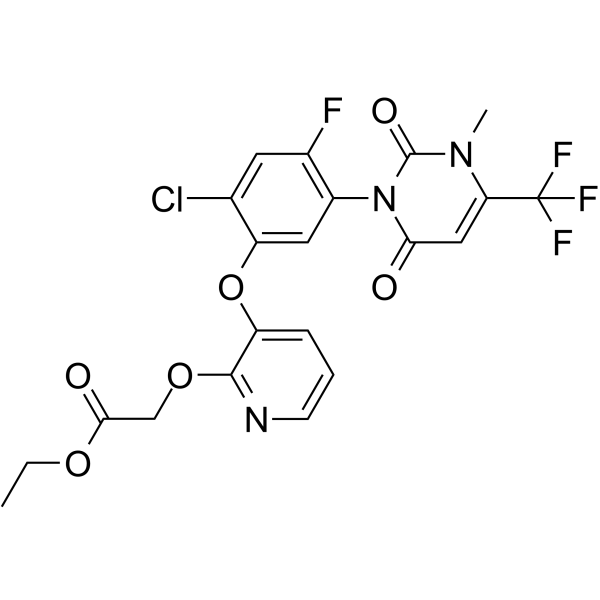
Epyrifenacil

Based on 1 Customer Validation
Epyrifenacil is a protoporphyrinogen oxidase (PPO) inhibiting herbicide, potently targeting the PPO2 isoform from weeds such as Amaranthus palmeri with an IC50 of 0.637 nM. Epyrifenacil also inhibits liver mitochondrial PPO across species, with IC50 values of 2.2 nM (mouse), 2.6 nM (rat), 12.1 nM (rabbit), 7.6 nM (dog), and 10.2 nM (human). Epyrifenacil induces liver tumor development in mice. Epyrifenacil can be used for weed control, and also used as a tool compound in toxicological research to study the mechanism of PPO inhibition, chemical-induced hepatotoxicity, and the mode of action of non-genotoxic carcinogens in rodents[3].
Nur für Forschungszwecke. Wir verkaufen nicht an Patienten.
- Reinheit : 99.04%
- CAS. Nr.: 353292-31-6
- Formel: C21H16ClF4N3O6
- Molecular Weight:517.81
-
Speicherung:Powder -20°C, 3 years ; In solvent -80°C, 6 months , -20°C, 1 month

To place orders, for customer services and technical support, please contact: MedChemExpress USA
Tel: 609-228-6898 E-mail: [email protected] [email protected]


-
 Biologische Aktivität
-
Chemical Information
-
Lösungsmittel & Löslichkeit
- Protokoll
- Reinheit & Dokumentation
- Verweise
-
 Help & FAQs




Biologische Aktivität
Beschreibung
In Vitro
Epyrifenacil (156-5000 μg/plate) shows no genotoxic potential in the bacterial reverse mutation test[2].
Epyrifenacil (1.9-120.0 μg/mL) shows no genotoxic potential in the mammalian cell gene mutation test[2].
Epyrifenacil (15.6-125 μg/mL) shows no genotoxic potential in the mammalian chromosomal aberration test[2].
Epyrifenacil (40 ppm) exhibits systemic herbicidal activity in three-leaf stage wild soybean plants, completely killing whole plants including shoot apical meristems within 5 days of foliar application at 40 ppm[3].
Epyrifenacil (20 g a.i. ha-1) provides complete control of barnyardgrass and Italian ryegrass in glasshouse pot trials when applied as a late-post foliar spray at 20 g a.i. ha-1[3].
MedChemExpress (MCE) has not independently confirmed the accuracy of these methods. They are for reference only. Further protocols information, click here.
In Vivo
Epyrifenacil (50, 300, and 800 ppm; dietary; ad libitum daily; 90 days) induces dose-dependent hepatotoxicity and anemia in Crl:CD(SD) rats, with NOAELs of 3 mg/kg bw/day for males and 19 mg/kg bw/day for females[1].
Epyrifenacil (100, 300, and 1000 mg/kg; p.o.; daily; 90 days) induces dose-dependent anemia and liver glycogen elevation in TOYO beagles, with NOAELs of 100 mg/kg bw/day for males and 300 mg/kg bw/day for females, and no evident hepatocyte injury[1].
MedChemExpress (MCE) has not independently confirmed the accuracy of these methods. They are for reference only.
-
Animal Model:Crl:CD1(ICR) mice[1]
-
Dosage:5; 25; 100 ppm
-
Administration:dietary; ad libitum daily; 90 days
-
Result:Induced hepatocyte injury characterized by hepatocellular degeneration/necrosis and/or single-cell necrosis/apoptosis, hepatocellular hypertrophy, and anemia.
Exhibited NOAEL of 0.7 mg/kg bw/day for males and 4.1 mg/kg bw/day for females.
-
Animal Model:Crl:CD(SD) rats[1]
-
Dosage:50; 300; 800 ppm
-
Administration:dietary; ad libitum daily; 90 days
-
Result:Induced hepatocyte injury characterized by hepatocellular degeneration/necrosis and/or single-cell necrosis/apoptosis, hepatocellular hypertrophy, and anemia.
Exhibited NOAEL of 3 mg/kg bw/day for males and 19 mg/kg bw/day for females.
-
Animal Model:TOYO dogs[1]
-
Dosage:100; 300; 1000 mg/kg/day
-
Administration:p.o.; daily; 90 days
-
Result:Induced anemia and increased liver glycogen associated with increased alkaline phosphatase (ALP), with no evident hepatocyte injury.
Exhibited NOAEL of 100 mg/kg bw/day for males and 300 mg/kg bw/day for females.


Chemical Information
-
CAS. Nr. 353292-31-6
-
Appearance Solid
-
Molecular Weight 517.81
-
Formel C21H16ClF4N3O6
-
Color White to off-white
-
SMILES
FC(C(N(C)C1=O)=CC(N1C2=C(F)C=C(Cl)C(OC3=CC=CN=C3OCC(OCC)=O)=C2)=O)(F)F
-
Versand
Room temperature in continental US; may vary elsewhere.
-
Speicherung
Powder -20°C 3 years In solvent -80°C 6 months -20°C 1 month


Lösungsmittel & Löslichkeit
In Vitro:
DMSO : 100 mg/mL (193.12 mM; Need ultrasonic; Hygroscopic DMSO has a significant impact on the solubility of product, please use newly opened DMSO)
Please refer to the solubility information to select the appropriate solvent. Once prepared, please aliquot and store the solution to prevent product inactivation from repeated freeze-thaw cycles.
Storage method and period of stock solution: -80°C, 6 months; -20°C, 1 month. When stored at -80°C, please use it within 6 months. When stored at -20°C, please use it within 1 month.
Please refer to the solubility information to select the appropriate solvent. Once prepared, please aliquot and store the solution to prevent product inactivation from repeated freeze-thaw cycles.
Storage method and period of stock solution: -80°C, 6 months; -20°C, 1 month. When stored at -80°C, please use it within 6 months. When stored at -20°C, please use it within 1 month.
Konzentration (Stammlösung) × Volumen (Stammlösung) = Konzentration (Ziellösung) × Volumen (Ziellösung)
In Vivo:
Select the appropriate dissolution method based on your experimental animal and administration route.
- For the following dissolution methods, please ensure to first prepare a clear stock solution using an In Vitro approach and then sequentially add co-solvents:
- To ensure reliable experimental results, the clarified stock solution can be appropriately stored based on storage conditions. As for the working solution for In Vivo experiments, it is recommended to prepare freshly and use it on the same day.
- The percentages shown for the solvents indicate their volumetric ratio in the final prepared solution. If precipitation or phase separation occurs during preparation, heat and/or sonication can be used to aid dissolution.
In Vivo Dissolution Calculator
Please enter the basic information of animal experiments:
-
-
-
-
Recommended: Prepare an additional quantity of animals to account for potential losses during experiments.
Please enter your animal formula composition:
-
%DMSO +
Recommended: Keep the proportion of DMSO in working solution below 2% if your animal is weak.
-
%+
-
+%Tween-80 + +
-
%Saline +
The co-solvents required include: DMSO, . All of co-solvents are available by MedChemExpress (MCE). , Tween 80. All of co-solvents are available by MedChemExpress (MCE).
Working solution concentration: 0.22 mg/mL
Method for preparing stock solution: mg drug dissolved in μL DMSO. Stock solution concentration: mg/mL.
1. Take μL DMSO stock solution;
2. Add μL .
μL , mix evenly;
3. Then add μL Tween 80, mix evenly;
4. Then add μL
Please ensure that the stock solution in the first step is dissolved to a clear state, and add co-solvents in sequence. You can use ultrasonic heating (ultrasonic cleaner, recommended frequency 20-40 kHz), vortexing, etc. to assist dissolution.

Protokoll
-
Liver Cancer Modeling
Liver cancer can be classified into primary liver cancer and secondary liver cancer. Secondary liver cancer is the metastatic liver cancer. Primary liver cancer includes hepatocellular carcinoma (HCC), intrahepatic cholangiocarcinoma (ICC) and fibrolamellar HCC, of which HCC is the most common form, accounting for approximately 90% of primary liver cancers[1]. HCC mouse models include chemical agent-induced models, transplanted tumor models, and genetic engineered models.
-
Hepatotoxicity Study
This protocol evaluates hepatotoxicity using complementary in vivo mouse APAP acute liver injury and in vitro hepatocyte-based cytotoxicity readouts. In vivo APAP injury is assessed by serum ALT/AST, liver histology, hepatic glutathione, protein adducts, necrosis, inflammation, and regeneration-related endpoints. In vitro hepatotoxicity is assessed by loss of viability, leakage of ALT/AST/LDH, oxidative-stress markers, mitochondrial function, nuclear morphology, intracellular calcium, and high-content imaging endpoints.
-
Genotoxicity/Mutagenicity Study
The bacterial reverse mutation assay detects point mutations that restore amino-acid prototrophy in auxotrophic Salmonella typhimurium or Escherichia coli tester strains; after exposure to a test article, mutagenic activity is read out as an increased number of revertant colonies on minimal agar compared with the vehicle control. The assay uses tester strains with different mutation targets so that base-substitution and frameshift mutagens can be detected, and testing is performed with and without exogenous mammalian metabolic activation because some chemicals require biotransformation to become mutagenic.


Reinheit & Dokumentation
-
Data Sheet (278 KB)
-
SDS (398 KB)
- English - EN (398 KB)
- Français - FR (398 KB)
- Deutsch - DE (398 KB)
- Norwegian - NO (398 KB)
- Español - ES (398 KB)
- Swedish - SV (398 KB)
- Italian - IT (398 KB)
- Korean - KR (398 KB)
- Portuguese - PT (398 KB)
-
Handling Instructions (2659 KB)
Verweise
[1]. Matsunaga K, et al. Comparative hepatotoxicity of a herbicide, epyrifenacil, in humans and rodents by comparing the dynamics and kinetics of its causal metabolite. J Pestic Sci. 2021;46(4):333-341. [Content Brief]
[2]. Fukunaga S, et al. Evaluation of the mode of action and human relevance of liver tumors in male mice treated with epyrifenacil. Regul Toxicol Pharmacol. 2022;136:105268. [Content Brief]
[3]. Sada Y, et al. Epyrifenacil, a new systemic PPO-inhibiting herbicide for broad-spectrum weed control. Pest Manag Sci. 2025;81(5):2463-2468. [Content Brief]


Complete Stock Solution Preparation Table
Please refer to the solubility information to select the appropriate solvent. Once prepared, please aliquot and store the solution to prevent product inactivation from repeated freeze-thaw cycles.
Storage method and period of stock solution: -80°C, 6 months; -20°C, 1 month. When stored at -80°C, please use it within 6 months. When stored at -20°C, please use it within 1 month.
| Optional Solvent | Concentration Solvent Mass | 1 mg | 5 mg | 10 mg | 25 mg |
|---|---|---|---|---|---|
| DMSO | 1 mM | 1.9312 mL | 9.6561 mL | 19.3121 mL | 48.2803 mL |
| 5 mM | 0.3862 mL | 1.9312 mL | 3.8624 mL | 9.6561 mL | |
| 10 mM | 0.1931 mL | 0.9656 mL | 1.9312 mL | 4.8280 mL | |
| 15 mM | 0.1287 mL | 0.6437 mL | 1.2875 mL | 3.2187 mL | |
| 20 mM | 0.0966 mL | 0.4828 mL | 0.9656 mL | 2.4140 mL | |
| 25 mM | 0.0772 mL | 0.3862 mL | 0.7725 mL | 1.9312 mL | |
| 30 mM | 0.0644 mL | 0.3219 mL | 0.6437 mL | 1.6093 mL | |
| 40 mM | 0.0483 mL | 0.2414 mL | 0.4828 mL | 1.2070 mL | |
| 50 mM | 0.0386 mL | 0.1931 mL | 0.3862 mL | 0.9656 mL | |
| 60 mM | 0.0322 mL | 0.1609 mL | 0.3219 mL | 0.8047 mL | |
| 80 mM | 0.0241 mL | 0.1207 mL | 0.2414 mL | 0.6035 mL | |
| 100 mM | 0.0193 mL | 0.0966 mL | 0.1931 mL | 0.4828 mL |


Epyrifenacil Related Classifications
HY-139838 Related Classifications
 Powered by Bioz