



PLP (139-151)
Based on 1 publication(s) in Google Scholar
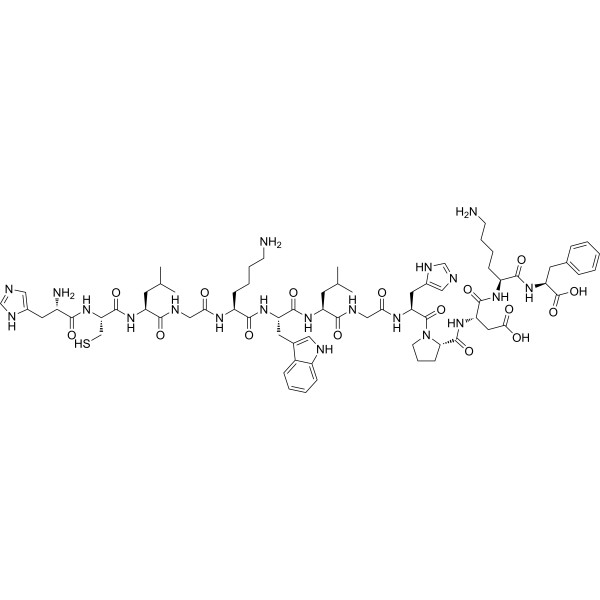
PLP (139-151) is amino acid residue 139 to 151 of myelin proteolipid protein (PLP) used to induce experimental autoimmune encephalomyelitis (EAE).
For research use only. We do not sell to patients.
- Purity : 98.18%
- CAS No.: 131334-43-5
- Formula: C72H104N20O16S
- Molecular Weight:1537.79
-
Storage:
Sealed storage, away from moisture.
Powder -80°C, 2 years , -20°C, 1 year* In solvent : -80°C, 6 months; -20°C, 1 month (sealed storage, away from moisture)

To place orders, for customer services and technical support, please contact: MedChemExpress USA
Tel: 609-228-6898 E-mail: [email protected] [email protected]


-
 Biological Activity
-
Chemical Information
-
Solvent & Solubility
- Purity & Documentation
- References
-
 Help & FAQs


Publications Citing Use of MedChemExpress (MCE) PLP (139-151)
More

Biological Activity
Description
In Vitro
Severe clinical and histological EAE could be induced by adoptive transfer of the peptide-specific T cell line and 3 of 4 T cell clones. The T cell line/clones all responded strongly to PLP (139-151) in in vitro proliferative assays. Line SPL and all of the clones show strong proliferative response to the whole PLP molecule and to PLP (139-151)[1].
MedChemExpress (MCE) has not independently confirmed the accuracy of these methods. They are for reference only.
Induced Disease Models
Please do not refer to only one article to determine the experimental conditions. It is recommended to determine the optimal experimental conditions (animal strain, age, dosage, frequency and cycle, detection time and indicators, etc.) through preliminary experiments before the formal experiment.
PLP (139-151) can be used in animal modeling to create relapsing-remitting experimental autoimmune encephalomyelitis (RR-EAE) models. The pro-inflammatory cytokine IL-17 plays a crucial role in the PLP (139-151)-induced encephalomyelitis process. After subcutaneous injection of PLP (139-151) into mice, CD4 cells that specifically respond to PLP (139-151) and release pro-inflammatory cytokines migrate to and accumulate in the damaged central nervous system (CNS) regions[4][5].
Administration: 100 μg • sc • single dose
2. One day after the subcutaneous injection of PLP (139-151), perform an intraperitoneal injection of 100 μl (2 ng/μl, dissolved in phosphate-buffered saline (PBS)) of Bordetella pertussis toxin (BPX) to further enhance the mouse's immune response to PLP (139-151).
3. Monitor the mice daily for changes in body weight and clinical status. Perform neurological evaluations using a clinical score (CS) system with the following scale: 0 for no abnormalities; 0.5 for a drooping tail tip; 1 for a limp tail; 1.5 for hind limb dysfunction; 2 for hind limb weakness; 2.5 for dragging hind limbs; 3 for hind limb paralysis; 3.5 for complete hind limb paralysis with the mouse unable to right itself when placed on its side; and 4 for complete hind limb paralysis and partial front limb paralysis.
4. Isolate mice with early clinical symptoms of encephalomyelitis in separate cages with easier access to food and water. Dehydrated mice should receive an intraperitoneal injection of saline solution at least once a day.
Histological Changes: Resulted iron deposits in the cerebellum, medulla, and spinal cord of the mice.
Molecular Changes: Enhanced the immune signals of TSPO and Iba1 (markers of microglia and macrophage activation) in immunohistochemical results, indicating that microglia and macrophages were activated.
MedChemExpress (MCE) has not independently confirmed the accuracy of these methods. They are for reference only.


Chemical Information
-
CAS No. 131334-43-5
-
Appearance Solid
-
Molecular Weight 1537.79
-
Formula C72H104N20O16S
-
Color White to off-white
-
Sequence
His-Cys-Leu-Gly-Lys-Trp-Leu-Gly-His-Pro-Asp-Lys-Phe
-
Sequence Shortening
HCLGKWLGHPDKF
-
Shipping
Room temperature in continental US; may vary elsewhere.
-
Storage
Sealed storage, away from moisture
Powder -80°C 2 years -20°C 1 year * In solvent : -80°C, 6 months; -20°C, 1 month (sealed storage, away from moisture)


Publications (1)
-
Journal Impact Factor
-
Most Recent
-
Immunity
Cognate interaction-dependent pathogenicity of meningeal B cells drives neuroinflammation relapse. [Abstract]2025 Jul 8:S1074-7613(25)00285-7. PMID: 40669468


Solvent & Solubility
In Vitro:
H2O : 100 mg/mL (65.03 mM; Need ultrasonic)
Please refer to the solubility information to select the appropriate solvent. Once prepared, please aliquot and store the solution to prevent product inactivation from repeated freeze-thaw cycles.
Storage method and period of stock solution: -80°C, 6 months; -20°C, 1 month (sealed storage, away from moisture). When stored at -80°C, please use it within 6 months. When stored at -20°C, please use it within 1 month.
* Note: If you choose water as the stock solution, please dilute it to the working solution, then filter and sterilize it with a 0.22 μm filter before use.
Please refer to the solubility information to select the appropriate solvent. Once prepared, please aliquot and store the solution to prevent product inactivation from repeated freeze-thaw cycles.
Storage method and period of stock solution: -80°C, 6 months; -20°C, 1 month (sealed storage, away from moisture). When stored at -80°C, please use it within 6 months. When stored at -20°C, please use it within 1 month.
* Note: If you choose water as the stock solution, please dilute it to the working solution, then filter and sterilize it with a 0.22 μm filter before use.
Concentration (start) × Volume (start) = Concentration (final) × Volume (final)
In Vivo:
For the following dissolution methods, please prepare the working solution directly:
It is recommended to prepare fresh solutions and use them promptly within a short period of time.
The percentages shown for the solvents indicate their volumetric ratio in the final prepared solution. If precipitation or phase separation occurs during preparation, heat and/or sonication can be used to aid dissolution.
Add each solvent one by one: PBS
Solubility: 50 mg/mL (32.51 mM); Clear solution; Need ultrasonic


Purity & Documentation
-
Data Sheet (281 KB)
-
SDS (254 KB)
- English - EN (254 KB)
- Français - FR (254 KB)
- Deutsch - DE (254 KB)
- Norwegian - NO (254 KB)
- Español - ES (254 KB)
- Swedish - SV (254 KB)
- Italian - IT (254 KB)
- Korean - KR (254 KB)
- Portuguese - PT (254 KB)
-
Handling Instructions (2659 KB)
References
[1]. Kuchroo VK, et al. Induction of experimental allergic encephalomyelitis by myelin proteolipid-protein-specific T cell clones and synthetic peptides. Pathobiology. 1991;59(5):305-12. [Content Brief]
[2]. Sobel RA, et al. Acute experimental allergic encephalomyelitis in SJL/J mice induced by a synthetic peptide ofmyelin proteolipid protein. J Neuropathol Exp Neurol. 1990 Sep;49(5):468-79. [Content Brief]
[3]. Bebo BF Jr, et al. Male SJL mice do not relapse after induction of EAE with PLP 139-151. J Neurosci Res. 1996 Sep 15;45(6):680-9. [Content Brief]
[4]. Coda AR, et al. In vivo imaging of CNS microglial activation/macrophage infiltration with combined [18F]DPA-714-PET and SPIO-MRI in a mouse model of relapsing remitting experimental autoimmune encephalomyelitis. Eur J Nucl Med Mol Imaging. 2021 Jan;48(1):40-52. [Content Brief]
[5]. Turvey ME, et al. Quantitative proteome profiling of CNS-infiltrating autoreactive CD4+ cells reveals selective changes during experimental autoimmune encephalomyelitis. J Proteome Res. 2014 Aug 1;13(8):3655-70. [Content Brief]
[6]. Zhang H, et al. Intrinsic and induced regulation of the age-associated onset of spontaneous experimental autoimmune encephalomyelitis. J Immunol. 2008 Oct 1;181(7):4638-47. [Content Brief]


Complete Stock Solution Preparation Table
Please refer to the solubility information to select the appropriate solvent. Once prepared, please aliquot and store the solution to prevent product inactivation from repeated freeze-thaw cycles.
Storage method and period of stock solution: -80°C, 6 months; -20°C, 1 month (sealed storage, away from moisture). When stored at -80°C, please use it within 6 months. When stored at -20°C, please use it within 1 month.
| Optional Solvent | Concentration Solvent Mass | 1 mg | 5 mg | 10 mg | 25 mg |
|---|---|---|---|---|---|
| H2O | 1 mM | 0.6503 mL | 3.2514 mL | 6.5028 mL | 16.2571 mL |
| 5 mM | 0.1301 mL | 0.6503 mL | 1.3006 mL | 3.2514 mL | |
| 10 mM | 0.0650 mL | 0.3251 mL | 0.6503 mL | 1.6257 mL | |
| 15 mM | 0.0434 mL | 0.2168 mL | 0.4335 mL | 1.0838 mL | |
| 20 mM | 0.0325 mL | 0.1626 mL | 0.3251 mL | 0.8129 mL | |
| 25 mM | 0.0260 mL | 0.1301 mL | 0.2601 mL | 0.6503 mL | |
| 30 mM | 0.0217 mL | 0.1084 mL | 0.2168 mL | 0.5419 mL | |
| 40 mM | 0.0163 mL | 0.0813 mL | 0.1626 mL | 0.4064 mL | |
| 50 mM | 0.0130 mL | 0.0650 mL | 0.1301 mL | 0.3251 mL | |
| 60 mM | 0.0108 mL | 0.0542 mL | 0.1084 mL | 0.2710 mL |
* Note: If you choose water as the stock solution, please dilute it to the working solution, then filter and sterilize it with a 0.22 μm filter before use.


PLP (139-151) Related Classifications
HY-P0129 Related Classifications
 Powered by Bioz