



Gap 26 TFA
Based on 9 publication(s) in Google Scholar
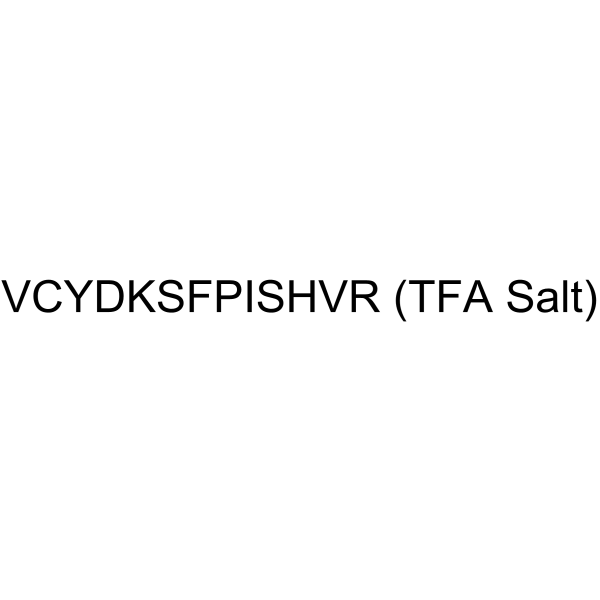
Gap 26 TFA is a connexin mimetic peptide, composed of residue numbers 63-75 of the first extracellular loop of connexin 43 (gap junction blocker), containing the SHVR amino acid motif.
For research use only. We do not sell to patients.
- Purity : 99.68%
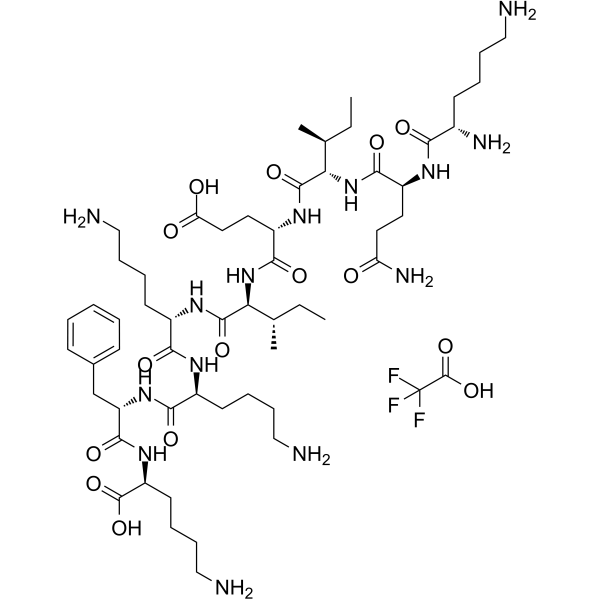
- Formula: C70H107N19O19S·xC2HF3O2
- Molecular Weight:1550.78 (free base)
-
Storage:
Sealed storage, away from moisture.
Powder -80°C, 2 years , -20°C, 1 year* In solvent : -80°C, 6 months; -20°C, 1 month (sealed storage, away from moisture)

To place orders, for customer services and technical support, please contact: MedChemExpress USA
Tel: 609-228-6898 E-mail: [email protected] [email protected]


-
 Biological Activity
-
Chemical Information
-
Solvent & Solubility
- Purity & Documentation
- References
-
 Help & FAQs


Publications Citing Use of MedChemExpress (MCE) Gap 26 TFA
More- Cell Metab. 2021 Feb 2;33(2):283-299.e9. [Abstract]
- J Ethnopharmacol. 2026 Nov 15:370:122013. [Abstract]
- Toxicology. 2022 Aug:478:153283. [Abstract]
- Lab Invest. 2022 Jan;102(1):90-101. [Abstract]
- J Immunol. 2025 Jan 1;214(1):130-140. [Abstract]
- ACS Chem Biol. 2020 Jun 19;15(6):1392-1400. [Abstract]
- Medicina (Kaunas). 2024 May 8;60(5):780. [Abstract]
- Cureus. 2024 Apr 26;16(4):e59053. [Abstract]
- Biomed Pharmacother. 2022 Apr 22;150:112973. [Abstract]


Biological Activity
Description
In Vitro
Gap 26 (0.25 mg/mL, 30 min) reduces the wave size in the three cell lines (RBE4, SV-ARBEC and ECV304). Gap 26 (0.25 mg/mL, 30 min) completely abolishes the InsP3-triggered ATP response and reduced the ATP release to below the control level, indicating that the basal ATP release is also affected[1].
Gap 26 does indeed significantly inhibit our InsP3-triggered intercellular calcium waves, but it did not have any effect on dye coupling through junctional channels as evidenced by the FRAP experiments, despite the fact that connexin 43 was present in the cell lines used[1].
Gap 26 (100-300 μM) dose-dependently reduces the rhythmic responses of rabbit superior mesenteric arteries, with IC50 of 28.4 ± 3.4 μM[2].
MedChemExpress (MCE) has not independently confirmed the accuracy of these methods. They are for reference only.


Chemical Information
-
Appearance Solid
-
Molecular Weight 1550.78 (free base)
-
Formula C70H107N19O19S·xC2HF3O2
-
Color White to off-white
-
Sequence
Val-Cys-Tyr-Asp-Lys-Ser-Phe-Pro-Ile-Ser-His-Val-Arg
-
Sequence Shortening
VCYDKSFPISHVR
-
Shipping
Room temperature in continental US; may vary elsewhere.
-
Storage
Sealed storage, away from moisture
Powder -80°C 2 years -20°C 1 year * In solvent : -80°C, 6 months; -20°C, 1 month (sealed storage, away from moisture)


Publications (9)
-
Journal Impact Factor
-
Most Recent
-
Cell Metab
Platelets Facilitate the Wound-Healing Capability of Mesenchymal Stem Cells by Mitochondrial Transfer and Metabolic Reprogramming. [Abstract]2021 Feb 2;33(2):283-299.e9. PMID: 33400911 -
J Ethnopharmacol
Qishen paste improves cardiac conduction in heart failure by regulating cardiac resident macrophage Connexin43. [Abstract]2026 Nov 15:370:122013. PMID: 42269798 -
Toxicology
Oxidative stress and Cx43-mediated apoptosis are involved in PFOS-induced nephrotoxicity. [Abstract]2022 Aug:478:153283. PMID: 35934180 -
Lab Invest
Bioglass promotes wound healing by inhibiting endothelial cell pyroptosis through regulation of the connexin 43/reactive oxygen species (ROS) signaling pathway. [Abstract]2022 Jan;102(1):90-101. PMID: 34521991 -
J Immunol
Plasmacytoid dendritic cell sensing of African swine fever virus-infected macrophages results in STING-dependent robust interferon-α production. [Abstract]2025 Jan 1;214(1):130-140. PMID: 40073264 -
ACS Chem Biol
Cyanopyrrolidine Inhibitors of Ubiquitin Specific Protease 7 Mediate Desulfhydration of the Active-Site Cysteine. [Abstract]2020 Jun 19;15(6):1392-1400. PMID: 32302100 -
Medicina (Kaunas)
Comprehensive Pan-Cancer Analysis of Connexin 43 as a Potential Biomarker and Therapeutic Target in Human Kidney Renal Clear Cell Carcinoma (KIRC). [Abstract]2024 May 8;60(5):780. PMID: 38792963 -
Cureus
2024 Apr 26;16(4):e59053. PMID: 38680825 -
Biomed Pharmacother
Dioscin potentiates the antitumor effect of suicide gene therapy in melanoma by gap junction intercellular communication-mediated antigen cross-presentation. [Abstract]2022 Apr 22;150:112973. PMID: 35468581


Solvent & Solubility
In Vitro:
DMSO : 100 mg/mL (Need ultrasonic; Hygroscopic DMSO has a significant impact on the solubility of product, please use newly opened DMSO)
H2O : 50 mg/mL (Need ultrasonic)
In Vivo:
Select the appropriate dissolution method based on your experimental animal and administration route.
- For the following dissolution methods, please ensure to first prepare a clear stock solution using an In Vitro approach and then sequentially add co-solvents:
- To ensure reliable experimental results, the clarified stock solution can be appropriately stored based on storage conditions. As for the working solution for In Vivo experiments, it is recommended to prepare freshly and use it on the same day.
- The percentages shown for the solvents indicate their volumetric ratio in the final prepared solution. If precipitation or phase separation occurs during preparation, heat and/or sonication can be used to aid dissolution.
Add each solvent one by one: 10% DMSO 40% PEG300 5% Tween-80 45% Saline
Solubility: ≥ 2.5 mg/mL; Clear solution
This protocol yields a clear solution of ≥ 2.5 mg/mL (saturation unknown).
Taking 1 mL working solution as an example, add 100 μL DMSO stock solution (25.0 mg/mL) to 400 μL PEG300, and mix evenly; then add 50 μL Tween-80 and mix evenly; then add 450 μL Saline to adjust the volume to 1 mL.
Preparation of Saline: Dissolve 0.9 g sodium chloride in ddH₂O and dilute to 100 mL to obtain a clear Saline solution.
Add each solvent one by one: 10% DMSO 90% (20% SBE-β-CD in Saline)
Solubility: ≥ 2.5 mg/mL; Clear solution
This protocol yields a clear solution of ≥ 2.5 mg/mL (saturation unknown).
Taking 1 mL working solution as an example, add 100 μL DMSO stock solution (25.0 mg/mL) to 900 μL 20% SBE-β-CD in Saline, and mix evenly.
Preparation of 20% SBE-β-CD in Saline (4°C, storage for one week): 2 g SBE-β-CD powder is dissolved in 10 mL Saline, completely dissolve until clear.
For the following dissolution methods, please prepare the working solution directly:
It is recommended to prepare fresh solutions and use them promptly within a short period of time.
The percentages shown for the solvents indicate their volumetric ratio in the final prepared solution. If precipitation or phase separation occurs during preparation, heat and/or sonication can be used to aid dissolution.
Add each solvent one by one: PBS
Solubility: 100 mg/mL; Clear solution; Need ultrasonic
In Vivo Dissolution Calculator
Please enter the basic information of animal experiments:
-
-
-
-
Recommended: Prepare an additional quantity of animals to account for potential losses during experiments.
Working solution concentration: 0.22 mg/mL
This product has good water solubility, please refer to the measured solubility data in water/PBS/Saline for details.


Purity & Documentation
-
Data Sheet (273 KB)
-
SDS (252 KB)
- English - EN (252 KB)
- Français - FR (252 KB)
- Deutsch - DE (252 KB)
- Norwegian - NO (252 KB)
- Español - ES (252 KB)
- Swedish - SV (252 KB)
- Italian - IT (252 KB)
- Korean - KR (252 KB)
- Portuguese - PT (252 KB)
-
Handling Instructions (2659 KB)
References
[1]. Katleen Braet, et al. Photoliberating inositol-1,4,5-trisphosphate triggers ATP release that is blocked by the connexin mimetic peptide gap 26. Cell Calcium. 2003 Jan;33(1):37-48. [Content Brief]
[2]. Chaytor AT, et al. Peptides homologous to extracellular loop motifs of connexin 43 reversibly abolish rhythmic contractile activity in rabbit arteries. J Physiol. 1997 Aug 15;503 ( Pt 1):99-110. [Content Brief]

Calculators
Concentration (start) × Volume (start) = Concentration (final) × Volume (final)


Gap 26 TFA Related Classifications
HY-P1082A Related Classifications
 Powered by Bioz