



Estrogen receptor antagonist 7
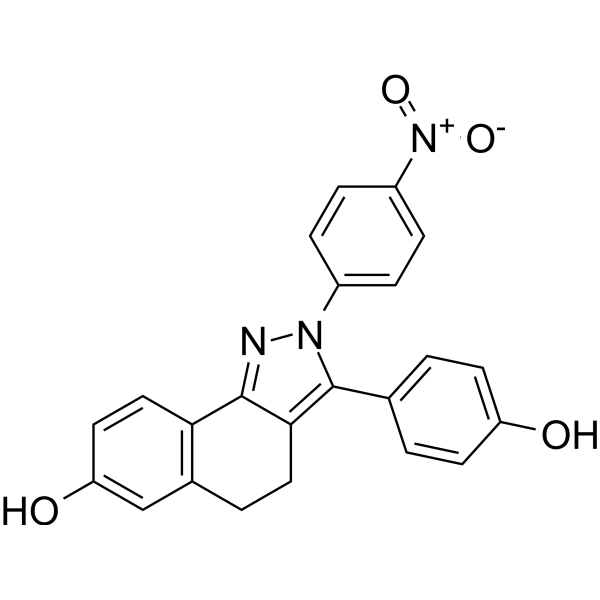
Estrogen receptor antagonist 7 (compound 13) is a potent estrogen receptors (ER) antagonist. Estrogen receptor antagonist 7 has antiproliferative activity against breast and ovarian cancer cells. Anticancer and anti-uterotrophic activities.
For research use only. We do not sell to patients.
- CAS No.: 2889371-04-2
- Formula: C23H17N3O4
- Molecular Weight:399.40
-
Storage:
Please store the product under the recommended conditions in the Certificate of Analysis.

To place orders, for customer services and technical support, please contact: MedChemExpress USA
Tel: 609-228-6898 E-mail: [email protected] [email protected]


-
 Biological Activity
-
Chemical Information
- Protocols
- Purity & Documentation
- References
-
 Help & FAQs




Biological Activity
Description
IC50 & Target
IC50: 7.2 µM in MCF-7, 11.71 µM in T-47D, 29.8 µM in SKOV-3[1]
In Vitro
Estrogen receptor antagonist 7 (compound 13) has antiproliferative activity against MCF-7, T-47D and SKOV-3 with IC50s of 7.2 µM, 11.71 µM and 29.8 µM, respectively[1].
MedChemExpress (MCE) has not independently confirmed the accuracy of these methods. They are for reference only. Further protocols information, click here.


Chemical Information
-
CAS No. 2889371-04-2
-
Molecular Weight 399.40
-
Formula C23H17N3O4
-
SMILES
OC(C=C1)=CC(CCC2=C3C4=CC=C(C=C4)O)=C1C2=NN3C5=CC=C([N+]([O-])=O)C=C5
-
Shipping
Room temperature in continental US; may vary elsewhere.
-
Storage
Please store the product under the recommended conditions in the Certificate of Analysis.

Protocols
-
Research Protocol for Endocrine Diseases
Endocrine diseases often arise from disrupted hormone production, hormone signaling, or target-tissue responsiveness; for diabetes-focused endocrine disease models, insulin signaling regulates glucose uptake, hepatic glucose output, lipid metabolism, and β-cell compensation. Type 2 diabetes develops through interacting defects in insulin resistance, β-cell dysfunction, adipose inflammation, hepatic glucose overproduction, altered incretin signaling, and ectopic lipid metabolism. A major unresolved question is whether endocrine dysfunction is driven primarily by target-tissue insulin resistance, intrinsic β-cell failure, immune/inflammatory stress, or combined multi-organ failure that differs by disease stage.
-
Cell Viability Determination by MTT Colorimetric Assay
The following protocol uses the MTT colorimetric assay as a classic literature-established method for assessing cell viability/metabolic activity in cultured mammalian cells. MTT[3-(4,5-dimethylthiazol-2-yl)-2,5-diphenyltetrazolium bromide] is reduced by metabolically active cells to a colored formazan product; the amount of formazan is quantified spectrophotometrically and provides an indirect measure of metabolically active viable cells. Importantly, MTT reduction reflects cellular oxidoreductase/metabolic activity rather than an absolute direct count of living cells, so changes in cellular metabolism can alter the signal independently of cell number.


Purity & Documentation
References

Calculators
Concentration (start) × Volume (start) = Concentration (final) × Volume (final)


Estrogen receptor antagonist 7 Related Classifications
HY-143253 Related Classifications
 Powered by Bioz