



Ferric pyrophosphate

Based on 1 Customer Validation
Ferric pyrophosphate is an orally effective anti-inflammatory agent and iron fortifier. Ferric pyrophosphate downregulates the expression of colonic pro-inflammatory cytokines, modulates the intestinal flora, and corrects the dysbiosis associated with iron deficiency anemia (IDA). Ferric pyrophosphate can be used in studies related to iron deficiency anemia.
Nos produits utilisent uniquement pour la recherche. Nous ne vendons pas aux patients.
- CAS No.: 10058-44-3
- Formule: Fe4(P2O7)3
- Masse moléculaire:745.21
-
Stockage:Powder -20°C, 3 years ; In solvent -80°C, 6 months , -20°C, 1 month


To place orders, for customer services and technical support, please contact: MedChemExpress USA
Tel: 609-228-6898 E-mail: [email protected] [email protected]


-
 Activité biologique
-
Chemical Information
-
Solvant et solubilité
- Protocole
- Pureté et documentation
- Références
-
 Help & FAQs


-

HY-W019888
Iron(II) chlorideRadical Polymerization Initiator -

HY-W019894
Manganese chlorideContrast Agent -
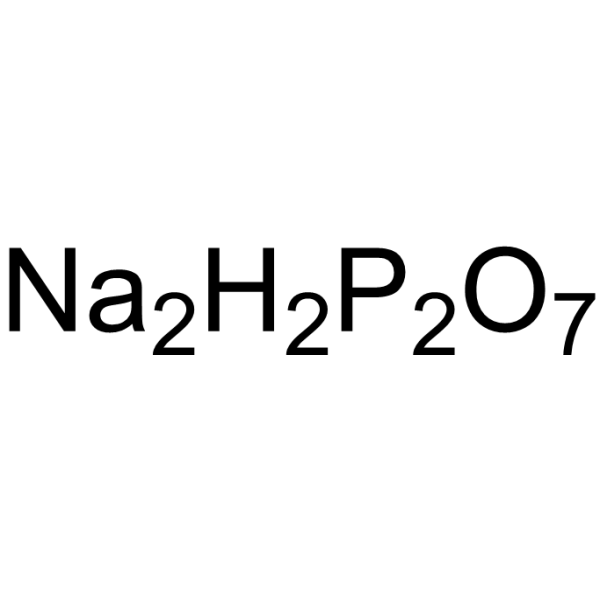
HY-W105970
Sodium pyrophosphateRibonuclease H Inhibitor -

HY-Y0998
Potassium hexacyanoferrate(III), 99.5%Chelating Agent -

HY-Y0416
Potassium ferrocyanide trihydrate, 98.5%Biochemical Reagent -
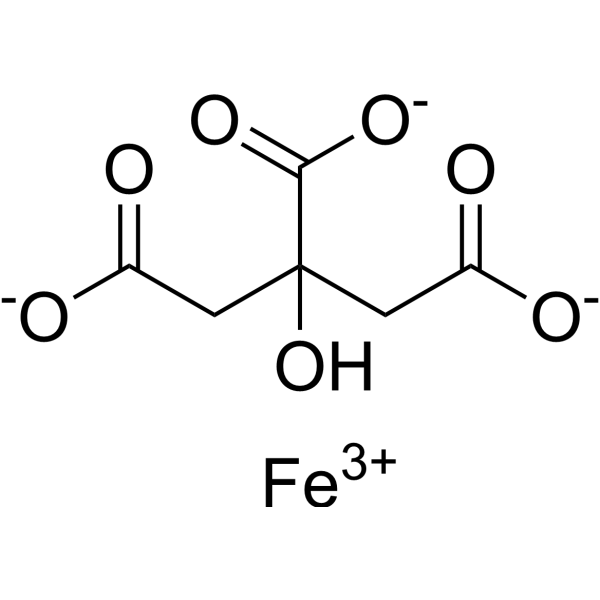
HY-N1428C
Ferric citrateIron Supplement -

HY-108775A
Sodium thiosulfate (99%, water≤1.0%)Antioxidant -

HY-112030
Dipotassium tetrachloroplatinateCatalyst/Sensitizer -

HY-107754
Cesium chloridePotassium Channel Blocker -
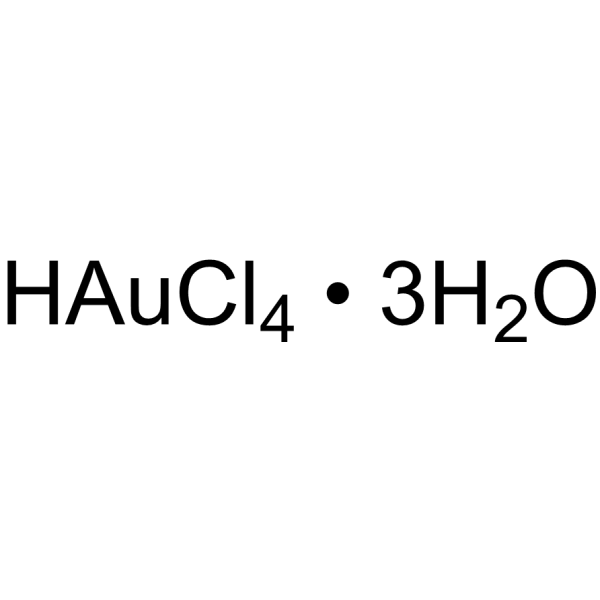
HY-W094581
Gold(III) chloride trihydrateReducing Agent


Activité biologique
Description
In Vivo
MedChemExpress (MCE) has not independently confirmed the accuracy of these methods. They are for reference only.
-
Animal Model:Sprague-Dawley suckling rats (mixed gender, newborn litters adjusted to 12 pups each, iron deficiency anemia induced via maternal low-iron diet during pregnancy)[1]
-
Dosage:2 mg Fe/kg BW; 10 mg Fe/kg BW
-
Administration:p.o.; daily; 13 days (postnatal days 2-14)
-
Result:Significantly increased body weight of IDA rats compared to the IDA control group at the end of treatment.
Significantly down-regulated colonic mRNA expression of pro-inflammatory cytokines IL-6, TNF-α, and IL-1β to levels not significantly different from the normal control group.
Reversed IDA-induced gut microbiota structural shifts (high dose), restoring the community structure to resemble the normal control group; increased the relative abundance of beneficial bacteria Bacteroides (from 6.9% to 18.7%) and Akkermansia compared to the IDA control group, and had a greater abundance of these taxa than high-dose FeSO4.
Essai clinique
| NCT Number | Sponsor | Condition | Start Date |
Phase

|
|---|---|---|---|---|
| NCT01329991 | Plexxikon| | 2011-05 | PHASE1 |


Chemical Information
-
CAS No. 10058-44-3
-
Appearance Solid
-
Masse moléculaire 745.21
-
Formule Fe4(P2O7)3
-
Color Off-white to light yellow
-
SMILES
[Fe4(P2O7)3]
-
Livraison
Room temperature in continental US; may vary elsewhere.
-
Stockage
Powder -20°C 3 years In solvent -80°C 6 months -20°C 1 month


Solvant et solubilité
In Vitro:
H2O : 50 mg/mL (67.10 mM; Need ultrasonic and warming)
Please refer to the solubility information to select the appropriate solvent. Once prepared, please aliquot and store the solution to prevent product inactivation from repeated freeze-thaw cycles.
Storage method and period of stock solution: -80°C, 6 months; -20°C, 1 month. When stored at -80°C, please use it within 6 months. When stored at -20°C, please use it within 1 month.
* Note: If you choose water as the stock solution, please dilute it to the working solution, then filter and sterilize it with a 0.22 μm filter before use.
Please refer to the solubility information to select the appropriate solvent. Once prepared, please aliquot and store the solution to prevent product inactivation from repeated freeze-thaw cycles.
Storage method and period of stock solution: -80°C, 6 months; -20°C, 1 month. When stored at -80°C, please use it within 6 months. When stored at -20°C, please use it within 1 month.
* Note: If you choose water as the stock solution, please dilute it to the working solution, then filter and sterilize it with a 0.22 μm filter before use.
Concentration (start) × Volume (start) = Concentration (final) × Volume (final)

Protocole
-
RNA extraction experimental
By lysing cells, releasing RNA, and removing impurities such as proteins and DNA, high-purity RNA products are finally obtained. The commonly used traditional method is the guanidine isothiocyanate/phenol/chloroform method (Trizol), which is suitable for a variety of animal materials including animal tissues, microorganisms, cultured cells, etc., and most plant materials.
-
LPS-Induced Endotoxemia/Systemic Inflammation
Lipopolysaccharide (LPS)-induced endotoxemia is a widely used in vivo model of acute systemic inflammation in which LPS, a Gram-negative bacterial endotoxin, activates innate immune signaling primarily through TLR4, leading to rapid and transient induction of pro-inflammatory cytokines such as TNF-α, IL-6, and IL-1β in circulation and tissues. This cytokine surge is commonly used as a measurable readout of systemic inflammatory activation and immune dysregulation, and is typically assessed within hours after intraperitoneal LPS administration in mouse models of endotoxemia. The model captures key features of systemic inflammatory response syndrome, including cytokine release, immune cell activation, and downstream tissue responses, and has been used to evaluate anti-inflammatory interventions such as cytokine modulation, lipid mediators, and immune cell-targeting therapies.
-
Research Protocol for Inflammation-related Diseases
The NLRP3 inflammasome is a cytosolic innate immune signaling platform that integrates priming signals and danger-signal activation to promote caspase-1 activation, maturation of IL-1β and IL-18, and gasdermin D-mediated pyroptotic cell death. The core experimental logic is to determine whether inflammatory disease phenotypes are driven by increased NLRP3 expression, ASC-containing inflammasome assembly, caspase-1 cleavage, GSDMD cleavage, and extracellular release of IL-1β/IL-18 rather than by nonspecific cell injury alone. The pathway is strongly linked to inflammation-related disease phenotypes because monosodium urate crystals activate NALP3/NLRP3 inflammasome signaling in gout-like crystal inflammation, cholesterol crystals activate NLRP3 inflammasomes in atherogenesis models, and DSS-induced intestinal inflammation has been reported to involve NLRP3 inflammasome activity. However, experimental colitis studies also show context-dependent protective effects of NLRP3 inflammasome co


Pureté et documentation
-
Fiche technique (272 KB)
-
SDS (394 KB)
- English - EN (394 KB)
- Français - FR (394 KB)
- Deutsch - DE (394 KB)
- Norwegian - NO (394 KB)
- Español - ES (394 KB)
- Swedish - SV (394 KB)
- Italian - IT (394 KB)
- Korean - KR (394 KB)
- Portuguese - PT (394 KB)
-
Instruction de manipulation (2659 KB)
Références


Complete Stock Solution Preparation Table
Please refer to the solubility information to select the appropriate solvent. Once prepared, please aliquot and store the solution to prevent product inactivation from repeated freeze-thaw cycles.
Storage method and period of stock solution: -80°C, 6 months; -20°C, 1 month. When stored at -80°C, please use it within 6 months. When stored at -20°C, please use it within 1 month.
| Optional Solvent | Concentration Solvent Mass | 1 mg | 5 mg | 10 mg | 25 mg |
|---|---|---|---|---|---|
| H2O | 1 mM | 1.3419 mL | 6.7095 mL | 13.4190 mL | 33.5476 mL |
| 5 mM | 0.2684 mL | 1.3419 mL | 2.6838 mL | 6.7095 mL | |
| 10 mM | 0.1342 mL | 0.6710 mL | 1.3419 mL | 3.3548 mL | |
| 15 mM | 0.0895 mL | 0.4473 mL | 0.8946 mL | 2.2365 mL | |
| 20 mM | 0.0671 mL | 0.3355 mL | 0.6710 mL | 1.6774 mL | |
| 25 mM | 0.0537 mL | 0.2684 mL | 0.5368 mL | 1.3419 mL | |
| 30 mM | 0.0447 mL | 0.2237 mL | 0.4473 mL | 1.1183 mL | |
| 40 mM | 0.0335 mL | 0.1677 mL | 0.3355 mL | 0.8387 mL | |
| 50 mM | 0.0268 mL | 0.1342 mL | 0.2684 mL | 0.6710 mL | |
| 60 mM | 0.0224 mL | 0.1118 mL | 0.2237 mL | 0.5591 mL |
* Note: If you choose water as the stock solution, please dilute it to the working solution, then filter and sterilize it with a 0.22 μm filter before use.


Ferric pyrophosphate Related Classifications
HY-B1648 Related Classifications
 Powered by Bioz