



Allethrin

Based on 1 Customer Validation
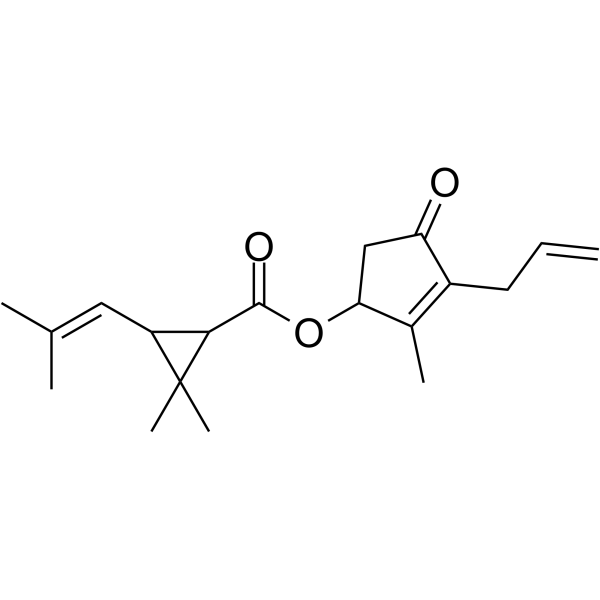
Allethrin, a pyrethroid insecticide is a major mosquito repellent agent. Allethrin induces oxidative stress, apoptosis and calcium release in rat testicular carcinoma cells (LC540). Allethrin induces BCL-2, caspase-3 activation and release of intracellular calcium.
For research use only. We do not sell to patients.
- Purity: 98.04%
- CAS No.: 584-79-2
- Formula: C19H26O3
- Molecular Weight:302.41
-
Storage:
4°C, sealed storage, away from moisture and light
* In solvent : -80°C, 6 months; -20°C, 1 month (sealed storage, away from moisture and light)

To place orders, for customer services and technical support, please contact: MedChemExpress USA
Tel: 609-228-6898 E-mail: [email protected] [email protected]


-
 Biological Activity
-
Chemical Information
-
Solvent & Solubility
- Purity & Documentation
- References
-
 Help & FAQs
-

Anti-Infection Compound Library
HY-L002
-
Apoptosis Compound Library
HY-L003
-
Anti-Cancer Compound Library
HY-L025
-
Anti-Aging Compound Library
HY-L034
-
Oxygen Sensing Compound Library
HY-L045
-
Ferroptosis Compound Library
HY-L051
-
Traditional Chinese Medicine Active Compound Library
HY-L065
-
Anti-Parkinson's Disease Compound Library
HY-L085
-
Neurodegenerative Disease-related Compound Library
HY-L086
-
Human Metabolite Library
HY-L123
-
Cysteine Targeted Covalent Library
HY-L153
-
Cell Death Library
HY-L162
-
Mitophagy Compound Library
HY-L180
-
Bioactive Compound Library Max
HY-L181
-
MCE Bioactive Compound Library
HY-L001V
-
Bioactive Compound Library
HY-L001
-
Pesticide Compound Library
HY-L183
-
Non-Alcoholic Fatty Liver Disease (NAFLD) Compound Library
HY-L199
-
High-Throughput Bioactive Compound Library
HY-L205
-
Mass Spectrometry Human Metabolite Library
HY-L215
-
Environmental Pollutant Compound Library
HY-L247




Biological Activity
Allethrin (0.001-250 μM) induces cytotoxicity and oxidative stress. Allethrin is cytotoxic to isolated Leydig cells and testicular cancer cells. Cytotoxicity is due to free radical generation and altered antioxidant status[1].
Morphological analyses of LC540 cells treated with Allethrin (125 μM) reveals the presence of apoptotic bodies[1].
Allethrin (125 μM) induces BCL-2, caspase-3 activation and release of intracellular calcium[1].
Allethrin (IC50≈85 μM) is toxic to human corneal epithelial (HCE) cells causing death through mitochondrial pathway[2].
MedChemExpress (MCE) has not independently confirmed the accuracy of these methods. They are for reference only.
-
Cell Line:LC540 cells (derived from rat Leydig cell tumor)
-
Concentration:0.001-250 μM
-
Incubation Time:24 hours
-
Result:At low concentrations did not display appreciable cell killing activity up to 50 μM when incubated for 24 h.
At concentrations above 100 μM, cell killing was observed. Based on the results obtained, the IC50 was 125 μM.
-
Cell Line:LC540 cells
-
Concentration:125 μM
-
Incubation Time:24 hours
-
Result:Revealed the presence of apoptotic bodies. The percentage of cells displaying early apoptotic features increased significantly.
-
Cell Line:LC540 cells
-
Concentration:125 μM
-
Incubation Time:0, 3, 6, 9, 12, 24 hours
-
Result:BCL-2, pro-Caspase-3 and PARP-1 protein expression decreased significantly with an increase in cleaved PARP-1 levels.
MedChemExpress (MCE) has not independently confirmed the accuracy of these methods. They are for reference only.
-
Animal Model:Male Wistar rats aged 90 days[3]
-
Dosage:25, 50, 100, and 150 mg/kg
-
Administration:Orally administered every day for 60 days
-
Result:Increased levels of LPO products were observed in the caput, cauda, and testes of allethrin treated rats.
In the caput, increased levels of NO was observed at all the doses tested, when compared with the vehicle treated control.
Significant increase in catalase activity was observed in the cauda obtained from 50, 100, and 150 mg/kg.
GPx activity was significantly increased in the caput obtained from 150 mg/kg treated rats. In the cauda, it was found to be increased significantly in the 50 and 100 mg/kg treated groups. In contrast, the activity of GPx activity was significantly decreased in the testes of rats treated with 150 mg/kg.
GST activity was found to be increased significantly in a dose dependent manner in the caput and cauda of allethrin treated rats.
In the caput, significant increase in the activity of SOD was observed in the 150 mg/kg body treated rats. In the cauda and testes, treatment resulted in increase of SOD activity at all the doses tested.


Chemical Information
-
CAS No. 584-79-2
-
Appearance Liquid (Density: 1.01 g/cm3)
-
Molecular Weight 302.41
-
Formula C19H26O3
-
Color Colorless to light yellow
-
SMILES
O=C(C1C(C)(C)C1/C=C(C)\C)OC2C(C)=C(CC=C)C(C2)=O
-
Shipping
Room temperature in continental US; may vary elsewhere.
-
Storage
4°C, sealed storage, away from moisture and light
* In solvent : -80°C, 6 months; -20°C, 1 month (sealed storage, away from moisture and light)


Solvent & Solubility
DMSO : 100 mg/mL (330.68 mM; Need ultrasonic; Hygroscopic DMSO has a significant impact on the solubility of product, please use newly opened DMSO)
Please refer to the solubility information to select the appropriate solvent. Once prepared, please aliquot and store the solution to prevent product inactivation from repeated freeze-thaw cycles.
Storage method and period of stock solution: -80°C, 6 months; -20°C, 1 month (sealed storage, away from moisture and light). When stored at -80°C, please use it within 6 months. When stored at -20°C, please use it within 1 month.
Please refer to the solubility information to select the appropriate solvent. Once prepared, please aliquot and store the solution to prevent product inactivation from repeated freeze-thaw cycles.
Storage method and period of stock solution: -80°C, 6 months; -20°C, 1 month (sealed storage, away from moisture and light). When stored at -80°C, please use it within 6 months. When stored at -20°C, please use it within 1 month.
Concentration (start) × Volume (start) = Concentration (final) × Volume (final)


Purity & Documentation
-
Data Sheet (276 KB)
-
SDS (597 KB)
- English - EN (597 KB)
- Français - FR (597 KB)
- Deutsch - DE (597 KB)
- Norwegian - NO (597 KB)
- Español - ES (597 KB)
- Swedish - SV (597 KB)
- Italian - IT (597 KB)
- Korean - KR (597 KB)
- Portuguese - PT (597 KB)
-
Handling Instructions (2659 KB)
References
[1]. Golla Madhubabu, et al. Allethrin induces oxidative stress, apoptosis and calcium release in rat testicular carcinoma cells (LC540). Toxicol In Vitro. 2014 Dec;28(8):1386-95. [Content Brief]
[2]. Geetika Gupta, et al. Allethrin toxicity on human corneal epithelial cells involves mitochondrial pathway mediated apoptosis. Toxicol In Vitro. 2013 Dec;27(8):2242-8. [Content Brief]
[3]. Golla Madhubabu, et al. Allethrin induced toxicity in the male reproductive tract of rats contributes to disruption in the transcription of genes involved in germ cell production. Environ Toxicol. 2014 Nov;29(11):1330-45. [Content Brief]


Complete Stock Solution Preparation Table
Please refer to the solubility information to select the appropriate solvent. Once prepared, please aliquot and store the solution to prevent product inactivation from repeated freeze-thaw cycles.
Storage method and period of stock solution: -80°C, 6 months; -20°C, 1 month (sealed storage, away from moisture and light). When stored at -80°C, please use it within 6 months. When stored at -20°C, please use it within 1 month.
| Optional Solvent | Concentration Solvent Mass | 1 mg | 5 mg | 10 mg | 25 mg |
|---|---|---|---|---|---|
| DMSO | 1 mM | 3.3068 mL | 16.5338 mL | 33.0677 mL | 82.6692 mL |
| 5 mM | 0.6614 mL | 3.3068 mL | 6.6135 mL | 16.5338 mL | |
| 10 mM | 0.3307 mL | 1.6534 mL | 3.3068 mL | 8.2669 mL | |
| 15 mM | 0.2205 mL | 1.1023 mL | 2.2045 mL | 5.5113 mL | |
| 20 mM | 0.1653 mL | 0.8267 mL | 1.6534 mL | 4.1335 mL | |
| 25 mM | 0.1323 mL | 0.6614 mL | 1.3227 mL | 3.3068 mL | |
| 30 mM | 0.1102 mL | 0.5511 mL | 1.1023 mL | 2.7556 mL | |
| 40 mM | 0.0827 mL | 0.4133 mL | 0.8267 mL | 2.0667 mL | |
| 50 mM | 0.0661 mL | 0.3307 mL | 0.6614 mL | 1.6534 mL | |
| 60 mM | 0.0551 mL | 0.2756 mL | 0.5511 mL | 1.3778 mL | |
| 80 mM | 0.0413 mL | 0.2067 mL | 0.4133 mL | 1.0334 mL | |
| 100 mM | 0.0331 mL | 0.1653 mL | 0.3307 mL | 0.8267 mL |


Allethrin Related Classifications
HY-B1559 Related Classifications
 Powered by Bioz