



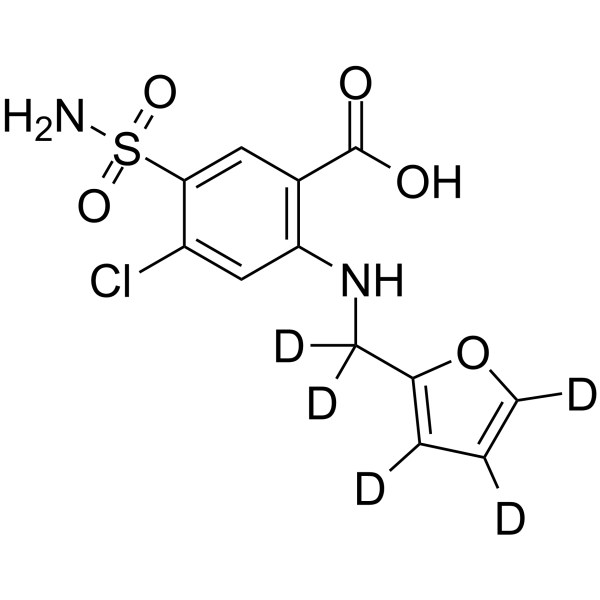
Furosemide-d5

Based on 1 Customer Validation
Furosemide-d5 is the deuterated-labeled Furosemide (HY-B0135). Furosemide is an orally active GABAA receptor antagonist. Furosemide inhibits carbonic anhydrase, the sodium-chloride cotransporter, sodium reabsorption, tubuloglomerular feedback, and GABA-induced chloride flux. Furosemide can be used as a diuretic reagent. Furosemide is applied in the research of hepatic necrosis, sepsis-associated acute kidney injury, hypoalbuminemia-related fluid retention, and congestive heart failure.
Para uso exclusivo en investigación. No vendemos a pacientes.
- Pureza : 99.85%
- No. CAS: 1189482-35-6
- Fòrmula: C12H6D5ClN2O5S
- Peso molecular:335.77
-
Almacenamiento:Powder -20°C, 3 years , 4°C, 2 years ; In solvent -80°C, 6 months , -20°C, 1 month

To place orders, for customer services and technical support, please contact: MedChemExpress USA
Tel: 609-228-6898 E-mail: [email protected] [email protected]


-
 Actividad biológica
-
Chemical Information
-
Solvente y solubilidad
- Protocolo
- Pureza y Documentación
- Referencias
-
 Help & FAQs




Actividad biológica
Descripciòn
Aplicación
1. This compound can be used as a tracer
2. This compound can be used as an internal standard for quantitative analysis by NMR, GC-MS, or LC-MS.


Chemical Information
-
No. CAS 1189482-35-6
-
Unlabeled CAS 54-31-9
-
Appearance Solid
-
Peso molecular 335.77
-
Fòrmula C12H6D5ClN2O5S
-
Color White to off-white
-
SMILES
OC(C1=C(C=C(C(S(N)(=O)=O)=C1)Cl)NC([2H])([2H])C2=C([2H])C([2H])=C([2H])O2)=O
-
Envío
Room temperature in continental US; may vary elsewhere.
-
Almacenamiento
Powder -20°C 3 years 4°C 2 years In solvent -80°C 6 months -20°C 1 month


Solvente y solubilidad
In Vitro:
DMSO : ≥ 100 mg/mL (297.82 mM; Hygroscopic DMSO has a significant impact on the solubility of product, please use newly opened DMSO)
* "≥" means soluble, but saturation unknown.
Please refer to the solubility information to select the appropriate solvent. Once prepared, please aliquot and store the solution to prevent product inactivation from repeated freeze-thaw cycles.
Storage method and period of stock solution: -80°C, 6 months; -20°C, 1 month. When stored at -80°C, please use it within 6 months. When stored at -20°C, please use it within 1 month.
Please refer to the solubility information to select the appropriate solvent. Once prepared, please aliquot and store the solution to prevent product inactivation from repeated freeze-thaw cycles.
Storage method and period of stock solution: -80°C, 6 months; -20°C, 1 month. When stored at -80°C, please use it within 6 months. When stored at -20°C, please use it within 1 month.
Concentration (start) × Volume (start) = Concentration (final) × Volume (final)

Protocolo
-
Nephrotoxicity Study
This protocol assesses nephrotoxicity by combining functional kidney injury readouts, urinary/tissue injury biomarkers, and renal histopathology. Serum creatinine and BUN reflect impaired kidney function, while KIM-1, NGAL, clusterin, osteopontin, IL-18, cystatin C, nephrin, Oat5, urinary protein, glucose, and alkaline phosphatase have been used to detect tubular injury in cisplatin-, gentamicin-, and acetaminophen-induced nephrotoxicity models.
-
LPS-Induced Endotoxemia/Systemic Inflammation
Lipopolysaccharide (LPS)-induced endotoxemia is a widely used in vivo model of acute systemic inflammation in which LPS, a Gram-negative bacterial endotoxin, activates innate immune signaling primarily through TLR4, leading to rapid and transient induction of pro-inflammatory cytokines such as TNF-α, IL-6, and IL-1β in circulation and tissues. This cytokine surge is commonly used as a measurable readout of systemic inflammatory activation and immune dysregulation, and is typically assessed within hours after intraperitoneal LPS administration in mouse models of endotoxemia. The model captures key features of systemic inflammatory response syndrome, including cytokine release, immune cell activation, and downstream tissue responses, and has been used to evaluate anti-inflammatory interventions such as cytokine modulation, lipid mediators, and immune cell-targeting therapies.
-
Research Protocol for Cardiovascular Diseases
Cardiovascular disease can be modeled as maladaptive cardiac remodeling, where ischemic injury or pressure overload activates inflammatory signaling, fibroblast activation, extracellular-matrix deposition, cardiomyocyte hypertrophy, vascular remodeling, and progressive ventricular dysfunction. The TGF-β/SMAD axis is a central profibrotic pathway after myocardial injury and pressure overload, while innate immune and cytokine pathways regulate leukocyte recruitment, scar formation, and adverse remodeling. Key unresolved questions include which inflammatory signals are reparative versus harmful, when fibrosis is protective versus maladaptive, and whether pathway inhibition improves function without weakening necessary infarct healing or compensatory remodeling.


Pureza y Documentación
-
Ficha de datos (291 KB)
-
SDS (419 KB)
- English - EN (419 KB)
- Français - FR (419 KB)
- Deutsch - DE (419 KB)
- Norwegian - NO (419 KB)
- Español - ES (419 KB)
- Swedish - SV (419 KB)
- Italian - IT (419 KB)
- Korean - KR (419 KB)
- Portuguese - PT (419 KB)
-
Instrucciones de manejo (2659 KB)
Referencias


Complete Stock Solution Preparation Table
Please refer to the solubility information to select the appropriate solvent. Once prepared, please aliquot and store the solution to prevent product inactivation from repeated freeze-thaw cycles.
Storage method and period of stock solution: -80°C, 6 months; -20°C, 1 month. When stored at -80°C, please use it within 6 months. When stored at -20°C, please use it within 1 month.
| Optional Solvent | Concentration Solvent Mass | 1 mg | 5 mg | 10 mg | 25 mg |
|---|---|---|---|---|---|
| DMSO | 1 mM | 2.9782 mL | 14.8911 mL | 29.7823 mL | 74.4557 mL |
| 5 mM | 0.5956 mL | 2.9782 mL | 5.9565 mL | 14.8911 mL | |
| 10 mM | 0.2978 mL | 1.4891 mL | 2.9782 mL | 7.4456 mL | |
| 15 mM | 0.1985 mL | 0.9927 mL | 1.9855 mL | 4.9637 mL | |
| 20 mM | 0.1489 mL | 0.7446 mL | 1.4891 mL | 3.7228 mL | |
| 25 mM | 0.1191 mL | 0.5956 mL | 1.1913 mL | 2.9782 mL | |
| 30 mM | 0.0993 mL | 0.4964 mL | 0.9927 mL | 2.4819 mL | |
| 40 mM | 0.0745 mL | 0.3723 mL | 0.7446 mL | 1.8614 mL | |
| 50 mM | 0.0596 mL | 0.2978 mL | 0.5956 mL | 1.4891 mL | |
| 60 mM | 0.0496 mL | 0.2482 mL | 0.4964 mL | 1.2409 mL | |
| 80 mM | 0.0372 mL | 0.1861 mL | 0.3723 mL | 0.9307 mL | |
| 100 mM | 0.0298 mL | 0.1489 mL | 0.2978 mL | 0.7446 mL |


Furosemide-d5 Related Classifications
HY-B0135S Related Classifications
 Powered by Bioz