



Macrocarpal D

Based on 1 Customer Validation
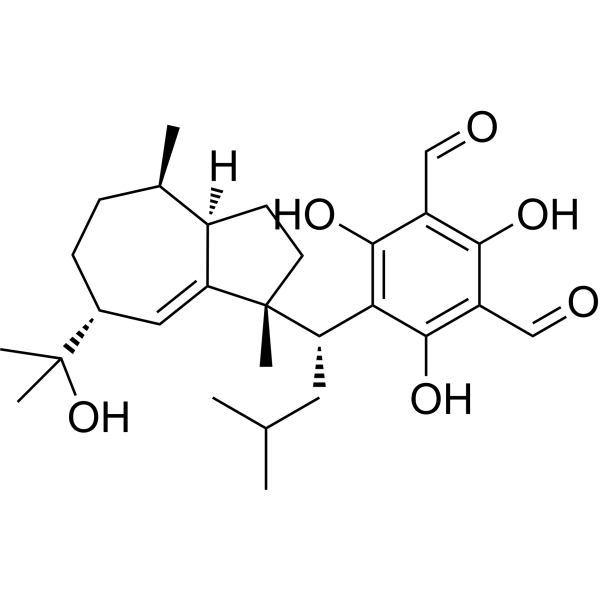
Macrocarpal D is a potent antibacterial agent. Macrocarpal D is a phloroglucinol dialdehyde diterpene derivatives that can be found in the leaves of Eucalyptus macrocarpa.
Para uso exclusivo en investigación. No vendemos a pacientes.
- Pureza : 95.0%
- No. CAS: 142647-71-0
- Fòrmula: C28H40O6
- Peso molecular:472.61
-
Almacenamiento:Powder -20°C, 3 years ; In solvent -80°C, 6 months , -20°C, 1 month

To place orders, for customer services and technical support, please contact: MedChemExpress USA
Tel: 609-228-6898 E-mail: [email protected] [email protected]


-
 Actividad biológica
-
Chemical Information
- Protocolo
- Pureza y Documentación
- Referencias
-
 Help & FAQs




Actividad biológica
Descripciòn
In Vitro
Macrocarpal D shows antibacterial activity with the MIC of 1.56, 1.56, 0.78, 1.56 µg/mL for Staphylococcus aureus FAD209P, Micrococcus luteus ATCC9341, Bacillus subtiUs PCI2l9, Mycobacterium smegmatis ATCC607, respectively[1].
MedChemExpress (MCE) has not independently confirmed the accuracy of these methods. They are for reference only. Further protocols information, click here.


Chemical Information
-
No. CAS 142647-71-0
-
Appearance Solid
-
Peso molecular 472.61
-
Fòrmula C28H40O6
-
Color Yellow to brown
-
SMILES
OC1=C([C@H](CC(C)C)[C@@]2(C)CC[C@@]3([H])C2=C[C@H](C(C)(C)O)CC[C@H]3C)C(O)=C(C=O)C(O)=C1C=O
-
Synonyms
(-)-Macrocarpal D
-
Structure Classification
-
Initial Source
-
Envío
Room temperature in continental US; may vary elsewhere.
-
Almacenamiento
Powder -20°C 3 years In solvent -80°C 6 months -20°C 1 month

Protocolo
-
Research Protocol for Infectious Diseases
Infectious-disease experiments test how pathogens interact with host barriers, innate immune receptors, inflammatory signaling, pathogen replication, and tissue injury; pattern-recognition receptors such as TLRs, RIG-I-like receptors, NOD-like receptors, and inflammasomes detect microbial molecules and activate NF-κB, interferon, and cytokine responses. The central hypothesis is that infection severity reflects the balance between pathogen burden and host response: protective inflammation restricts pathogen growth, whereas excessive or mislocalized inflammation contributes to tissue damage and disease phenotype. Unresolved questions include which host pathways are protective versus pathogenic, why some infection models fail to translate to human disease, and which combined readouts best predict clinically relevant infection outcomes.


Pureza y Documentación
-
Ficha de datos (272 KB)
-
SDS (251 KB)
- English - EN (251 KB)
- Français - FR (251 KB)
- Deutsch - DE (251 KB)
- Norwegian - NO (251 KB)
- Español - ES (251 KB)
- Swedish - SV (251 KB)
- Italian - IT (251 KB)
- Korean - KR (251 KB)
- Portuguese - PT (251 KB)
-
Instrucciones de manejo (2659 KB)
Referencias

Calculators
Concentration (start) × Volume (start) = Concentration (final) × Volume (final)


Macrocarpal D Related Classifications
HY-N3343 Related Classifications
 Powered by Bioz