



Perflubron

Based on 1 Customer Validation
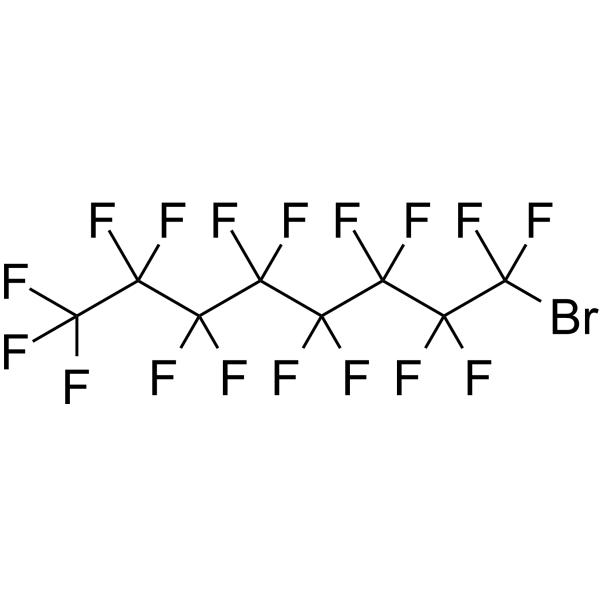
Perflubron (Perfluorooctyl bromide) is a contrast medium for magnetic resonance imaging and sonography. Perflubron inhibits chemokine expression and NF-κB activation. Perflubron can be emulsified with egg phospholipids (EYP) and shows exceptionally fast excretion characteristics. Perflubron has anti-inflammatory, antiviral and cytoprotective effects.
Para uso exclusivo en investigación. No vendemos a pacientes.
- Pureza : 99.54%
- No. CAS: 423-55-2
- Fòrmula: C8BrF17
- Peso molecular:498.96
-
Almacenamiento:Pure form -20°C, 3 years , 4°C, 2 years ; In solvent -80°C, 6 months , -20°C, 1 month

To place orders, for customer services and technical support, please contact: MedChemExpress USA
Tel: 609-228-6898 E-mail: [email protected] [email protected]


-
 Actividad biológica
-
Chemical Information
-
Solvente y solubilidad
- Protocolo
- Pureza y Documentación
- Referencias
-
 Help & FAQs


-

HY-B1724R
Perflubron (Standard)Contrast Medium -

HY-W142432
Perfluoroundecanoic acidOxidative Stress Inducer -

HY-109540
PerfluorohexaneHIFU Enhancer -
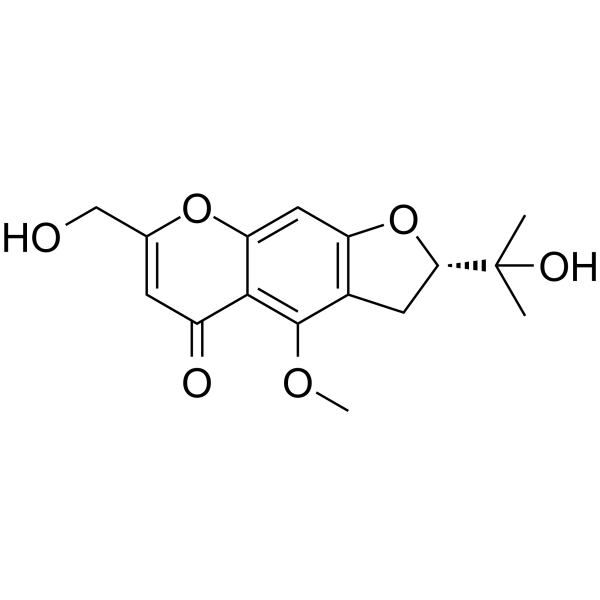
HY-N0634
CimifuginAnti-allergic Agent -
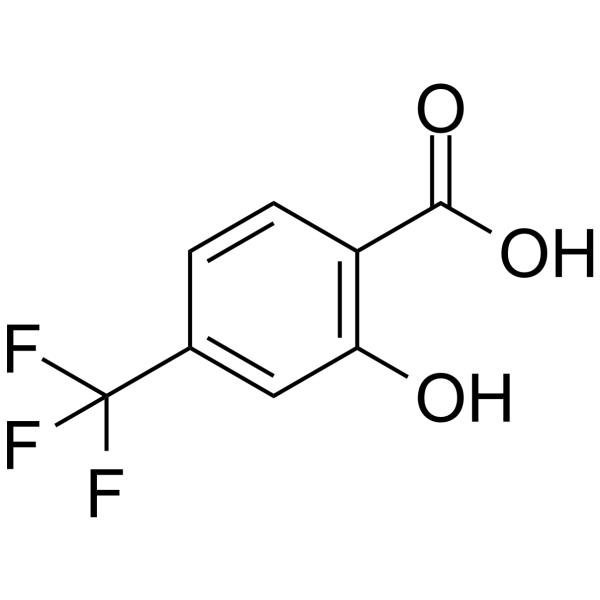
HY-W014632
4-Trifluoromethylsalicylic acidOrganic Carboxylic Acid -
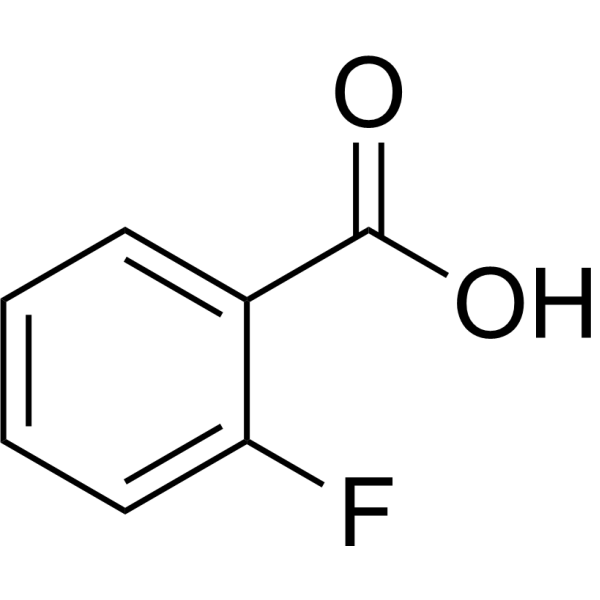
HY-Y1115
2-Fluorobenzoic acidBiochemical Reagent -

HY-W013677
4-Fluorobenzoic acidDrug Intermediate -
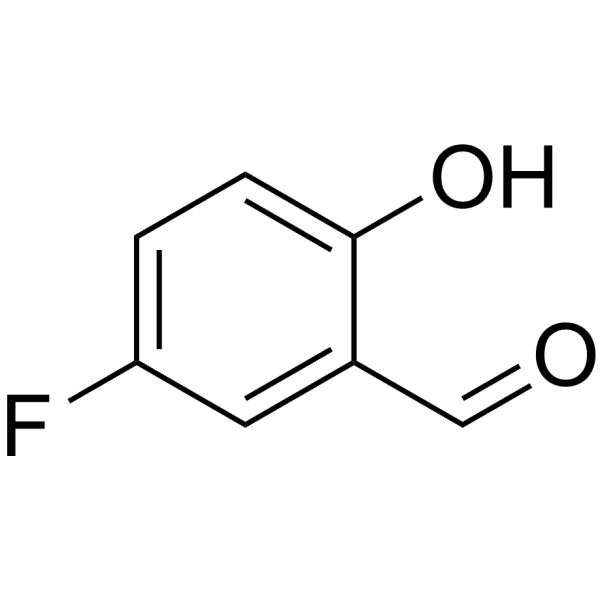
HY-W007331
5-FluorosalicylaldehydeBiochemical Reagent -
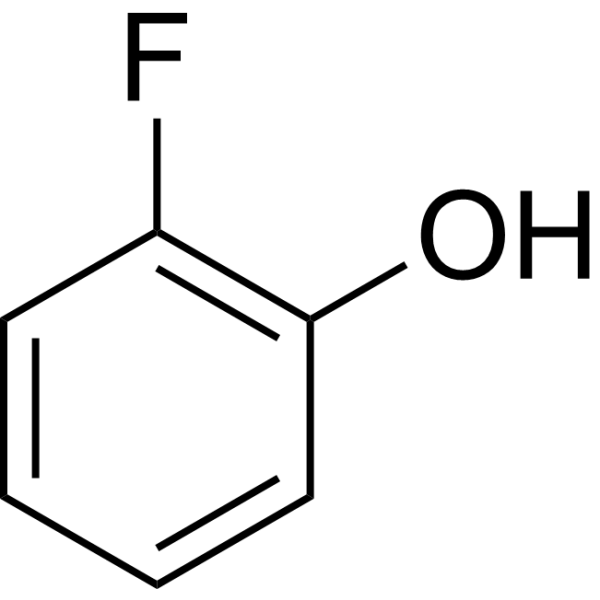
HY-41755
2-FluorophenolBiochemical Reagent -
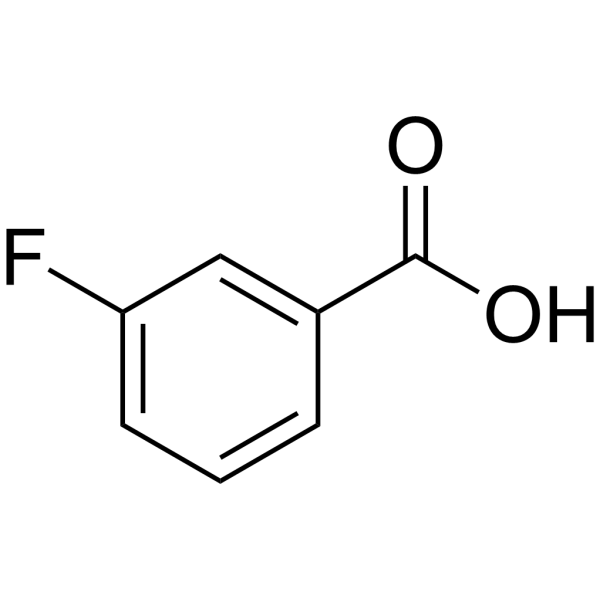
HY-W015753
3-Fluorobenzoic acidBiochemical Reagent -
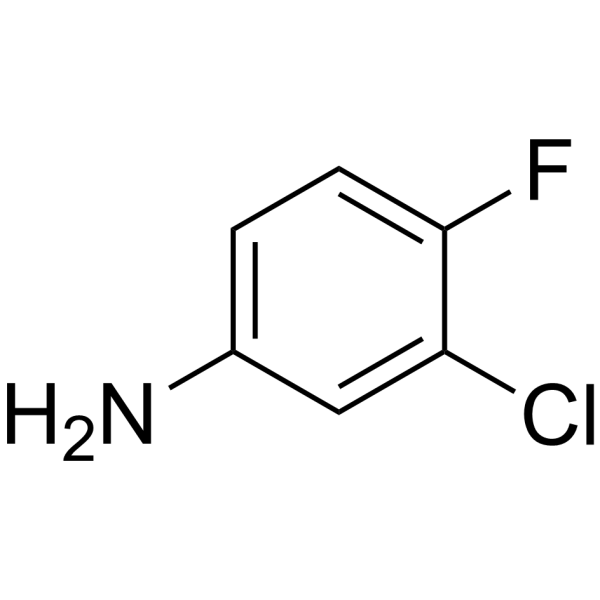
HY-Y0680
3-Chloro-4-fluoroanilineBiochemical Reagent -
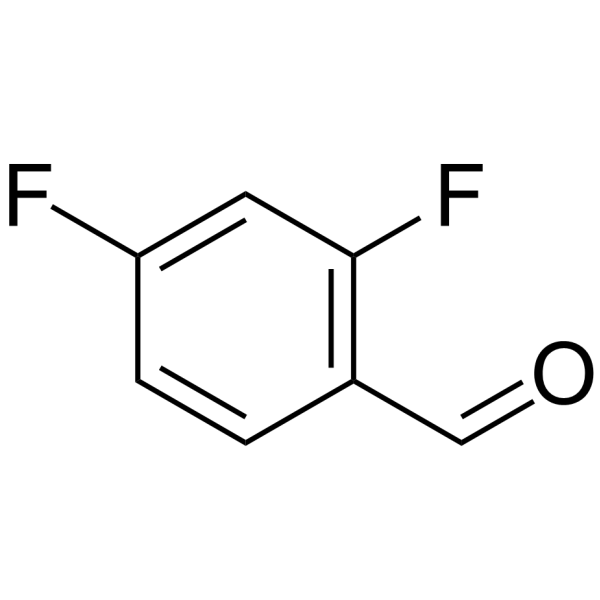
HY-W007410
2,4-DifluorobenzaldehydeDrug Intermediate


Actividad biológica
Descripciòn
In Vitro
Perflubron (40-48 h) attenuates neutrophil adhesion to activated endothelial cells (HUVECs) in vitro[2].
Perflubron (200 μL, 3 days) protects against hyperoxia-induced airway epithelial cell (Calu-3) injury by promoting cellular integrity as well as cytologic modifications[3].
Perflubron (40 min-4 h) stimulates mucin secretion in the tracheal segments of adult ferrets[4].
MedChemExpress (MCE) has not independently confirmed the accuracy of these methods. They are for reference only.
In Vivo
Perflubron (10 mL/kg, instillation, instilled over approximately 1 min) enhances adenovirus-mediated gene expression in lungs of transgenic mice with chronic alveolar filling[6].
Perflubron (39.4-46.6 mL/kg, instillation, instillation times of 17-28 minutes) increases BAL fluid total cell count and β-galactosidase activity in rhesus macaques[7].
MedChemExpress (MCE) has not independently confirmed the accuracy of these methods. They are for reference only.
-
Animal Model:Female, 3- to 4-week-old BALB/c mice infected intranasally with 50 μL of purified RSV diluted in PBS[5]
-
Dosage:50 μL
-
Administration:Intranasal delivery, 24 h before mice are killed
-
Result:Had a significant reduction in lung inflammation (pathology score: 18%).
Weakened the expression of all RSV-inducible chemokines.
Ensayo clínico
| NCT Number | Sponsor | Condition | Start Date |
Phase

|
|---|---|---|---|---|
| NCT01329991 | 2011-05 | PHASE1 |


Chemical Information
-
No. CAS 423-55-2
-
Appearance Liquid (Density: 1.93 g/cm3)
-
Peso molecular 498.96
-
Fòrmula C8BrF17
-
Color Colorless to light yellow
-
SMILES
FC(F)(F)C(F)(F)C(F)(F)C(F)(F)C(F)(F)C(F)(F)C(F)(F)C(F)(Br)F
-
Synonyms
Perfluorooctyl bromide; 1-Bromoperfluorooctane; PFOB
-
Envío
Room temperature in continental US; may vary elsewhere.
-
Almacenamiento
Pure form -20°C 3 years 4°C 2 years In solvent -80°C 6 months -20°C 1 month


Solvente y solubilidad
In Vitro:
DMSO : 16.67 mg/mL (33.41 mM; Need ultrasonic; Hygroscopic DMSO has a significant impact on the solubility of product, please use newly opened DMSO)
Please refer to the solubility information to select the appropriate solvent. Once prepared, please aliquot and store the solution to prevent product inactivation from repeated freeze-thaw cycles.
Storage method and period of stock solution: -80°C, 6 months; -20°C, 1 month. When stored at -80°C, please use it within 6 months. When stored at -20°C, please use it within 1 month.
Please refer to the solubility information to select the appropriate solvent. Once prepared, please aliquot and store the solution to prevent product inactivation from repeated freeze-thaw cycles.
Storage method and period of stock solution: -80°C, 6 months; -20°C, 1 month. When stored at -80°C, please use it within 6 months. When stored at -20°C, please use it within 1 month.
Concentration (start) × Volume (start) = Concentration (final) × Volume (final)
In Vivo:
Select the appropriate dissolution method based on your experimental animal and administration route.
- For the following dissolution methods, please ensure to first prepare a clear stock solution using an In Vitro approach and then sequentially add co-solvents:
- To ensure reliable experimental results, the clarified stock solution can be appropriately stored based on storage conditions. As for the working solution for In Vivo experiments, it is recommended to prepare freshly and use it on the same day.
- The percentages shown for the solvents indicate their volumetric ratio in the final prepared solution. If precipitation or phase separation occurs during preparation, heat and/or sonication can be used to aid dissolution.
Add each solvent one by one: 10% DMSO 40% PEG300 5% Tween-80 45% Saline
Solubility: ≥ 1.67 mg/mL (3.35 mM); Clear solution
This protocol yields a clear solution of ≥ 1.67 mg/mL (saturation unknown).
Taking 1 mL working solution as an example, add 100 μL DMSO stock solution (16.7 mg/mL) to 400 μL PEG300, and mix evenly; then add 50 μL Tween-80 and mix evenly; then add 450 μL Saline to adjust the volume to 1 mL.
Preparation of Saline: Dissolve 0.9 g sodium chloride in ddH₂O and dilute to 100 mL to obtain a clear Saline solution.
In Vivo Dissolution Calculator
Please enter the basic information of animal experiments:
-
-
-
-
Recommended: Prepare an additional quantity of animals to account for potential losses during experiments.
Please enter your animal formula composition:
-
%DMSO +
Recommended: Keep the proportion of DMSO in working solution below 2% if your animal is weak.
-
%+
-
+%Tween-80 + +
-
%Saline +
The co-solvents required include: DMSO, . All of co-solvents are available by MedChemExpress (MCE). , Tween 80. All of co-solvents are available by MedChemExpress (MCE).
Working solution concentration: 0.22 mg/mL
Method for preparing stock solution: mg drug dissolved in μL DMSO. Stock solution concentration: mg/mL.
1. Take μL DMSO stock solution;
2. Add μL .
μL , mix evenly;
3. Then add μL Tween 80, mix evenly;
4. Then add μL
Please ensure that the stock solution in the first step is dissolved to a clear state, and add co-solvents in sequence. You can use ultrasonic heating (ultrasonic cleaner, recommended frequency 20-40 kHz), vortexing, etc. to assist dissolution.


Pureza y Documentación
-
Ficha de datos (275 KB)
-
SDS (396 KB)
- English - EN (396 KB)
- Français - FR (396 KB)
- Deutsch - DE (396 KB)
- Norwegian - NO (396 KB)
- Español - ES (396 KB)
- Swedish - SV (396 KB)
- Italian - IT (396 KB)
- Korean - KR (396 KB)
- Portuguese - PT (396 KB)
-
Instrucciones de manejo (2659 KB)
Referencias
[1]. Perflubron, From Wikipedia, the free encyclopedia
[2]. Perflubron
[3]. Woods CM, et al. Perflubron attenuates neutrophil adhesion to activated endothelial cells in vitro. Am J Physiol Lung Cell Mol Physiol. 2000 May;278(5):L1008-17. [Content Brief]
[4]. Babu PB, et al. Hyperoxia-induced changes in human airway epithelial cells: the protective effect of perflubron. Pediatr Crit Care Med. 2005 Mar;6(2):188-94. [Content Brief]
[5]. Kishioka C, et al. Perfluorooctyl bromide (perflubron) stimulates mucin secretion in the ferret trachea. Chest. 1999 Mar;115(3):823-8. [Content Brief]
[6]. Haeberle HA, et al. Perflubron reduces lung inflammation in respiratory syncytial virus infection by inhibiting chemokine expression and nuclear factor-kappa B activation. Am J Respir Crit Care Med. 2002 May 15;165(10):1433-8. [Content Brief]
[7]. Weiss DJ, et al. Perflubron enhances adenovirus-mediated gene expression in lungs of transgenic mice with chronic alveolar filling. Hum Gene Ther. 1999 Sep 20;10(14):2287-93. [Content Brief]
[8]. Weiss DJ, et al. Use of perflubron to enhance lung gene expression: safety and initial efficacy studies in non-human primates. Mol Ther. 2002 Jan;5(1):8-15. [Content Brief]


Complete Stock Solution Preparation Table
Please refer to the solubility information to select the appropriate solvent. Once prepared, please aliquot and store the solution to prevent product inactivation from repeated freeze-thaw cycles.
Storage method and period of stock solution: -80°C, 6 months; -20°C, 1 month. When stored at -80°C, please use it within 6 months. When stored at -20°C, please use it within 1 month.
| Optional Solvent | Concentration Solvent Mass | 1 mg | 5 mg | 10 mg | 25 mg |
|---|---|---|---|---|---|
| DMSO | 1 mM | 2.0042 mL | 10.0208 mL | 20.0417 mL | 50.1042 mL |
| 5 mM | 0.4008 mL | 2.0042 mL | 4.0083 mL | 10.0208 mL | |
| 10 mM | 0.2004 mL | 1.0021 mL | 2.0042 mL | 5.0104 mL | |
| 15 mM | 0.1336 mL | 0.6681 mL | 1.3361 mL | 3.3403 mL | |
| 20 mM | 0.1002 mL | 0.5010 mL | 1.0021 mL | 2.5052 mL | |
| 25 mM | 0.0802 mL | 0.4008 mL | 0.8017 mL | 2.0042 mL | |
| 30 mM | 0.0668 mL | 0.3340 mL | 0.6681 mL | 1.6701 mL |


Perflubron Related Classifications
HY-B1724 Related Classifications
 Powered by Bioz