



GelMA, 30% methacrylation

Based on 1 Customer Validation
GelMA (Gelatin Methacryloyl), 30% methacrylation, is a derivative obtained by the reaction of Methacrylic anhydride (MA) (HY-W017330) and gelatin. GelMA exhibits excellent biocompatibility, biodegradability, and moldability. GelMA can be photocrosslinked into hydrogels and can be used for research in regeneration of tissues, such as skin, tendon, bone, cartilage, blood vessel, and cardiovascular system. GelMA hydrogel also can be used for research on drug delivery, organ-on-a-chip, and biosensing.
For research use only. We do not sell to patients.
- CAS No.: 2280018-77-9
-
Storage:
-20°C, protect from light
* In solvent : -80°C, 6 months; -20°C, 1 month (protect from light)


To place orders, for customer services and technical support, please contact: MedChemExpress USA
Tel: 609-228-6898 E-mail: [email protected] [email protected]


-
 Biological Activity
-
Chemical Information
-
Solvent & Solubility
- Protocols
- Purity & Documentation
- References
-
 Help & FAQs


-

HY-W763582A
GelMA, 60% methacrylationCulture Substrate -
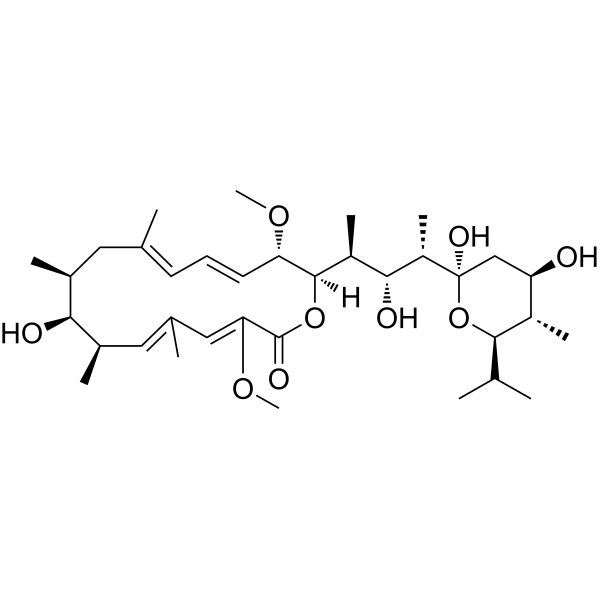
HY-100558
Bafilomycin A1V-ATPase Inhibitor -
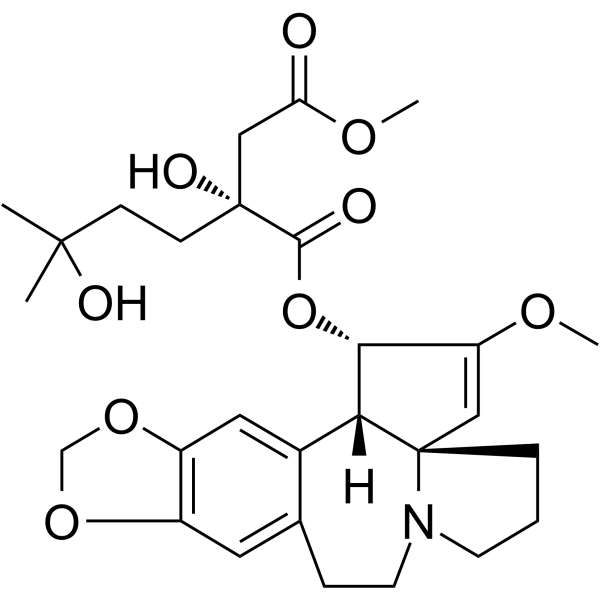
HY-N0862
HarringtonineInfluenza Virus Inhibitor -
HY-158220
Hyaluronic acid Methacryloyl (MW 400 kDa)Hyaluronic Acid -
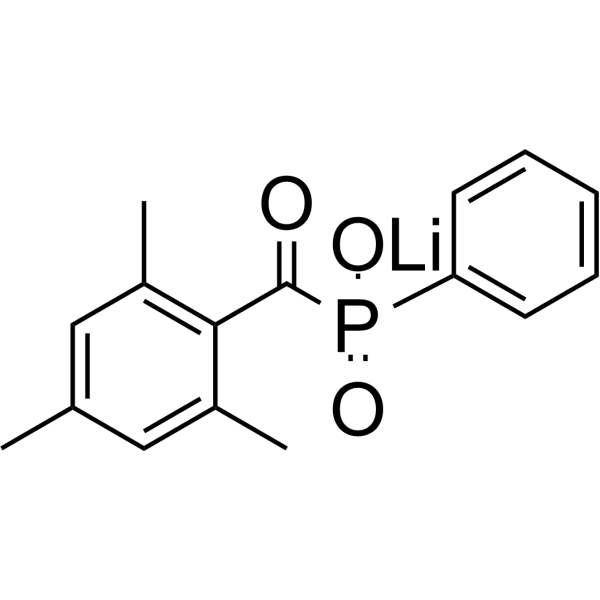
HY-44076
LAPRadical Initiator -
HY-158231
Polyether F127 DiacrylateAcrylated Triblock Copolymer


Biological Activity
Description
In Vitro
GelMA, 30% methacrylation can be photocrosslinked with the photoinitiator LAP (HY-44076) to form a hydrogel that functions as a bioactive and biodegradable scaffold, providing structural support and cell-adhesion motifs for tissue cells[1].
GelMA, 30% methacrylation can be formulated into hydrogels incorporated with chitosan microspheres (CM-SIN) for application in osteoarthritis research[2].
GelMA, 30% methacrylation can be combined with poly(lactic-co-glycolic acid) (PLGA) (HY-B2247) microparticles to fabricate a composite microparticle system for drug delivery[3].
MedChemExpress (MCE) has not independently confirmed the accuracy of these methods. They are for reference only. Further protocols information, click here.
In Vivo
MedChemExpress (MCE) has not independently confirmed the accuracy of these methods. They are for reference only.


Chemical Information
-
CAS No. 2280018-77-9
-
Appearance Solid
-
Color White to off-white
-
SMILES
[GelMA, 30% methacrylation]
-
Synonyms
Gelatin Methacryloyl, 30% methacrylation
-
Shipping
Room temperature in continental US; may vary elsewhere.
-
Storage
-20°C, protect from light
* In solvent : -80°C, 6 months; -20°C, 1 month (protect from light)


Solvent & Solubility
In Vitro:
H2O : 30.03 mg/mL (Need ultrasonic)

Protocols
-
3D Hydrogel Synthetic Scaffold Culture
3D hydrogel synthetic scaffold culture embeds cells, spheroids, organoids, or tissue fragments inside a hydrated crosslinked polymer network so that cells receive matrix and cell-cell cues in three dimensions rather than from a flat plastic surface. A literature-supported model protocol is PEG-4MAL hydrogel culture, in which four-arm maleimide-terminated PEG is functionalized with cysteine-containing adhesive peptides such as RGD and crosslinked with protease-degradable peptides such as GPQ-W; this creates a defined, modular scaffold that supports human organoid generation and culture. The readouts are scaffold-supported growth, morphology, lumen formation, budding, viability, proliferation, lineage-marker expression, and matrix-dependent expansion or differentiation; reported assays include transmitted-light imaging, immunofluorescence, in situ hybridization, qRT-PCR, and rheological characterization.
-
Chromatin Immunoprecipitation
Chromatin Immunoprecipitation (ChIP) is a molecular biology technique used to study the interaction between proteins and chromatin.


Purity & Documentation
-
Data Sheet (270 KB)
-
SDS (393 KB)
- English - EN (393 KB)
- Français - FR (393 KB)
- Deutsch - DE (393 KB)
- Norwegian - NO (393 KB)
- Español - ES (393 KB)
- Swedish - SV (393 KB)
- Italian - IT (393 KB)
- Korean - KR (393 KB)
- Portuguese - PT (393 KB)
-
Handling Instructions (2659 KB)
References
[2]. Chen P, et al. Intra-articular delivery of sinomenium encapsulated by chitosan microspheres and photo-crosslinked GelMA hydrogel ameliorates osteoarthritis by effectively regulating autophagy. Biomaterials. 2016 Mar;81:1-13. [Content Brief]
[4]. Zhao X, et al. Antibacterial anti-oxidant electroactive injectable hydrogel as self-healing wound dressing with hemostasis and adhesiveness for cutaneous wound healing. Biomaterials. 2017 Apr;122:34-47. [Content Brief]

Calculators
Concentration (start) × Volume (start) = Concentration (final) × Volume (final)


GelMA, 30% methacrylation Related Classifications
HY-W763582 Related Classifications
 Powered by Bioz