



GIP (1-30) amide,human
Based on 1 publication(s) in Google Scholar
GIP (1-30) amide,human is a glucose-dependent insulinotropic polypeptide (GIP) fragment. GIP is an incretin hormone that stimulates insulin secretion and reduces postprandial glycaemic excursions. GIP (1-30) amide,human dose-dependently promotes insulin secretion over the range 10-9-10-6 M.
For research use only. We do not sell to patients.
- CAS No.: 198624-01-0
- Formula: C162H240N40O47S
- Molecular Weight:3531.94
-
Storage:
Please store the product under the recommended conditions in the Certificate of Analysis.


To place orders, for customer services and technical support, please contact: MedChemExpress USA
Tel: 609-228-6898 E-mail: [email protected] [email protected]


-
 Biological Activity
-
Chemical Information
- Protocols
- Purity & Documentation
- References
-
 Help & FAQs




Publications Citing Use of MedChemExpress (MCE) GIP (1-30) amide,human
More

Biological Activity
Description
In Vitro
The glucose-dependent action of Glucose-dependent insulinotropic polypeptide (GIP) on pancreatic β-cells has attracted attention towards its exploitation as a potential drug for type 2 diabetes. In a 50% aqueous trifluoroethanol solvent, GIP(1-30) amide has an α-helical structural region from F6 to A28. The structures calculated for GIP(1-30) amide remain within one family of conformations and the level of agreement between the structures demonstrated the ordered arrangement[1].
MedChemExpress (MCE) has not independently confirmed the accuracy of these methods. They are for reference only. Further protocols information, click here.


Chemical Information
-
CAS No. 198624-01-0
-
Molecular Weight 3531.94
-
Formula C162H240N40O47S
-
Sequence
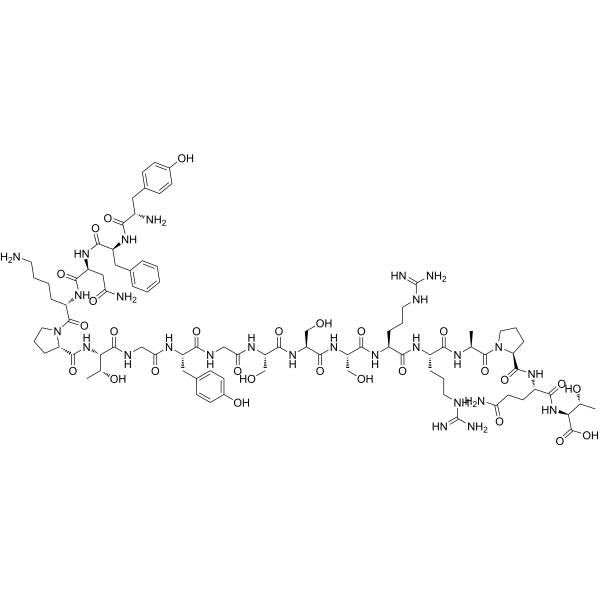
Tyr-Ala-Glu-Gly-Thr-Phe-Ile-Ser-Asp-Tyr-Ser-Ile-Ala-Met-Asp-Lys-Ile-His-Gln-Gln-Asp-Phe-Val-Asn-Trp-Leu-Leu-Ala-Gln-Lys-NH2
-
Sequence Shortening
YAEGTFISDYSIAMDKIHQQDFVNWLLAQK-NH2
-
Shipping
Room temperature in continental US; may vary elsewhere.
-
Storage
Please store the product under the recommended conditions in the Certificate of Analysis.


Publications (1)
-
Journal Impact Factor
-
Most Recent

Protocols
-
Research Protocol for Endocrine Diseases
Endocrine diseases often arise from disrupted hormone production, hormone signaling, or target-tissue responsiveness; for diabetes-focused endocrine disease models, insulin signaling regulates glucose uptake, hepatic glucose output, lipid metabolism, and β-cell compensation. Type 2 diabetes develops through interacting defects in insulin resistance, β-cell dysfunction, adipose inflammation, hepatic glucose overproduction, altered incretin signaling, and ectopic lipid metabolism. A major unresolved question is whether endocrine dysfunction is driven primarily by target-tissue insulin resistance, intrinsic β-cell failure, immune/inflammatory stress, or combined multi-organ failure that differs by disease stage.
-
Human Islet Cell Culture
The method of preserving islets in vitro, with purified reduced immunogenicity. The steps are islet isolation, islet cell purification, in vitro determination of islet function and islet cell culture.


Purity & Documentation
References

Calculators
Concentration (start) × Volume (start) = Concentration (final) × Volume (final)


GIP (1-30) amide,human Related Classifications
HY-P2080 Related Classifications
 Powered by Bioz