



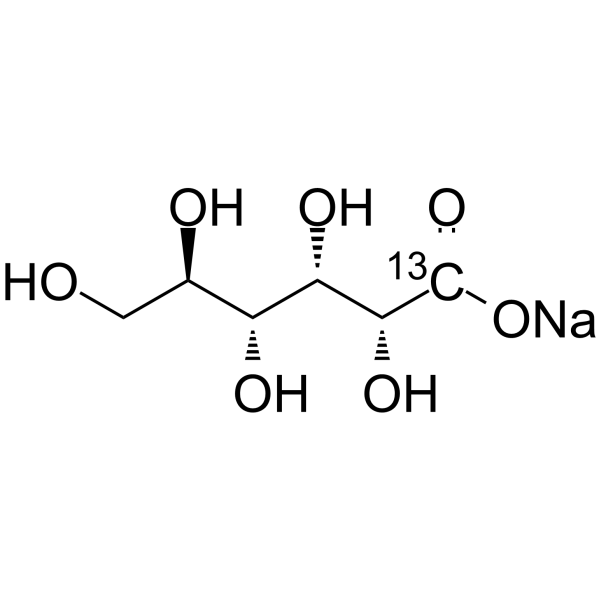
Gluconate-1-13C sodium

Based on 1 Customer Validation
Gluconate-1-13C (D-Gluconic acid-1-13C) sodium is the 13C labeled Gluconate sodium (HY-B1092A). Gluconate (D-Gluconic acid) sodium is an orally active glucose derivative. Gluconate sodium reduces nitric oxide and inflammatory cytokines (IL-1β and IL-6). Gluconate sodium inhibits ERK phosphorylation. Gluconate sodium has antioxidant and antiplatelet activation activities. Gluconate sodium has antitumor activity against colorectal cancer. Gluconate sodium improves osteoarthritis, intestinal damage and acute lung injury.
For research use only. We do not sell to patients.
- Purity : 99.89%
- CAS No.: 2687959-99-3
- Formula: C513CH11NaO7
- Molecular Weight:219.13
-
Storage:
4°C, sealed storage, away from moisture
* In solvent : -80°C, 6 months; -20°C, 1 month (sealed storage, away from moisture)

To place orders, for customer services and technical support, please contact: MedChemExpress USA
Tel: 609-228-6898 E-mail: [email protected] [email protected]


-
 Biological Activity
-
Chemical Information
-
Solvent & Solubility
- Purity & Documentation
- References
-
 Help & FAQs


All Endogenous Metabolite Isoforms
More

Biological Activity
Description
In Vitro
Stable heavy isotopes of hydrogen, carbon, and other elements have been incorporated into drug molecules, largely as tracers for quantitation during the drug development process. Deuteration has gained attention because of its potential to affect the pharmacokinetic and metabolic profiles of drugs[1].
MedChemExpress (MCE) has not independently confirmed the accuracy of these methods. They are for reference only.
Application
1. This compound can be used as a tracer
2. This compound can be used as an internal standard for quantitative analysis by NMR, GC-MS, or LC-MS.


Chemical Information
-
CAS No. 2687959-99-3
-
Unlabeled CAS 527-07-1
-
Appearance Solid
-
Molecular Weight 219.13
-
Formula C513CH11NaO7
-
Color White to off-white
-
SMILES
O[C@H]([C@H]([C@@H]([C@@H](CO)O)O)O)[13C](O[Na])=O
-
Synonyms
D-Gluconic acid sodium salt-1-13C; Sodium D-gluconate-1-13C; D-Gluconate sodium salt-1-13C
-
Shipping
Room temperature in continental US; may vary elsewhere.
-
Storage
4°C, sealed storage, away from moisture
* In solvent : -80°C, 6 months; -20°C, 1 month (sealed storage, away from moisture)


Solvent & Solubility
In Vitro:
H2O : 25 mg/mL (114.09 mM; Need ultrasonic)
Please refer to the solubility information to select the appropriate solvent. Once prepared, please aliquot and store the solution to prevent product inactivation from repeated freeze-thaw cycles.
Storage method and period of stock solution: -80°C, 6 months; -20°C, 1 month (sealed storage, away from moisture). When stored at -80°C, please use it within 6 months. When stored at -20°C, please use it within 1 month.
* Note: If you choose water as the stock solution, please dilute it to the working solution, then filter and sterilize it with a 0.22 μm filter before use.
Please refer to the solubility information to select the appropriate solvent. Once prepared, please aliquot and store the solution to prevent product inactivation from repeated freeze-thaw cycles.
Storage method and period of stock solution: -80°C, 6 months; -20°C, 1 month (sealed storage, away from moisture). When stored at -80°C, please use it within 6 months. When stored at -20°C, please use it within 1 month.
* Note: If you choose water as the stock solution, please dilute it to the working solution, then filter and sterilize it with a 0.22 μm filter before use.
Concentration (start) × Volume (start) = Concentration (final) × Volume (final)


Purity & Documentation
-
Data Sheet (275 KB)
-
SDS (254 KB)
- English - EN (254 KB)
- Français - FR (254 KB)
- Deutsch - DE (254 KB)
- Norwegian - NO (254 KB)
- Español - ES (254 KB)
- Swedish - SV (254 KB)
- Italian - IT (254 KB)
- Korean - KR (254 KB)
- Portuguese - PT (254 KB)
-
Handling Instructions (2659 KB)
References
[1]. Saluk-Juszczak J. A comparative study of antioxidative activity of calcium-D-glucarate, sodium-D-gluconate and D-glucono-1,4-lactone in a human blood platelet model. Platelets. 2010;21(8):632-40. [Content Brief]
[2]. Kameue C, et al. Dietary sodium gluconate protects rats from large bowel cancer by stimulating butyrate production. J Nutr. 2004 Apr;134(4):940-4. [Content Brief]
[3]. Saleem TH, et al. Possible Protective Effects of Quercetin and Sodium Gluconate Against Colon Cancer Induction by Dimethylhydrazine in Mice. Asian Pac J Cancer Prev. 2015;16(14):5823-8. [Content Brief]
[4]. Zhang Y, et al. Dietary supplementation with sodium gluconate improves the growth performance and intestinal function in weaned pigs challenged with a recombinant Escherichia coli strain. BMC Vet Res. 2022 Aug 6;18(1):303. [Content Brief]
[5]. Kang SJ, et al. Protective effects of calcium gluconate on osteoarthritis induced by anterior cruciate ligament transection and partial medial meniscectomy in Sprague-Dawley rats. J Orthop Surg Res. 2014 Mar 7;9(1):14. [Content Brief]
[6]. Liu L, et al. Effects of calcium gluconate on lipopolysaccharide-induced acute lung injury in mice. Biochem Biophys Res Commun. 2018 Sep 18;503(4):2931-2935. [Content Brief]


Complete Stock Solution Preparation Table
Please refer to the solubility information to select the appropriate solvent. Once prepared, please aliquot and store the solution to prevent product inactivation from repeated freeze-thaw cycles.
Storage method and period of stock solution: -80°C, 6 months; -20°C, 1 month (sealed storage, away from moisture). When stored at -80°C, please use it within 6 months. When stored at -20°C, please use it within 1 month.
| Optional Solvent | Concentration Solvent Mass | 1 mg | 5 mg | 10 mg | 25 mg |
|---|---|---|---|---|---|
| H2O | 1 mM | 4.5635 mL | 22.8175 mL | 45.6350 mL | 114.0875 mL |
| 5 mM | 0.9127 mL | 4.5635 mL | 9.1270 mL | 22.8175 mL | |
| 10 mM | 0.4564 mL | 2.2818 mL | 4.5635 mL | 11.4088 mL | |
| 15 mM | 0.3042 mL | 1.5212 mL | 3.0423 mL | 7.6058 mL | |
| 20 mM | 0.2282 mL | 1.1409 mL | 2.2818 mL | 5.7044 mL | |
| 25 mM | 0.1825 mL | 0.9127 mL | 1.8254 mL | 4.5635 mL | |
| 30 mM | 0.1521 mL | 0.7606 mL | 1.5212 mL | 3.8029 mL | |
| 40 mM | 0.1141 mL | 0.5704 mL | 1.1409 mL | 2.8522 mL | |
| 50 mM | 0.0913 mL | 0.4564 mL | 0.9127 mL | 2.2818 mL | |
| 60 mM | 0.0761 mL | 0.3803 mL | 0.7606 mL | 1.9015 mL | |
| 80 mM | 0.0570 mL | 0.2852 mL | 0.5704 mL | 1.4261 mL | |
| 100 mM | 0.0456 mL | 0.2282 mL | 0.4564 mL | 1.1409 mL |
* Note: If you choose water as the stock solution, please dilute it to the working solution, then filter and sterilize it with a 0.22 μm filter before use.


Gluconate-1-13C sodium Related Classifications
HY-B1092AS Related Classifications
 Powered by Bioz