



GW 610

Based on 1 Customer Validation
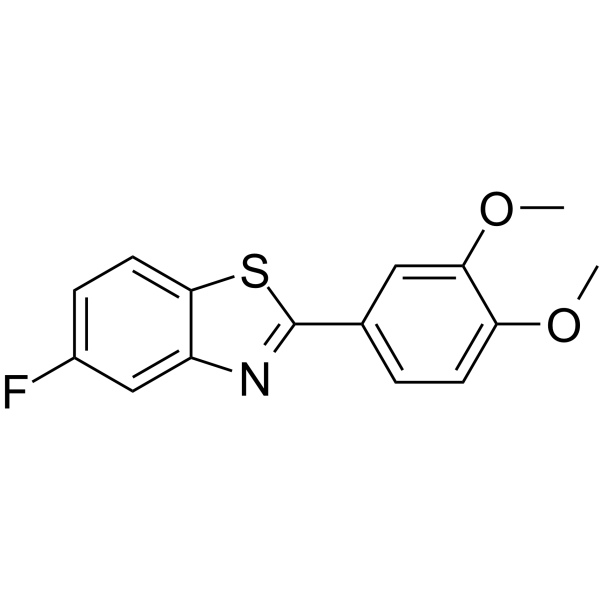
GW 610 (NSC 721648), an antitumor agent, is a potent AhR ligand with a Ki of 6.8 nM. GW 610 induces CYP1A1 expression in MCF-7 cells. GW 610 shows potent and selective anticancer activity against lung, colon, and breast cancer cell lines.
For research use only. We do not sell to patients.
- Purity : 99.78%
- CAS No.: 872726-44-8
- Formula: C15H12FNO2S
- Molecular Weight:289.32
-
Storage:
4°C, protect from light
* In solvent : -80°C, 6 months; -20°C, 1 month (protect from light)

To place orders, for customer services and technical support, please contact: MedChemExpress USA
Tel: 609-228-6898 E-mail: [email protected] [email protected]


-
 Biological Activity
-
Chemical Information
-
Solvent & Solubility
- Protocols
- Purity & Documentation
- References
-
 Help & FAQs




Biological Activity
Description
Cellular Effect
|
Cell Line

|
Type | Value | Description | References |
|---|---|---|---|---|
| A549 | IC50 |
15.88 μM
Compound: 1, PMX 610
|
Cytotoxicity against human A549 cells after 24 hrs by MTT assay
Cytotoxicity against human A549 cells after 24 hrs by MTT assay
|
[PMID: 22858144] |
| COLO 205 | IC50 |
13.94 μM
Compound: 1, PMX 610
|
Cytotoxicity against human COLO205 cells after 24 hrs by MTT assay
Cytotoxicity against human COLO205 cells after 24 hrs by MTT assay
|
[PMID: 22858144] |
| HCC 2998 | GI50 |
0.00025 μM
Compound: 8n
|
Antiproliferative activity against human colon cancer cell line HCC2998
Antiproliferative activity against human colon cancer cell line HCC2998
|
[PMID: 16392802] |
| HCC 2998 | GI50 |
0.25 nM
Compound: 8n
|
Antiproliferative activity against human colon cancer cell line HCC2998
Antiproliferative activity against human colon cancer cell line HCC2998
|
[PMID: 16392802] |
| HCT-116 | GI50 |
5.4 μM
Compound: 5
|
Antiproliferative activity against human HCT116 cell line
Antiproliferative activity against human HCT116 cell line
|
[PMID: 16789754] |
| HT-29 | GI50 |
2.6 μM
Compound: 5
|
Antiproliferative activity against human HT29 cell line
Antiproliferative activity against human HT29 cell line
|
[PMID: 16789754] |
| KM12 | GI50 |
0.29 μM
Compound: 8n
|
Antiproliferative activity against human colon cancer cell line KM12
Antiproliferative activity against human colon cancer cell line KM12
|
[PMID: 16392802] |
| MCF-10A | IC50 |
25.22 μM
Compound: 1, PMX 610
|
Cytotoxicity against human MCF10A cells after 24 hrs by MTT assay
Cytotoxicity against human MCF10A cells after 24 hrs by MTT assay
|
[PMID: 22858144] |
| MCF7 | GI50 |
<0.0001 μM
Compound: 8n
|
Antiproliferative activity against human breast cancer cell line MCF7
Antiproliferative activity against human breast cancer cell line MCF7
|
[PMID: 16392802] |
| MCF7 | GI50 |
<0.1 nM
Compound: 8n
|
Antiproliferative activity against human breast cancer cell line MCF7
Antiproliferative activity against human breast cancer cell line MCF7
|
[PMID: 16392802] |
| MCF7 | GI50 |
0.008 μM
Compound: 5
|
Antiproliferative activity against human MCF7 cell line
Antiproliferative activity against human MCF7 cell line
|
[PMID: 16789754] |
| MCF7 | GI50 |
0.514 μM
Compound: 5, PMX610, NSC-721648
|
Antiproliferative activity against human estrogen receptor positive MCF7 cells after 72 hrs by MTT assay in presence of aryl hydrocarbon receptor antagonist alpha-naphthoflavone
Antiproliferative activity against human estrogen receptor positive MCF7 cells after 72 hrs by MTT assay in presence of aryl hydrocarbon receptor antagonist alpha-naphthoflavone
|
[PMID: 18666770] |
| MCF7 | GI50 |
<0.0001 μM
Compound: 5, PMX610, NSC-721648
|
Antiproliferative activity against estrogen receptor positive human MCF7 cells after 72 hrs by MTT assay
Antiproliferative activity against estrogen receptor positive human MCF7 cells after 72 hrs by MTT assay
|
[PMID: 18666770] |
| MCF7 | GI50 |
<0.1 nM
Compound: 5, PMX610, NSC-721648
|
Antiproliferative activity against estrogen receptor positive human MCF7 cells after 72 hrs by MTT assay
Antiproliferative activity against estrogen receptor positive human MCF7 cells after 72 hrs by MTT assay
|
[PMID: 18666770] |
| MCF7 | IC50 |
20.22 μM
Compound: 1, PMX 610
|
Cytotoxicity against human MCF7 cells after 24 hrs by MTT assay
Cytotoxicity against human MCF7 cells after 24 hrs by MTT assay
|
[PMID: 22858144] |
| MDA-MB-468 | GI50 |
<0.0001 μM
Compound: 8n
|
Antiproliferative activity against human breast cancer cell line MDA468
Antiproliferative activity against human breast cancer cell line MDA468
|
[PMID: 16392802] |
| MDA-MB-468 | GI50 |
<0.1 nM
Compound: 8n
|
Antiproliferative activity against human breast cancer cell line MDA468
Antiproliferative activity against human breast cancer cell line MDA468
|
[PMID: 16392802] |
| MDA-MB-468 | GI50 |
<0.0001 μM
Compound: 5
|
Antiproliferative activity against human MDA-MB-468 cell line
Antiproliferative activity against human MDA-MB-468 cell line
|
[PMID: 16789754] |
| MDA-MB-468 | GI50 |
<0.1 nM
Compound: 5
|
Antiproliferative activity against human MDA-MB-468 cell line
Antiproliferative activity against human MDA-MB-468 cell line
|
[PMID: 16789754] |
| MDA-MB-468 | GI50 |
0.27 μM
Compound: 5, PMX610, NSC-721648
|
Antiproliferative activity against estrogen receptor deficient human MDA468 cells after 72 hrs by MTT assay in presence of aryl hydrocarbon receptor antagonist alpha-naphthoflavone
Antiproliferative activity against estrogen receptor deficient human MDA468 cells after 72 hrs by MTT assay in presence of aryl hydrocarbon receptor antagonist alpha-naphthoflavone
|
[PMID: 18666770] |
| MDA-MB-468 | GI50 |
<0.0001 μM
Compound: 5, PMX610, NSC-721648
|
Antiproliferative activity against estrogen receptor deficient human MDA468 cells after 72 hrs by MTT assay
Antiproliferative activity against estrogen receptor deficient human MDA468 cells after 72 hrs by MTT assay
|
[PMID: 18666770] |
| MDA-MB-468 | GI50 |
<0.1 nM
Compound: 5, PMX610, NSC-721648
|
Antiproliferative activity against estrogen receptor deficient human MDA468 cells after 72 hrs by MTT assay
Antiproliferative activity against estrogen receptor deficient human MDA468 cells after 72 hrs by MTT assay
|
[PMID: 18666770] |
In Vitro
GW 610 inhibits the proliferation of MCF-7, MDA 468, KM 12, and HCC 2998 cells, with GI50s of <0.1 nM, <0.1 nM, 290 nM, and 0.25 nM, respectively[1].
GW 610 (0.1-1 μM) induces CYP1A1 mRNA and protein in MDA-MB-468, MCF-7, KM12, and HCC2998 cells, whereas CYP2S1 and CYP2W1 are induced only in breast cancer cells[3].
MedChemExpress (MCE) has not independently confirmed the accuracy of these methods. They are for reference only.
-
Cell Line:MDA-MB-468, MCF-7, KM12, and HCC2998 cells
-
Concentration:0.1, 1 μM
-
Incubation Time:48 hours
-
Result:Induced CYP1A1 mRNA and protein in all cell lines including KM12 and HCC2998 CRC cells.
Induced CYP2S1 and CYP2W1 mRNA and protein expression in MDA-MB-468 and MCF-7 breast cancer cells.


Chemical Information
-
CAS No. 872726-44-8
-
Appearance Solid
-
Molecular Weight 289.32
-
Formula C15H12FNO2S
-
Color Light yellow to brown
-
SMILES
FC1=CC=C(SC(C2=CC=C(OC)C(OC)=C2)=N3)C3=C1
-
Synonyms
NSC 721648
-
Shipping
Room temperature in continental US; may vary elsewhere.
-
Storage
4°C, protect from light
* In solvent : -80°C, 6 months; -20°C, 1 month (protect from light)


Solvent & Solubility
In Vitro:
DMSO : 25 mg/mL (86.41 mM; ultrasonic and warming and heat to 60°C; Hygroscopic DMSO has a significant impact on the solubility of product, please use newly opened DMSO)
Please refer to the solubility information to select the appropriate solvent. Once prepared, please aliquot and store the solution to prevent product inactivation from repeated freeze-thaw cycles.
Storage method and period of stock solution: -80°C, 6 months; -20°C, 1 month (protect from light). When stored at -80°C, please use it within 6 months. When stored at -20°C, please use it within 1 month.
Please refer to the solubility information to select the appropriate solvent. Once prepared, please aliquot and store the solution to prevent product inactivation from repeated freeze-thaw cycles.
Storage method and period of stock solution: -80°C, 6 months; -20°C, 1 month (protect from light). When stored at -80°C, please use it within 6 months. When stored at -20°C, please use it within 1 month.
Concentration (start) × Volume (start) = Concentration (final) × Volume (final)
In Vivo:
Select the appropriate dissolution method based on your experimental animal and administration route.
- For the following dissolution methods, please ensure to first prepare a clear stock solution using an In Vitro approach and then sequentially add co-solvents:
- To ensure reliable experimental results, the clarified stock solution can be appropriately stored based on storage conditions. As for the working solution for In Vivo experiments, it is recommended to prepare freshly and use it on the same day.
- The percentages shown for the solvents indicate their volumetric ratio in the final prepared solution. If precipitation or phase separation occurs during preparation, heat and/or sonication can be used to aid dissolution.
In Vivo Dissolution Calculator
Please enter the basic information of animal experiments:
-
-
-
-
Recommended: Prepare an additional quantity of animals to account for potential losses during experiments.
Please enter your animal formula composition:
-
%DMSO +
Recommended: Keep the proportion of DMSO in working solution below 2% if your animal is weak.
-
%+
-
+%Tween-80 + +
-
%Saline +
The co-solvents required include: DMSO, . All of co-solvents are available by MedChemExpress (MCE). , Tween 80. All of co-solvents are available by MedChemExpress (MCE).
Working solution concentration: 0.22 mg/mL
Method for preparing stock solution: mg drug dissolved in μL DMSO. Stock solution concentration: mg/mL. * In solvent : -80°C, 6 months; -20°C, 1 month (protect from light)
1. Take μL DMSO stock solution;
2. Add μL .
μL , mix evenly;
3. Then add μL Tween 80, mix evenly;
4. Then add μL
Please ensure that the stock solution in the first step is dissolved to a clear state, and add co-solvents in sequence. You can use ultrasonic heating (ultrasonic cleaner, recommended frequency 20-40 kHz), vortexing, etc. to assist dissolution.


Purity & Documentation
-
Data Sheet (273 KB)
-
SDS (251 KB)
- English - EN (251 KB)
- Français - FR (251 KB)
- Deutsch - DE (251 KB)
- Norwegian - NO (251 KB)
- Español - ES (251 KB)
- Swedish - SV (251 KB)
- Italian - IT (251 KB)
- Korean - KR (251 KB)
- Portuguese - PT (251 KB)
-
Handling Instructions (2659 KB)
References
[1]. Mortimer CG, et, al. Antitumor benzothiazoles. 26.(1) 2-(3,4-dimethoxyphenyl)-5-fluorobenzothiazole (GW 610, NSC 721648), a simple fluorinated 2-arylbenzothiazole, shows potent and selective inhibitory activity against lung, colon, and breast cancer cell lines. J Med Chem. 2006 Jan 12;49(1):179-85. [Content Brief]
[2]. Aiello S, et, al. Synthesis and biological properties of benzothiazole, benzoxazole, and chromen-4-one analogues of the potent antitumor agent 2-(3,4-dimethoxyphenyl)-5-fluorobenzothiazole (PMX 610, NSC 721648). J Med Chem. 2008 Aug 28;51(16):5135-9. [Content Brief]
[3]. Tan BS, et, al. CYP2S1 and CYP2W1 mediate 2-(3,4-dimethoxyphenyl)-5-fluorobenzothiazole (GW-610, NSC 721648) sensitivity in breast and colorectal cancer cells. Mol Cancer Ther. 2011 Oct;10(10):1982-92. [Content Brief]
[4]. Boon Shing Tan, et al. CYP2S1 and CYP2W1 mediate 2-(3,4-dimethoxyphenyl)-5-fluorobenzothiazole (GW-610, NSC 721648) sensitivity in breast and colorectal cancer cells. Mol Cancer Ther. 2011 Oct;10(10):1982-92. [Content Brief]


Complete Stock Solution Preparation Table
Please refer to the solubility information to select the appropriate solvent. Once prepared, please aliquot and store the solution to prevent product inactivation from repeated freeze-thaw cycles.
Storage method and period of stock solution: -80°C, 6 months; -20°C, 1 month (protect from light). When stored at -80°C, please use it within 6 months. When stored at -20°C, please use it within 1 month.
| Optional Solvent | Concentration Solvent Mass | 1 mg | 5 mg | 10 mg | 25 mg |
|---|---|---|---|---|---|
| DMSO | 1 mM | 3.4564 mL | 17.2819 mL | 34.5638 mL | 86.4095 mL |
| 5 mM | 0.6913 mL | 3.4564 mL | 6.9128 mL | 17.2819 mL | |
| 10 mM | 0.3456 mL | 1.7282 mL | 3.4564 mL | 8.6410 mL | |
| 15 mM | 0.2304 mL | 1.1521 mL | 2.3043 mL | 5.7606 mL | |
| 20 mM | 0.1728 mL | 0.8641 mL | 1.7282 mL | 4.3205 mL | |
| 25 mM | 0.1383 mL | 0.6913 mL | 1.3826 mL | 3.4564 mL | |
| 30 mM | 0.1152 mL | 0.5761 mL | 1.1521 mL | 2.8803 mL | |
| 40 mM | 0.0864 mL | 0.4320 mL | 0.8641 mL | 2.1602 mL | |
| 50 mM | 0.0691 mL | 0.3456 mL | 0.6913 mL | 1.7282 mL | |
| 60 mM | 0.0576 mL | 0.2880 mL | 0.5761 mL | 1.4402 mL | |
| 80 mM | 0.0432 mL | 0.2160 mL | 0.4320 mL | 1.0801 mL |


GW 610 Related Classifications
HY-118474 Related Classifications
 Powered by Bioz