



Hi 76-0079
Based on 1 publication(s) in Google Scholar
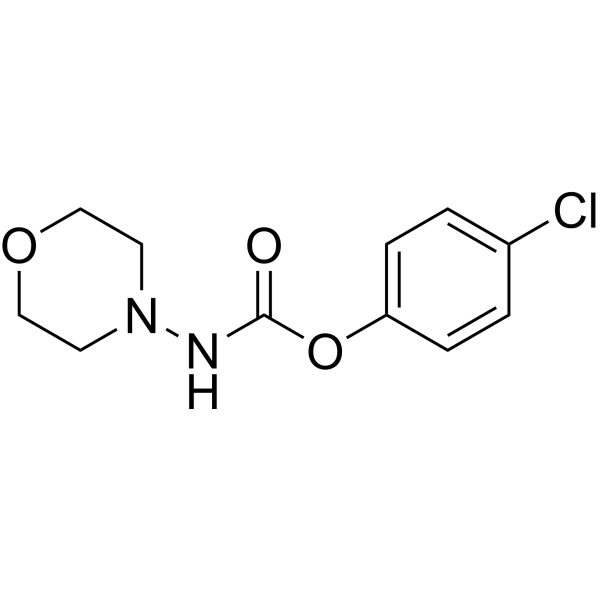
Hi 76-0079 (NNC0076-0079; 76-0079) is a lipase inhibitor that specifically targets hormone-sensitive lipase (HSL). Hi 76-0079 inhibits PNPB Hydrolysis in cell lysates of HEK293A cells overexpressing Lipe with an IC50 value of 0.1 μM. Hi 76-0079 synergizes with the ATGL inhibitor Atglistatin (HY-15859) to block lipolysis in vitro. Hi 76-0079 can be used for the study of lipid metabolism.
For research use only. We do not sell to patients.
- Purity : 99.82%
- CAS No.: 374567-94-9
- Formula: C11H13ClN2O3
- Molecular Weight:256.69
-
Storage:Powder -20°C, 3 years , 4°C, 2 years ; In solvent -80°C, 6 months , -20°C, 1 month

To place orders, for customer services and technical support, please contact: MedChemExpress USA
Tel: 609-228-6898 E-mail: [email protected] [email protected]


-
 Biological Activity
-
Chemical Information
-
Solvent & Solubility
- Protocols
- Purity & Documentation
- References
-
 Help & FAQs


Publications Citing Use of MedChemExpress (MCE) Hi 76-0079
More

Biological Activity
Description
In Vitro
Hi 76-0079 (10 μM, 3 h) synergistically inhibits basal and forskolin-activated lipolysis in 3T3-L1 adipocytes, significantly reducing the release of free fatty acids (FA) and glycerol in the culture medium, when used in combination with Atglistatin (HY-15859)[1].
Hi 76-0079 (10 μM, 9 h) combined with Atglistatin to treat wild-type mouse WAT tissue pieces, inhibits WAT lipase activity, almost completely blocking basal and forskolin-activated lipolysis, and has no significant effect on the residual lipase activity of WAT tissue from ATGL-knockout (ATGL-ko) mice[1].
Hi 76-0079 (60 min) combined with Atglistatin significantly inhibits triglyceride (TG) hydrolase activity in lysates of brown adipose tissue (BAT), skeletal muscle (SM), cardiac muscle (CM), and liver from wild-type mice, but has no significant inhibitory effect on TG hydrolase activity in lysates of the above tissues from ATGL-ko mice[1].
MedChemExpress (MCE) has not independently confirmed the accuracy of these methods. They are for reference only.


Chemical Information
-
CAS No. 374567-94-9
-
Appearance Solid
-
Molecular Weight 256.69
-
Formula C11H13ClN2O3
-
Color White to off-white
-
SMILES
O=C(NN1CCOCC1)OC2=CC=C(C=C2)Cl
-
Synonyms
NNC0076-0079; 76-0079
-
Shipping
Room temperature in continental US; may vary elsewhere.
-
Storage
Powder -20°C 3 years 4°C 2 years In solvent -80°C 6 months -20°C 1 month


Publications (1)
-
Journal Impact Factor
-
Most Recent


Solvent & Solubility
In Vitro:
DMSO : 200 mg/mL (779.15 mM; Need ultrasonic; Hygroscopic DMSO has a significant impact on the solubility of product, please use newly opened DMSO)
Please refer to the solubility information to select the appropriate solvent. Once prepared, please aliquot and store the solution to prevent product inactivation from repeated freeze-thaw cycles.
Storage method and period of stock solution: -80°C, 6 months; -20°C, 1 month. When stored at -80°C, please use it within 6 months. When stored at -20°C, please use it within 1 month.
Please refer to the solubility information to select the appropriate solvent. Once prepared, please aliquot and store the solution to prevent product inactivation from repeated freeze-thaw cycles.
Storage method and period of stock solution: -80°C, 6 months; -20°C, 1 month. When stored at -80°C, please use it within 6 months. When stored at -20°C, please use it within 1 month.
Concentration (start) × Volume (start) = Concentration (final) × Volume (final)
In Vivo:
Select the appropriate dissolution method based on your experimental animal and administration route.
- For the following dissolution methods, please ensure to first prepare a clear stock solution using an In Vitro approach and then sequentially add co-solvents:
- To ensure reliable experimental results, the clarified stock solution can be appropriately stored based on storage conditions. As for the working solution for In Vivo experiments, it is recommended to prepare freshly and use it on the same day.
- The percentages shown for the solvents indicate their volumetric ratio in the final prepared solution. If precipitation or phase separation occurs during preparation, heat and/or sonication can be used to aid dissolution.
Add each solvent one by one: 10% DMSO 40% PEG300 5% Tween-80 45% Saline
Solubility: ≥ 5 mg/mL (19.48 mM); Clear solution
This protocol yields a clear solution of ≥ 5 mg/mL (saturation unknown).
Taking 1 mL working solution as an example, add 100 μL DMSO stock solution (50.0 mg/mL) to 400 μL PEG300, and mix evenly; then add 50 μL Tween-80 and mix evenly; then add 450 μL Saline to adjust the volume to 1 mL.
Preparation of Saline: Dissolve 0.9 g sodium chloride in ddH₂O and dilute to 100 mL to obtain a clear Saline solution.
Add each solvent one by one: 10% DMSO 90% (20% SBE-β-CD in Saline)
Solubility: ≥ 5 mg/mL (19.48 mM); Clear solution
This protocol yields a clear solution of ≥ 5 mg/mL (saturation unknown).
Taking 1 mL working solution as an example, add 100 μL DMSO stock solution (50.0 mg/mL) to 900 μL 20% SBE-β-CD in Saline, and mix evenly.
Preparation of 20% SBE-β-CD in Saline (4°C, storage for one week): 2 g SBE-β-CD powder is dissolved in 10 mL Saline, completely dissolve until clear.
For the following dissolution methods, please prepare the working solution directly:
It is recommended to prepare fresh solutions and use them promptly within a short period of time.
The percentages shown for the solvents indicate their volumetric ratio in the final prepared solution. If precipitation or phase separation occurs during preparation, heat and/or sonication can be used to aid dissolution.
Add each solvent one by one: 50% PEG300 50% Saline
Solubility: 5 mg/mL (19.48 mM); Suspended solution; Need ultrasonic
In Vivo Dissolution Calculator
Please enter the basic information of animal experiments:
-
-
-
-
Recommended: Prepare an additional quantity of animals to account for potential losses during experiments.
Please enter your animal formula composition:
-
%DMSO +
Recommended: Keep the proportion of DMSO in working solution below 2% if your animal is weak.
-
%+
-
+%Tween-80 + +
-
%Saline +
The co-solvents required include: DMSO, . All of co-solvents are available by MedChemExpress (MCE). , Tween 80. All of co-solvents are available by MedChemExpress (MCE).
Working solution concentration: 0.22 mg/mL
Method for preparing stock solution: mg drug dissolved in μL DMSO. Stock solution concentration: mg/mL.
1. Take μL DMSO stock solution;
2. Add μL .
μL , mix evenly;
3. Then add μL Tween 80, mix evenly;
4. Then add μL
Please ensure that the stock solution in the first step is dissolved to a clear state, and add co-solvents in sequence. You can use ultrasonic heating (ultrasonic cleaner, recommended frequency 20-40 kHz), vortexing, etc. to assist dissolution.


Purity & Documentation
-
Data Sheet (272 KB)
-
SDS (254 KB)
- English - EN (254 KB)
- Français - FR (254 KB)
- Deutsch - DE (254 KB)
- Norwegian - NO (254 KB)
- Español - ES (254 KB)
- Swedish - SV (254 KB)
- Italian - IT (254 KB)
- Korean - KR (254 KB)
- Portuguese - PT (254 KB)
-
Handling Instructions (2659 KB)
References
[1]. Mayer N, et al. Development of small-molecule inhibitors targeting adipose triglyceride lipase. Nat Chem Biol. 2013 Dec;9(12):785-7. [Content Brief]
[2]. Sakai K, et al. Critical role of neutral cholesteryl ester hydrolase 1 in cholesteryl ester hydrolysis in murine macrophages. J Lipid Res. 2014 Oct;55(10):2033-40. [Content Brief]


Complete Stock Solution Preparation Table
Please refer to the solubility information to select the appropriate solvent. Once prepared, please aliquot and store the solution to prevent product inactivation from repeated freeze-thaw cycles.
Storage method and period of stock solution: -80°C, 6 months; -20°C, 1 month. When stored at -80°C, please use it within 6 months. When stored at -20°C, please use it within 1 month.
| Optional Solvent | Concentration Solvent Mass | 1 mg | 5 mg | 10 mg | 25 mg |
|---|---|---|---|---|---|
| DMSO | 1 mM | 3.8957 mL | 19.4787 mL | 38.9575 mL | 97.3937 mL |
| 5 mM | 0.7791 mL | 3.8957 mL | 7.7915 mL | 19.4787 mL | |
| 10 mM | 0.3896 mL | 1.9479 mL | 3.8957 mL | 9.7394 mL | |
| 15 mM | 0.2597 mL | 1.2986 mL | 2.5972 mL | 6.4929 mL | |
| 20 mM | 0.1948 mL | 0.9739 mL | 1.9479 mL | 4.8697 mL | |
| 25 mM | 0.1558 mL | 0.7791 mL | 1.5583 mL | 3.8957 mL | |
| 30 mM | 0.1299 mL | 0.6493 mL | 1.2986 mL | 3.2465 mL | |
| 40 mM | 0.0974 mL | 0.4870 mL | 0.9739 mL | 2.4348 mL | |
| 50 mM | 0.0779 mL | 0.3896 mL | 0.7791 mL | 1.9479 mL | |
| 60 mM | 0.0649 mL | 0.3246 mL | 0.6493 mL | 1.6232 mL | |
| 80 mM | 0.0487 mL | 0.2435 mL | 0.4870 mL | 1.2174 mL | |
| 100 mM | 0.0390 mL | 0.1948 mL | 0.3896 mL | 0.9739 mL |


Hi 76-0079 Related Classifications
HY-153523 Related Classifications
 Powered by Bioz