



Histatin-3 TFA

Based on 1 Customer Validation
Histatin-3 TFA, a 32 amino acid peptide, possesses powerful antimicrobial properties. Histatin-3 TFA behaves as a substrate for proprotein convertase 1 (PC1), being cleaved by this endoprotease primarily at a site carboxy terminal to the single Arg25 residue (HRGYR decrease SN). Histatin-3 TFA is a moderately potent, reversible and competitive inhibitor of the furin-mediated cleavage of the pentapeptide pGlu-Arg-Thr-Lys-Arg-MCA fluorogenic substrate, with an estimated inhibition constant Ki of 1.98 μM.
연구목적의 판매만을 진행합니다. 환자를 대상으로 한 판매는 하지 않습니다.
- Purity : 98.26%
- CAS No.: 112844-49-2
- 화학식: C178H258N64O48.xC2HF3O2
- 분자량:4062.35 (free acid)
-
보관:
Sealed storage, away from moisture and light.
Powder -80°C, 2 years , -20°C, 1 year* In solvent : -80°C, 6 months; -20°C, 1 month (sealed storage, away from moisture and light)

To place orders, for customer services and technical support, please contact: MedChemExpress USA
Tel: 609-228-6898 E-mail: [email protected] [email protected]


-
 Biological Activity
-
Chemical Information
-
용액&용해도
- Protocol
- 순도&문서
- References
-
 Help & FAQs




Biological Activity
제품 설명


Chemical Information
-
CAS No. 112844-49-2
-
Appearance Solid
-
분자량 4062.35 (free acid)
-
화학식 C178H258N64O48.xC2HF3O2
-
Color White to off-white
-
Sequence
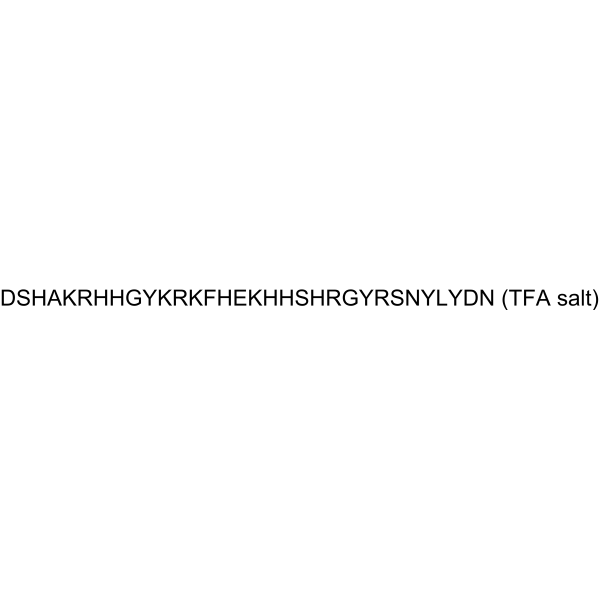
Asp-Ser-His-Ala-Lys-Arg-His-His-Gly-Tyr-Lys-Arg-Lys-Phe-His-Glu-Lys-His-His-Ser-His-Arg-Gly-Tyr-Arg-Ser-Asn-Tyr-Leu-Tyr-Asp-Asn
-
Sequence Shortening
DSHAKRHHGYKRKFHEKHHSHRGYRSNYLYDN
-
선적
Room temperature in continental US; may vary elsewhere.
-
보관
Sealed storage, away from moisture and light
Powder -80°C 2 years -20°C 1 year * In solvent : -80°C, 6 months; -20°C, 1 month (sealed storage, away from moisture and light)


용액&용해도
In Vitro:
H2O : 50 mg/mL (Need ultrasonic)


순도&문서
-
Data Sheet (264 KB)
-
SDS (394 KB)
- English - EN (394 KB)
- Français - FR (394 KB)
- Deutsch - DE (394 KB)
- Norwegian - NO (394 KB)
- Español - ES (394 KB)
- Swedish - SV (394 KB)
- Italian - IT (394 KB)
- Korean - KR (394 KB)
- Portuguese - PT (394 KB)
-
Handling Instructions (2659 KB)
References

Calculators
Concentration (start) × Volume (start) = Concentration (final) × Volume (final)


Histatin-3 TFA Related Classifications
HY-P5272 Related Classifications
 Powered by Bioz