



HIV-1 inhibitor-16
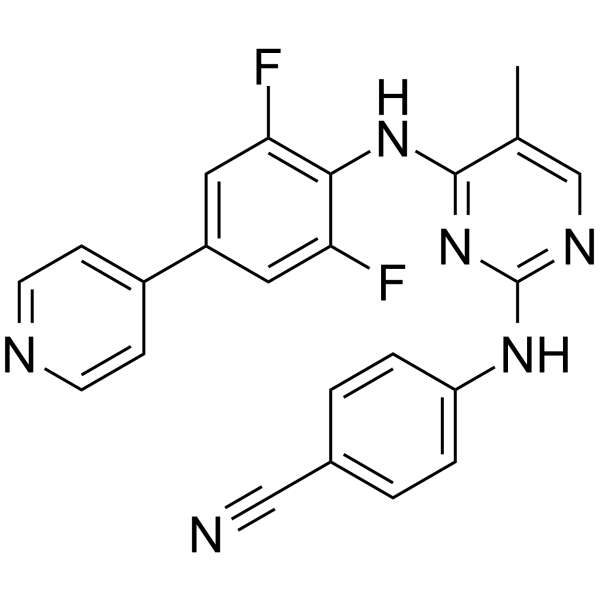
HIV-1 inhibitor-16 (compound 7a) is a highly potent HIV-1 inhibitor with an EC50 value of 1.3 nM for HIV-1 WT. HIV-1 inhibitor-16 also has certain inhibitory activity against HIV-1 K103N, E138K, Y181C and L100I strains with EC50s of 5.4 nM, 9.2 nM, 22 nM and 35 nM. HIV-1 inhibitor-16 has favorable solubility and liver microsome stability, and does not exhibit apparent CYP enzymatic inhibitory activity or acute toxicity.
For research use only. We do not sell to patients.
- CAS No.: 2719675-72-4
- Formula: C23H16F2N6
- Molecular Weight:414.41
-
Storage:
Please store the product under the recommended conditions in the Certificate of Analysis.

To place orders, for customer services and technical support, please contact: MedChemExpress USA
Tel: 609-228-6898 E-mail: [email protected] [email protected]


-
 Biological Activity
-
Chemical Information
- Protocols
- Purity & Documentation
- References
-
 Help & FAQs




Biological Activity
Description
IC50 & Target
[1]|
HIV-1 (WT) 1.3 nM (EC50) |
HIV-1 (K103N) 5.4 nM (EC50) |
HIV-1 (E138K) 9.2 nM (EC50) |
HIV-1 (Y181C) 22 nM (EC50) |
HIV-1 (L100I) 35 mM (EC50) |
Cellular Effect
|
Cell Line

|
Type | Value | Description | References |
|---|---|---|---|---|
| MT4 | CC50 |
264 μM
Compound: 7a
|
Cytotoxicity against human MT4 cells assessed as reduction in cell viability measured after 5 days by MTT assay
Cytotoxicity against human MT4 cells assessed as reduction in cell viability measured after 5 days by MTT assay
|
[PMID: 35073089] |


Chemical Information
-
CAS No. 2719675-72-4
-
Molecular Weight 414.41
-
Formula C23H16F2N6
-
SMILES
N#CC1=CC=C(NC2=NC=C(C)C(NC3=C(F)C=C(C4=CC=NC=C4)C=C3F)=N2)C=C1
-
Shipping
Room temperature in continental US; may vary elsewhere.
-
Storage
Please store the product under the recommended conditions in the Certificate of Analysis.

Protocols
-
Acute Systemic Toxicity Study
Acute systemic toxicity studies evaluate adverse effects occurring after a single exposure, or repeated exposure within a short acute window, and the main in vivo readouts are mortality, moribund condition, clinical signs, body-weight change, and gross pathological findings; acute oral toxicity methods were developed to replace classical LD50 testing with reduced-animal designs such as fixed-dose procedure, acute toxic class method, and up-and-down procedure. The fixed-dose procedure classifies acute toxicity by administering predefined dose levels and observing evident toxicity rather than using death as the primary endpoint, whereas the acute toxic class method uses sequential groups of three animals per step and the up-and-down procedure doses animals sequentially to estimate an LD50 with fewer animals than conventional LD50 testing.


Purity & Documentation
References

Calculators
Concentration (start) × Volume (start) = Concentration (final) × Volume (final)


HIV-1 inhibitor-16 Related Classifications
HY-144123 Related Classifications
 Powered by Bioz