



Hypotaurine (Standard)

Based on 1 Customer Validation
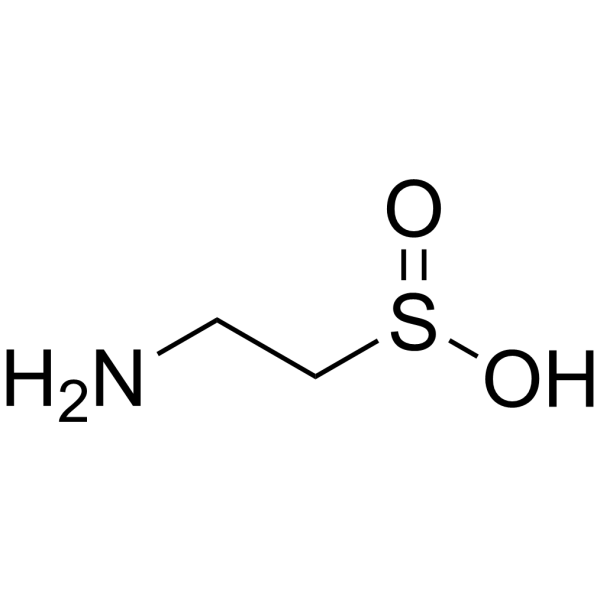
Hypotaurine (Standard) is the analytical standard of Hypotaurine. This product is intended for research and analytical applications. Hypotaurine (2-aminoethanesulfinic acid), an intermediate in taurine biosynthesis from cysteine in astrocytes, is an endogenous inhibitory amino acid of the glycine receptor. Antioxidant[1].
For research use only. We do not sell to patients.
- CAS No.: 300-84-5
- Formula: C2H7NO2S
- Molecular Weight:109.15
-
Storage:
Please store the product under the recommended conditions in the Certificate of Analysis.


To place orders, for customer services and technical support, please contact: MedChemExpress USA
Tel: 609-228-6898 E-mail: [email protected] [email protected]


-
 Product Information
-
Chemical Information
- Purity & Documentation
-
 Help & FAQs




Product Information
Information
Application
The compound is the grade of analytical standard, which is the reference standard supplied assay. It is commonly used in qualitative, quantitative and methodological research experiments in HPLC, GC and MS.


Chemical Information
-
CAS No. 300-84-5
-
Appearance Solid
-
Molecular Weight 109.15
-
Formula C2H7NO2S
-
Color White to off-white
-
SMILES
NCCS(O)=O
-
Synonyms
2-Aminoethanesulfinic acid (Standard)
-
Structure Classification
-
Initial Source
-
Shipping
Room temperature in continental US; may vary elsewhere.
-
Storage
Please store the product under the recommended conditions in the Certificate of Analysis.


Purity & Documentation
References
[1]. Green TR, et al. Antioxidant role and subcellular location of hypotaurine and taurine in human neutrophils. Biochim Biophys Acta. 1991 Jan 23;1073(1):91-7. https://www.ncbi.nlm.nih.gov/pubmed/1846756 [Content Brief]
[2]. Gao P, et al. Hypotaurine evokes a malignant phenotype in glioma through aberrant hypoxic signaling. Oncotarget. 2016 Mar 22;7(12):15200-14. [Content Brief]
[3]. Hara K, et al. Antinociceptive effect of intrathecal administration of hypotaurine in rat models of inflammatory and neuropathic pain. Amino Acids. 2012 Jul;43(1):397-404. Hara K, et al. Antinociceptive effect of intrathecal administration of hypotaurine in rat models of inflammatory and neuropathic pain. Amino Acids. 2012 Jul;43(1):397-404. [Content Brief]

Calculators
Concentration (start) × Volume (start) = Concentration (final) × Volume (final)


Hypotaurine (Standard) Related Classifications
HY-100803R Related Classifications
 Powered by Bioz