



CypK

Based on 1 Customer Validation
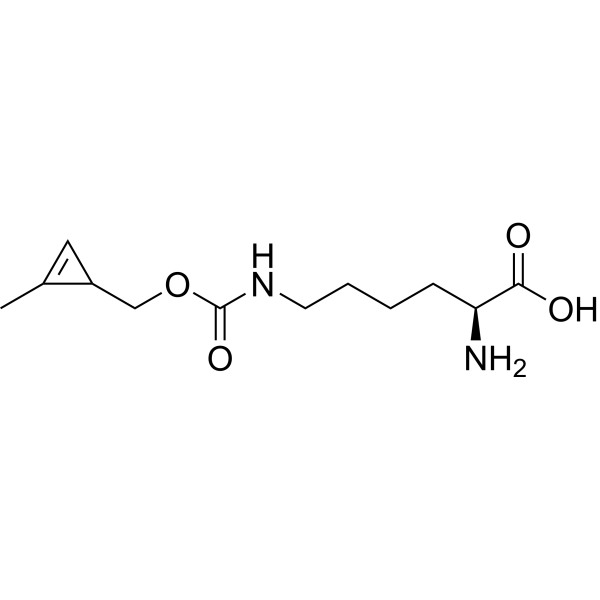
CypK (N-Cyclopropene-L-Lysine), a cyclopropene derivative of lysine, is efficiently incorporated into antibodies through genetic-code expansion. CypK is a minimal bioorthogonal handle for the creation of stable therapeutic protein conjugates.
For research use only. We do not sell to patients.
- Purity : 99.45%
- CAS No.: 1610703-09-7
- Formula: C12H20N2O4
- Molecular Weight:256.30
-
Storage:Powder -20°C, 3 years ; In solvent -80°C, 6 months , -20°C, 1 month

To place orders, for customer services and technical support, please contact: MedChemExpress USA
Tel: 609-228-6898 E-mail: [email protected] [email protected]


-
 Biological Activity
-
Chemical Information
-
Solvent & Solubility
- Purity & Documentation
- References
-
 Help & FAQs




Biological Activity
Description
In Vitro
Guidelines (Following is our recommended protocol. This protocol only provides a guideline, and should be modified according to your specific needs).
CypK assay[1] (express the antibody):
1. Thaw a vial of HEK suspension cells in a 250 mL flask containing 50 mL of expression medium supplemented with 100 units/mL penicillin, 100 μg/mL streptomycin, and 250 ng/mL amphotericin B. Keep the cells at 37 °C with 8% CO2 in humidified incubators equipped with a shaker at 125 rpm. Split cells to 0.3-0.5 x 10⁶ cells/mL (every 2-3 days) at least 2 times before transfecting.
2. When a density of 2.5 x 10⁶ cells/mL is reached (2-3 days after splitting), prepare a fresh solution of 100 mM CypK. For this purpose, weigh 64 mg of CypK, add 2.5 mL of 0.1 sodium hydroxide, vortex, spin down to recover all undissolved particles and sonicate.
3. Add 2.5 mL of CypK (100 mM in 0.1 M NaOH) to 42.5 mL of expression medium supplemented with antibiotics. Mix well, add 250 μL of 0.1 M HCl, and sterilize using a 0.22 μm filter.
4.Dilute 50 μg of HC and LC pKym1 plasmids to 2.5 mL with reduced serum medium. In a separate tube, dilute 135 μL of transfection reagent to 2.5 mL with reduced serum medium.
5. Five minutes after preparing the solutions, mix the plasmids and the transfection reagent solution and incubate for 20 min to allow the formation of complexes between the DNA and the transfection reagent.
6. In the meantime, centrifuge 125 million cells at the target density for 5 min at 500 x g, resuspend with the expression medium containing CypK and add the DNA–transfection reagent mixture.
7. After incubating cells for 20 h, add 250 μL of transfection reagent enhancers included in the kit.
8. Harvest antibodies from the supernatant 6-7 days after addition of CypK (no change of medium is required during expression).
MedChemExpress (MCE) has not independently confirmed the accuracy of these methods. They are for reference only.


Chemical Information
-
CAS No. 1610703-09-7
-
Appearance Solid
-
Molecular Weight 256.30
-
Formula C12H20N2O4
-
Color White to off-white
-
SMILES
N[C@@H](CCCCNC(OCC1C(C)=C1)=O)C(O)=O
-
Synonyms
N-Cyclopropene-L-Lysine
-
Shipping
Room temperature in continental US; may vary elsewhere.
-
Storage
Powder -20°C 3 years In solvent -80°C 6 months -20°C 1 month


Solvent & Solubility
In Vitro:
H2O : 33.33 mg/mL (130.04 mM; ultrasonic and adjust pH to 2 with HCl)
Please refer to the solubility information to select the appropriate solvent. Once prepared, please aliquot and store the solution to prevent product inactivation from repeated freeze-thaw cycles.
Storage method and period of stock solution: -80°C, 6 months; -20°C, 1 month. When stored at -80°C, please use it within 6 months. When stored at -20°C, please use it within 1 month.
* Note: If you choose water as the stock solution, please dilute it to the working solution, then filter and sterilize it with a 0.22 μm filter before use.
Please refer to the solubility information to select the appropriate solvent. Once prepared, please aliquot and store the solution to prevent product inactivation from repeated freeze-thaw cycles.
Storage method and period of stock solution: -80°C, 6 months; -20°C, 1 month. When stored at -80°C, please use it within 6 months. When stored at -20°C, please use it within 1 month.
* Note: If you choose water as the stock solution, please dilute it to the working solution, then filter and sterilize it with a 0.22 μm filter before use.
Concentration (start) × Volume (start) = Concentration (final) × Volume (final)
In Vivo:
Select the appropriate dissolution method based on your experimental animal and administration route.
- For the following dissolution methods, please ensure to first prepare a clear stock solution using an In Vitro approach and then sequentially add co-solvents:
- To ensure reliable experimental results, the clarified stock solution can be appropriately stored based on storage conditions. As for the working solution for In Vivo experiments, it is recommended to prepare freshly and use it on the same day.
- The percentages shown for the solvents indicate their volumetric ratio in the final prepared solution. If precipitation or phase separation occurs during preparation, heat and/or sonication can be used to aid dissolution.
Add each solvent one by one: 10% DMSO 40% PEG300 5% Tween-80 45% Saline
Solubility: ≥ 3 mg/mL (11.71 mM); Clear solution
This protocol yields a clear solution of ≥ 3 mg/mL (saturation unknown).
Taking 1 mL working solution as an example, add 100 μL DMSO stock solution (30.0 mg/mL) to 400 μL PEG300, and mix evenly; then add 50 μL Tween-80 and mix evenly; then add 450 μL Saline to adjust the volume to 1 mL.
Preparation of Saline: Dissolve 0.9 g sodium chloride in ddH₂O and dilute to 100 mL to obtain a clear Saline solution.
Add each solvent one by one: 10% DMSO 90% (20% SBE-β-CD in Saline)
Solubility: ≥ 3 mg/mL (11.71 mM); Clear solution
This protocol yields a clear solution of ≥ 3 mg/mL (saturation unknown).
Taking 1 mL working solution as an example, add 100 μL DMSO stock solution (30.0 mg/mL) to 900 μL 20% SBE-β-CD in Saline, and mix evenly.
Preparation of 20% SBE-β-CD in Saline (4°C, storage for one week): 2 g SBE-β-CD powder is dissolved in 10 mL Saline, completely dissolve until clear.
In Vivo Dissolution Calculator
Please enter the basic information of animal experiments:
-
-
-
-
Recommended: Prepare an additional quantity of animals to account for potential losses during experiments.
Working solution concentration: 0.22 mg/mL
This product has good water solubility, please refer to the measured solubility data in water/PBS/Saline for details.


Purity & Documentation
-
Data Sheet (271 KB)
-
SDS (254 KB)
- English - EN (254 KB)
- Français - FR (254 KB)
- Deutsch - DE (254 KB)
- Norwegian - NO (254 KB)
- Español - ES (254 KB)
- Swedish - SV (254 KB)
- Italian - IT (254 KB)
- Korean - KR (254 KB)
- Portuguese - PT (254 KB)
-
Handling Instructions (2659 KB)
References
[1]. Oller-Salvia B. Genetic Encoding of a Non-Canonical Amino Acid for the Generation of Antibody-Drug Conjugates Through a Fast Bioorthogonal Reaction. J Vis Exp. 2018 Sep 14;(139):58066. [Content Brief]
[2]. Oller-Salvia B, et, al. Rapid and Efficient Generation of Stable Antibody-Drug Conjugates via an Encoded Cyclopropene and an Inverse-Electron-Demand Diels-Alder Reaction. Angew Chem Int Ed Engl. 2018 Mar 5;57(11):2831-2834. [Content Brief]


Complete Stock Solution Preparation Table
Please refer to the solubility information to select the appropriate solvent. Once prepared, please aliquot and store the solution to prevent product inactivation from repeated freeze-thaw cycles.
Storage method and period of stock solution: -80°C, 6 months; -20°C, 1 month. When stored at -80°C, please use it within 6 months. When stored at -20°C, please use it within 1 month.
| Optional Solvent | Concentration Solvent Mass | 1 mg | 5 mg | 10 mg | 25 mg |
|---|---|---|---|---|---|
| H2O | 1 mM | 3.9017 mL | 19.5084 mL | 39.0168 mL | 97.5419 mL |
| 5 mM | 0.7803 mL | 3.9017 mL | 7.8034 mL | 19.5084 mL | |
| 10 mM | 0.3902 mL | 1.9508 mL | 3.9017 mL | 9.7542 mL | |
| 15 mM | 0.2601 mL | 1.3006 mL | 2.6011 mL | 6.5028 mL | |
| 20 mM | 0.1951 mL | 0.9754 mL | 1.9508 mL | 4.8771 mL | |
| 25 mM | 0.1561 mL | 0.7803 mL | 1.5607 mL | 3.9017 mL | |
| 30 mM | 0.1301 mL | 0.6503 mL | 1.3006 mL | 3.2514 mL | |
| 40 mM | 0.0975 mL | 0.4877 mL | 0.9754 mL | 2.4385 mL | |
| 50 mM | 0.0780 mL | 0.3902 mL | 0.7803 mL | 1.9508 mL | |
| 60 mM | 0.0650 mL | 0.3251 mL | 0.6503 mL | 1.6257 mL | |
| 80 mM | 0.0488 mL | 0.2439 mL | 0.4877 mL | 1.2193 mL | |
| 100 mM | 0.0390 mL | 0.1951 mL | 0.3902 mL | 0.9754 mL |
* Note: If you choose water as the stock solution, please dilute it to the working solution, then filter and sterilize it with a 0.22 μm filter before use.


CypK Related Classifications
HY-134669 Related Classifications
 Powered by Bioz