



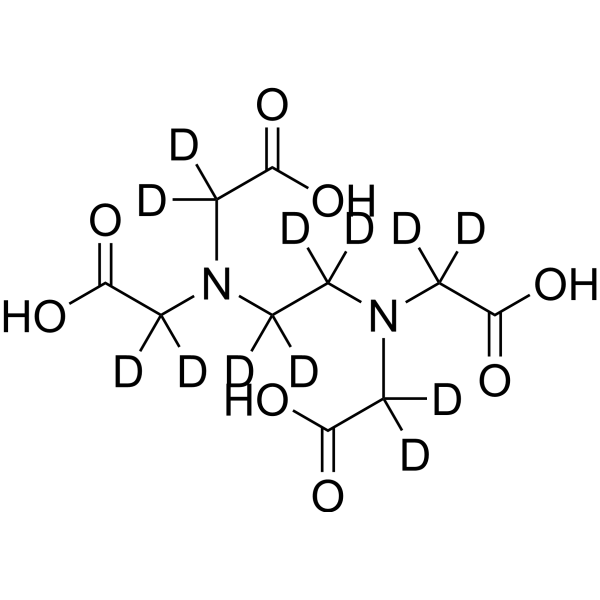
Ethylenediaminetetraacetic acid-d12

Based on 1 Customer Validation
Ethylenediaminetetraacetic acid-d12 is the deuterium labeled Ethylenediaminetetraacetic acid. Ethylenediaminetetraacetic acid (EDTA) is a metal chelators (binds to metal divalent and trivalent cations including calcium), which shows activities of anticoagulant and anti-hypercalcemic. Ethylenediaminetetraacetic acid decreases the metal ion-catalyzed oxidative damage to proteins, and allows maintenance of reducing environment during protein purification. Ethylenediaminetetraacetic acid can also decrease the formation of disulfide bonds.
For research use only. We do not sell to patients.
- Purity : 99.98%
- CAS No.: 203806-08-0
- Formula: C10H4D12N2O8
- Molecular Weight:304.32
-
Storage:
4°C, protect from light, stored under nitrogen
* In solvent : -80°C, 6 months; -20°C, 1 month (protect from light, stored under nitrogen)

To place orders, for customer services and technical support, please contact: MedChemExpress USA
Tel: 609-228-6898 E-mail: [email protected] [email protected]


-
 Biological Activity
-
Chemical Information
-
Solvent & Solubility
- Protocols
- Purity & Documentation
- References
-
 Help & FAQs




Biological Activity
Description
In Vitro
Stable heavy isotopes of hydrogen, carbon, and other elements have been incorporated into drug molecules, largely as tracers for quantitation during the drug development process. Deuteration has gained attention because of its potential to affect the pharmacokinetic and metabolic profiles of drugs[1].
MedChemExpress (MCE) has not independently confirmed the accuracy of these methods. They are for reference only. Further protocols information, click here.
Application
1. This compound can be used as a tracer
2. This compound can be used as an internal standard for quantitative analysis by NMR, GC-MS, or LC-MS.


Chemical Information
-
CAS No. 203806-08-0
-
Unlabeled CAS 60-00-4
-
Appearance Solid
-
Molecular Weight 304.32
-
Formula C10H4D12N2O8
-
Color White to off-white
-
SMILES
OC(C([2H])([2H])N(C([2H])([2H])C(O)=O)C([2H])([2H])C([2H])([2H])N(C([2H])([2H])C(O)=O)C([2H])([2H])C(O)=O)=O
-
Synonyms
EDTA-d12
-
Shipping
Room temperature in continental US; may vary elsewhere.
-
Storage
4°C, protect from light, stored under nitrogen
* In solvent : -80°C, 6 months; -20°C, 1 month (protect from light, stored under nitrogen)


Solvent & Solubility
In Vitro:
0.1 M NaOH : 6.67 mg/mL (21.92 mM; ultrasonic and warming and adjust pH to 7 with NaOH)
Please refer to the solubility information to select the appropriate solvent. Once prepared, please aliquot and store the solution to prevent product inactivation from repeated freeze-thaw cycles.
Storage method and period of stock solution: -80°C, 6 months; -20°C, 1 month (protect from light, stored under nitrogen). When stored at -80°C, please use it within 6 months. When stored at -20°C, please use it within 1 month.
Please refer to the solubility information to select the appropriate solvent. Once prepared, please aliquot and store the solution to prevent product inactivation from repeated freeze-thaw cycles.
Storage method and period of stock solution: -80°C, 6 months; -20°C, 1 month (protect from light, stored under nitrogen). When stored at -80°C, please use it within 6 months. When stored at -20°C, please use it within 1 month.
Concentration (start) × Volume (start) = Concentration (final) × Volume (final)

Protocols
-
Baculovirus-insect cell protein expression and purification
Baculovirus-insect cell expression uses recombinant baculovirus to deliver a target gene into insect cells, where late or very-late viral transcription drives recombinant protein production; the method was classically demonstrated by expression of human β-interferon in baculovirus-infected insect cells. The readout is target protein accumulation, assessed by activity, fluorescence if a fluorescent reporter is used, SDS-PAGE, Western blot, or purified protein yield. The system can express soluble, secreted, membrane-associated, and multiprotein targets, but expression outcome depends on the construct, baculovirus vector, insect cell line, multiplicity of infection, infection cell density, harvest time, and target-specific stability.
-
ROS/oxidative-stress fluorescent staining
ROS/oxidative-stress fluorescent staining uses cell-permeant fluorogenic probes that become fluorescent after oxidation inside cells or tissues; commonly used examples include DCFH-DA/DCFDA for broad cellular oxidant detection, DHE for superoxide-related signal detection, MitoSOX for mitochondrial superoxide-related signal detection, and CellROX probes for oxidative-stress-associated fluorescence readouts. The assay detects probe oxidation rather than a single ROS species unless the probe and analysis method have been chemically validated for that species. DCFH-DA enters cells, is deacetylated by intracellular esterases to DCFH, and produces fluorescent DCF after oxidation, so the readout is used as an operational measure of total cellular oxidative stress rather than a species-specific ROS measurement. DHE and MitoSOX can report superoxide-related oxidation, but red fluorescence alone can include non-specific ethidium-like oxidation products; HPLC or optimized spectral approaches are
-
Inclusion-body expression, solubilization, refolding and purification
Inclusion-body recovery uses insoluble recombinant protein aggregates from E. coli as a starting material; the workflow is cell disruption, inclusion-body isolation/washing, denaturant or mild solubilization, refolding into soluble protein, and final chromatographic purification. The readouts are soluble protein recovery, purity by SDS-PAGE/chromatography, structural recovery by methods such as circular dichroism when used, and biological activity when an assay is available.
-
Protocol For Protein Expression And Purification
Recombinant protein expression in Escherichia coli followed by purification of a His-tagged soluble protein by immobilized metal affinity chromatography (IMAC), with optional MBP fusion and TEV tag removal when the construct includes these elements. The biological readout is production of the encoded target protein, detected as an inducible band at the expected molecular mass by SDS-PAGE and quantified by total protein assay or chromatographic absorbance; the purification readout is enrichment of the target protein in elution fractions after selective binding of polyhistidine residues to immobilized Ni2+/metal-chelate resin and elution by imidazole-containing buffer. Expression is driven by an inducible bacterial expression system, commonly T7/lac-based, in which IPTG or lactose/auto-induction activates transcription and translation of the cloned gene; lower induction temperature, lower inducer concentration, induction timing, and solubility-enhancing fusion tags can influence the frac
-
Mammalian transient protein expression and purification
Mammalian transient protein expression introduces plasmid DNA into HEK293 or CHO cells for short-term recombinant protein production, allowing secreted, glycosylated, Fc-tagged, His-tagged, or membrane proteins to be produced without stable clone generation.


Purity & Documentation
-
Data Sheet (278 KB)
-
SDS (393 KB)
- English - EN (393 KB)
- Français - FR (393 KB)
- Deutsch - DE (393 KB)
- Norwegian - NO (393 KB)
- Español - ES (393 KB)
- Swedish - SV (393 KB)
- Italian - IT (393 KB)
- Korean - KR (393 KB)
- Portuguese - PT (393 KB)
-
Handling Instructions (2659 KB)
References
[1]. Russak EM, et al. Impact of Deuterium Substitution on the Pharmacokinetics of Pharmaceuticals. Ann Pharmacother. 2019 Feb;53(2):211-216. [Content Brief]
[2]. Chumanov RS, et al. Artifact-inducing enrichment of ethylenediaminetetraacetic acid and ethyleneglycoltetraacetic acid on anion exchange resins. Anal Biochem. 2011 May 1;412(1):34-9. [Content Brief]
[3]. Banfi G, et al. The role of ethylenediamine tetraacetic acid (EDTA) as in vitro anticoagulant for diagnostic purposes. Clin Chem Lab Med. 200745(5):565-76. [Content Brief]
[4]. Ibad A, et al. Chelation therapy in the treatment of cardiovascular diseases. J Clin Lipidol. 2016 Jan-Feb10(1):58-62. [Content Brief]


Complete Stock Solution Preparation Table
Please refer to the solubility information to select the appropriate solvent. Once prepared, please aliquot and store the solution to prevent product inactivation from repeated freeze-thaw cycles.
Storage method and period of stock solution: -80°C, 6 months; -20°C, 1 month (protect from light, stored under nitrogen). When stored at -80°C, please use it within 6 months. When stored at -20°C, please use it within 1 month.
| Optional Solvent | Concentration Solvent Mass | 1 mg | 5 mg | 10 mg | 25 mg |
|---|---|---|---|---|---|
| 0.1 M NaOH | 1 mM | 3.2860 mL | 16.4301 mL | 32.8601 mL | 82.1504 mL |
| 5 mM | 0.6572 mL | 3.2860 mL | 6.5720 mL | 16.4301 mL | |
| 10 mM | 0.3286 mL | 1.6430 mL | 3.2860 mL | 8.2150 mL | |
| 15 mM | 0.2191 mL | 1.0953 mL | 2.1907 mL | 5.4767 mL | |
| 20 mM | 0.1643 mL | 0.8215 mL | 1.6430 mL | 4.1075 mL |


Ethylenediaminetetraacetic acid-d12 Related Classifications
HY-Y0682S Related Classifications
 Powered by Bioz